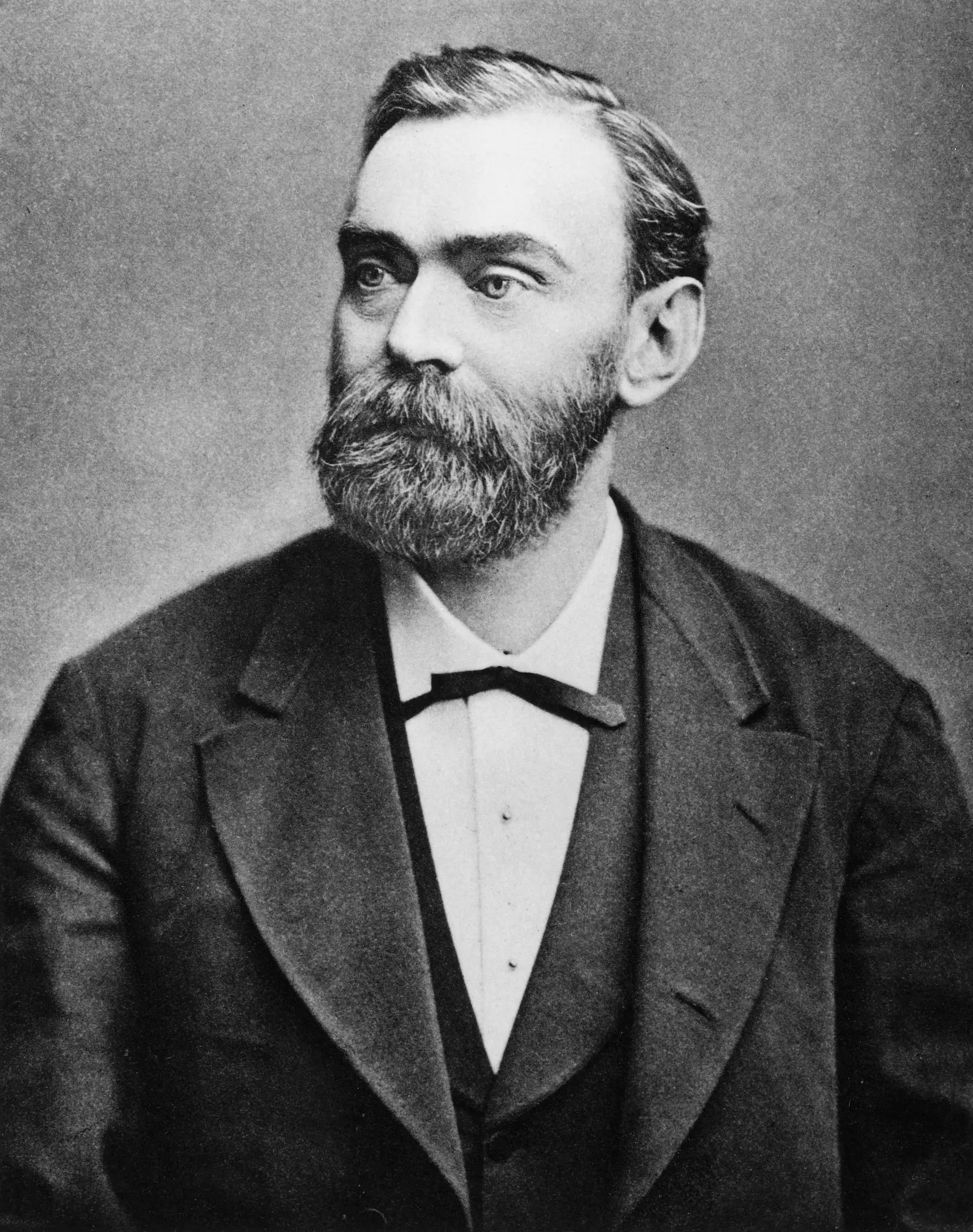
Alfred Nobel
 Sweden
chemist•industrialist•philanthropist
Birthday
October 21, 1833
Birth Sign
Libra
Birthplace
Stockholm, Sweden
Age
Died at 63
Height
5 ft 6 in (168 cm)
About
Alfred Bernhard Nobel was a Swedish chemist, inventor, and industrialist who changed the world twice: once with explosives, and again with peace prizes. Born in Stockholm on October 21, 1833, into the prominent Nobel family, he showed an early gift for science and languages, becoming fluent in six tongues. By age 24, he had filed his first patent. Nobel would go on to secure 355 patents over his lifetime, but one invention made him famous: dynamite, patented in 1867. This stable explosive, made by mixing nitroglycerin with an absorbent, revolutionized construction and mining. He followed with gelignite in 1875 and ballistite, an early smokeless propellant, in 1887.
Nobel was not just an inventor but a shrewd businessman. He and his family owned Bofors, an iron and steel producer that he transformed into a major armaments manufacturer. His enterprises spanned continents, and his wealth grew immense. Yet Nobel was a complex figure. A reading of his obituary in 1888, mistakenly titled "The Merchant of Death Is Dead," horrified him. It spurred him to reshape his legacy. When he died on December 10, 1896, in San Remo, Italy, his will revealed a surprise: the bulk of his fortune would fund the Nobel Prizes, awarded annually to those who "conferred the greatest benefit to humankind."
Today, his name adorns the prestigious awards in Physics, Chemistry, Medicine, Literature, and Peace. The Royal Swedish Academy of Sciences, which he was a member of, selects the physics and chemistry laureates. The synthetic element nobelium bears his name, as do companies like Dynamit Nobel and AkzoNobel, descendants of his ventures. Nobel's story is one of a man who sought to balance destruction with creation, leaving a legacy that continues to honor human achievement.
Early Life & Background
Alfred Nobel's early life was shaped by financial struggle and intellectual promise. Born in Stockholm in 1833, his father Immanuel Nobel was an engineer and inventor who had difficulty establishing a stable business in Sweden. The family lived in poverty until Immanuel moved to St. Petersburg, Russia, in 1837, where he found success manufacturing naval mines and equipment for the Russian military. In 1842, the rest of the family joined him. Alfred and his brothers were educated by private tutors, receiving a rigorous education in the natural sciences, humanities, and languages. By age 17, Alfred was fluent in Swedish, Russian, French, English, and German, and he later added Italian.
In 1850, Nobel traveled to Paris to study chemistry under Théophile-Jules Pelouze, a renowned chemist who had worked on explosives. He then spent a year in the United States working briefly with John Ericsson, the inventor of the ironclad warship Monitor. These experiences deepened his interest in explosives, particularly nitroglycerin, a volatile compound discovered in 1847. After the Crimean War ended in 1856, his father's company lost its military contracts and went bankrupt. The family returned to Sweden in 1859. Alfred, now focused on explosives, began experimenting with nitroglycerin in a small factory at Heleneborg, near Stockholm. On September 3, 1864, a catastrophic explosion killed his younger brother Emil and four others. This tragedy drove Nobel to develop a safer explosive: he invented the blasting cap in 1863, which allowed controlled detonation, and then sought a way to stabilize nitroglycerin itself.
Career Growth
Nobel's breakthrough came in 1867 when he patented dynamite, a mixture of nitroglycerin absorbed in kieselguhr, a porous clay. This made nitroglycerin safe to transport and handle, and it quickly became indispensable for mining, railroad construction, and demolition. Nobel established factories across Europe and the United States, building a global explosives empire. In 1875, he invented gelignite, a more powerful and water-resistant explosive that replaced dynamite in many applications. In 1887, he patented ballistite, a smokeless propellant that became a precursor to cordite, though a legal dispute over the patent followed.
In the 1880s, Nobel acquired the Bofors ironworks in Sweden and transformed it into a major armaments manufacturer, producing cannons and other weapons. By the 1890s, he had laboratories and companies in over 20 countries. Despite his business success, Nobel was troubled by the destructive uses of his inventions. In 1888, a French newspaper mistakenly published an obituary for Alfred instead of his brother Ludvig, headlining it "The Merchant of Death Is Dead." The article condemned him for profiting from war. This incident is widely believed to have motivated him to establish a prize for peace. In 1895, he signed his final will, leaving 94% of his immense fortune to fund the Nobel Prizes. He died of a stroke on December 10, 1896, in San Remo, Italy. The first Nobel Prizes were awarded in 1901.
Career Timeline
Public Image & Style
Alfred Nobel's public image is that of a stern, bearded 19th-century industrialist, often depicted in formal portraits. The visual aesthetic associated with him is the gold Nobel Prize medal and the formal ceremony. He is portrayed in media as a tragic, complex genius, a man of great wealth and intellect who was haunted by the destructive potential of his own inventions and sought redemption through the prizes. The global academic and scientific community participates in annual Nobel Prize speculation and ceremonies, which serve as the primary "fan culture" around his legacy. The Nobel Prize social media accounts are formal, educational, and celebratory, focusing on the laureates and their discoveries. There is no official fandom name; he is a historical figure, not a pop-culture celebrity.
Fame & Fandom (iFAMOUS Rankings)
Alfred Nobel stands as a singular figure whose legacy transcends the industrial era, yet his standing in modern fame metrics reflects a unique position of historical reverence rather than current viral dominance. While he remains a household name globally due to the enduring prestige of the prizes bearing his title, iFANN's Global Fame Engine has evaluated this person, but they do not currently hold a placement in the published rankings (Global Top 1,000 or a Top-100 scope list). This absence from the active charts does not diminish his impact; instead, it highlights how his fame operates on a different axis entirely. The world does not track him through trending algorithms or social media spikes but through the annual cycle of nominations and the global recognition of his institutions. His cultural footprint is vast, anchored by the story of the premature obituary that titled him "The Merchant of Death," a narrative that sparked the creation of the Peace Prize and transformed his identity from a weapons manufacturer to a benefactor of humanity. This paradoxical redemption arc is the defining legend of his life, one that history books recount with regularity. Today, his presence is felt in the halls of academies and the quiet anticipation of award ceremonies rather than in the frenetic energy of fan campaigns. There is no organized fandom for Alfred Nobel in the traditional sense, nor is there a specific name for those who revere his work. The entities associated with him today are the administrative bodies established by his will, such as the Nobel Foundation and the Nobel Prize committees, which operate as custodians of his legacy rather than centers for fan interaction. His influence persists through the continued nomination cycles, where thousands of candidates vie for honors that bear his name, ensuring his relevance remains steady across generations without needing the validation of a ranked chart.
Interesting Facts and Legends
Before his rise as an industrialist, Nobel displayed a literary flair by writing both a novel and a play during his youth. His tragedy, Nemesis, focused on Beatrice Cenci and was deemed blasphemous; while most copies were destroyed after his death, a single Swedish edition survived to tell the tale. He also patented a process for manufacturing improved plywood, a precursor to the modern material used worldwide. At his villa in San Remo, he kept a horse named Marmite, a personal touch often overlooked in biographies. Fluent in six languages including Russian, French, German, English, Italian, and Swedish, he navigated international business with ease. A persistent historical anecdote involves the mistaken obituary published by a French newspaper in 1888 following the death of his brother Ludvig; the paper confused the two men, labeling Alfred "The Merchant of Death." This error deeply distressed him and directly influenced his decision to establish the Nobel Prizes. Though he never married or had children, his relationship with Sophie Hess lasted nearly eighteen years, during which he provided her financial support until her death. The story of the obituary remains the most widely retold legend of his life, illustrating how a moment of public condemnation catalyzed a century of global philanthropy.
Notable Quotes
“I would rather take care of the stomachs of the living than the glory of the departed in the form of monuments.”
“Home is where I work and I work everywhere.”
“The merchant of death is dead.”
“If I have a thousand ideas and only one turns out to be good, I am satisfied.”
Family & Personal Life
Alfred Nobel was the third son of Immanuel Nobel, an engineer and inventor, and Andriette Ahlsell Nobel. His father's work in explosives and engineering shaped Alfred's career, but the family endured poverty early on. His older brothers were Robert and Ludvig, both of whom became successful in their own right: Ludvig founded the oil company Branobel in Russia. Alfred's younger brother Emil was killed in the 1864 nitroglycerin explosion at the family's factory. Nobel never married and had no children. He lived alone for much of his life, though he maintained close friendships and corresponded extensively with his brothers and his mother. In his later years, he kept a villa in San Remo, Italy, where he died.
Notable Connections
Alfred Nobel was the son of Immanuel Nobel, an engineer and inventor. His brother Ludvig was an oil magnate who founded Branobel. Nobel maintained a close friendship with Bertha von Suttner, a peace activist who won the 1905 Nobel Peace Prize; their correspondence influenced his decision to include a Peace Prize. His executor Ragnar Sohlman became the first director of the Nobel Foundation. Nobel briefly studied under John Ericsson, the inventor of the ironclad warship Monitor, in the United States.
Relationships & Dating History
Alfred Nobel never married and had no children. His romantic life was limited and often more intellectual than passionate. In his youth, he fell in love with a Russian girl named Alexandra, but she rejected his marriage proposal. In 1876, he placed an advertisement for a secretary and hired Bertha von Suttner, an Austrian countess and pacifist. Though a romantic spark was rumored, she soon left to secretly marry Baron Arthur Gundaccar von Suttner. They remained close friends and corresponded for the rest of his life; her anti-war activism is believed to have influenced his decision to include a Peace Prize in his will. She later won the Nobel Peace Prize in 1905. For nearly 18 years, Nobel had a relationship with Sophie Hess, a young woman from Vienna whom he met in a flower shop. He set her up in a villa in Paris and later in Baden bei Wien, Austria. Their relationship was tumultuous; she was reportedly demanding and unfaithful, but he financially supported her for the rest of his life. Their relationship is documented through a series of letters. As of 2026, Alfred Nobel is deceased and was never married.
- RumouredAlexandra1860 - 1860Nobel fell in love with her in his youth, but she rejected his marriage proposal.
- RumouredBertha von Suttner1876 - 1896She worked briefly as his secretary; they remained close friends and corresponded; she won the Nobel Peace Prize in 1905.
- DatedSophie Hess1876 - 1890Nobel met her in a Vienna flower shop; he supported her financially for the rest of his life despite her demands and infidelity.
Death & Aftermath
Died
December 10, 1896 (aged 63)
Death Place
San Remo, Liguria, Italy
Cause of Death
Cerebral hemorrhage
Alfred Nobel passed away on December 10, 1896, at his villa in San Remo, Italy. He was sixty-three years old and had been managing his international business affairs from his Italian residence despite declining health that included heart disease and diabetes. The immediate cause of death was a cerebral hemorrhage, confirmed by his personal physician. While some accounts suggest minor strokes preceded the fatal event, the official narrative remains consistent regarding this massive stroke resulting from chronic cardiovascular conditions. Public reaction evolved slowly rather than erupting immediately, as he was a prominent industrialist rather than a pop culture figure. Initial confusion lingered because a French newspaper had previously published a mistaken obituary titled "The Merchant of Death Is Dead" while he was still alive, condemning his work with explosives.
Upon his actual death, tributes from peers and institutions grew over time as the first Nobel Prizes were awarded in 1901. His funeral was a private affair held in the chapel of the Swedish Church in Paris on December 15, 1896, attended by close family members including his brother Emil and a small circle of friends. His body was subsequently transported back to Sweden and cremated, with ashes interred at the family plot in the Northern Cemetery in Stockholm. Posthumously, his estate faced intense scrutiny and litigation initiated by relatives who contested the validity of his will. These disputes were resolved through civil courts, leading to the establishment of the Nobel Foundation in 1900 to administer the prizes according to his specific instructions.
Net Worth (Estate Value)
$550 Million
iFANN Editorial Team estimate
At the time of his passing in 1896, Alfred Nobel's estate was valued at approximately 31.5 million Swedish kronor. Adjusted for inflation and converted to 2026 dollars, that figure translates to roughly $250-300 million. The Nobel Foundation, established in 1900 to manage the estate's assets and administer the prizes, now holds a diversified portfolio of stocks, bonds, real estate, and hedge funds. As of 2026, the foundation's total assets are estimated between 5.5 and 6 billion SEK, approximately $500-550 million USD. This fund generates annual returns that finance the prize amounts, currently 11 million SEK per prize. Additional revenue comes from donations and licensing of the Nobel name for merchandise and official events. The foundation's investment strategy has grown the original capital significantly over the decades, ensuring the prizes remain substantial. Per iFANN's editorial analysis, the total net worth attributed to Alfred Nobel's enduring legacy and estate management is $550 Million.
Awards Won (3)
Alfred Nobel did not win competitive awards; he was the founder of the Nobel Prizes. He received chivalric orders including the Order of the Polar Star (Sweden) and the Order of the Rose (Brazil). He was elected to the Royal Swedish Academy of Sciences in 1884. Posthumously, he was inducted into the National Inventors Hall of Fame in 1998, and the synthetic element nobelium was named after him.
1880 · Chivalric Order
1880 · Chivalric Order
Known For
Dynamite
1867 · Inventor
Nobel Prizes
1901 · Founder
Gelignite
1875 · Inventor
Ballistite
1887 · Inventor
Keywords
Quick Facts
- Profession
- chemist, industrialist, philanthropist
- Born
- October 21, 1833
- Birthplace
- Stockholm, Sweden
- Died
- December 10, 1896
- Death Place
- San Remo, Italy
- Gender
- Male
- Birth Sign
- Libra
- Height
- 5 ft 6 in (168 cm)
Personal Details
- Full Name
- Alfred Bernhard Nobel
- Height
- 5 ft 6 in (168 cm)
- Education
- Private tutors in St. Petersburg; studied chemistry in Paris under Théophile-Jules Pelouze and in the United States with John Ericsson
Frequently Asked Questions
Why did Alfred Nobel create the Nobel Prizes?
Did Alfred Nobel have a wife or children?
How many patents did Alfred Nobel have?
What was Alfred Nobel's net worth?
How old was Alfred Nobel when he died?
Join the community
fans discussing