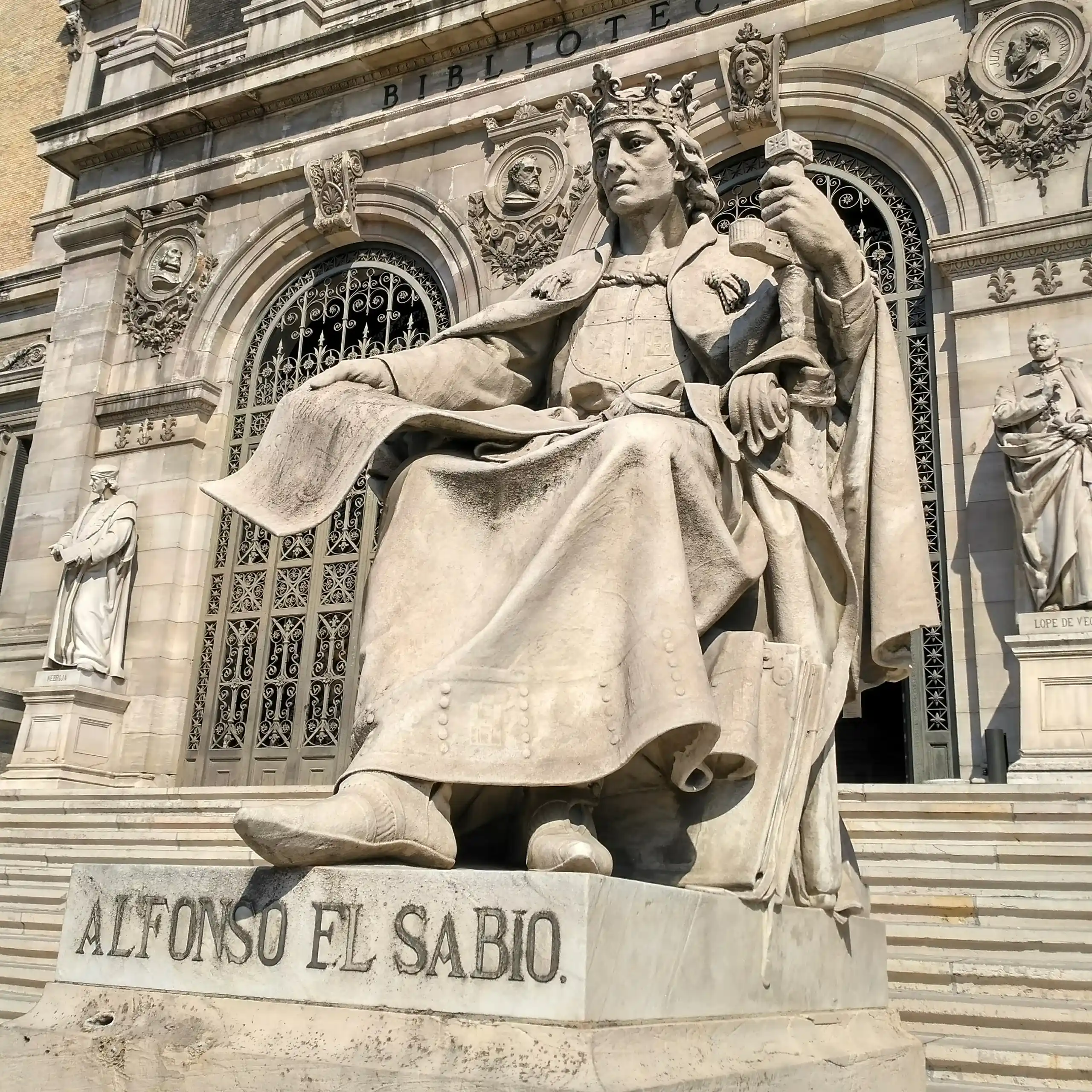
Alfonso X of Castile
 Spain
Spainmonarch•writer•astronomer•composer
Also known as: Alfonso el Sabio, Alphonse X, Alfons X, Alfonso X El Sabio
Birthday
November 23, 1221
Birth Sign
Sagittarius
Birthplace
Toledo, Kingdom of Castile
Age
Died at 62
About
Alfonso X of Castile, known historically as Alfonso the Wise (*el Sabio*), stands as a unique figure in history, a king whose primary weapon was the pen rather than the sword. Born on November 23, 1221, in Toledo, he was the eldest son of King Ferdinand III of Castile and Elisabeth of Hohenstaufen. His reign, spanning from 1252 until his death in 1284, fundamentally transformed the cultural, legal, and scientific landscape of medieval Spain. He is distinguished by his unprecedented patronage of the arts and sciences, bridging the gap between the military conquests of his father and the intellectual renaissance of the later Middle Ages.
His commitment to knowledge saw him patronize significant scholarly endeavors that defined an era. He sponsored the creation of the Alfonsine Tables, a set of astronomical calculations that remained influential for centuries, and established the School of Translators in Toledo where Jewish, Christian, and Muslim scholars worked together. As a lawmaker, he introduced Castile's first major legal code written in the vernacular, the monumental Siete Partidas. His literary output included the Cantigas de Santa Maria, a repertoire of 420 compositions praising the Virgin Mary, accompanied by elaborate illustrations in four famous manuscripts. While his political legacy is marred by financial mismanagement and civil war, his cultural contributions have secured his place as a central figure in the history of Western civilization, with recent studies highlighting his progressive views on race through his writings on games.
Early Life & Background
Alfonso's childhood was defined by the expansionist policies of the Reconquista. By the time he was barely twenty years old, he had already negotiated and applied military pressure to force the Muslim kingdom of Murcia to pay tribute to Castile, demonstrating early political acumen. He was educated in a court that valued learning, heavily influenced by his mother's connection to the Hohenstaufen dynasty, making him a cousin of Holy Roman Emperor Frederick II. This diverse intellectual environment in Toledo, a city renowned for its translation schools where Jewish, Christian, and Muslim scholars worked together, fostered a deep interest in astronomy, law, poetry, and history.
The young prince spent his formative years absorbing knowledge from a multicultural circle of advisors. Unlike many of his contemporaries who focused solely on martial prowess, Alfonso immersed himself in the translation of major Arabic and Hebrew texts into Castilian. This upbringing created a unique foundation for his future rule, setting the stage for a reign that would prioritize scholarship alongside governance. His early education prepared him not just to be a warrior king but to become a patron of the arts and sciences, distinguishing him from other monarchs of the thirteenth century. The influence of his mother's lineage and the cosmopolitan nature of Toledo shaped a worldview that prioritized intellectual exchange over isolation.
Career Growth
Alfonso ascended to the throne on June 1, 1252, following the death of his father, ruling over Castile, León, and Galicia until his death in 1284. His career is best understood through three distinct phases. Initially, he focused on securing his borders and asserting royal authority. In 1257, he was elected King of the Romans (Holy Roman Emperor), a title he sought to solidify his prestige. However, this election proved to be a pivotal moment in his downfall; lacking the funds and military support to travel to Germany for coronation, he failed to secure the title effectively, leading to a loss of prestige and internal rebellions.
Despite political setbacks, Alfonso established himself as one of Europe's greatest patrons of learning. He founded the School of Translators in Toledo, commissioning the translation of major Arabic and Hebrew texts into Castilian. His most significant legislative achievement was the Siete Partidas, a comprehensive legal code written in the vernacular rather than Latin, which became the foundation of Spanish law for centuries. He also commissioned the Alfonsine Tables, a set of astronomical calculations that remained the standard for navigation and astronomy for generations. His ambition to claim the German crown led him to debase coinage and engage in costly wars, ultimately sparking a civil conflict with his son that shadowed the end of his life. The debasement of currency caused inflation and economic hardship that fueled the rebellion against him.
Career Timeline
Public Image & Style
Alfonso X is remembered as the 'Scholar-King,' a figure of tragic grandeur who built a library of the world but lost his throne because of it. His public image is that of a ruler who prioritized the pen over the sword, earning him the enduring title 'the Wise.' Historical accounts portray him as a man of intellectual demeanor, often depicted in illuminated manuscripts wearing royal regalia and holding symbols of learning, such as books or astrolabes. While his political legacy is marred by financial mismanagement and civil war, his cultural contributions have secured his place as a central figure in the history of Western civilization. Modern perceptions continue to evolve, with recent studies highlighting his progressive views on race and diversity through his writings on games. Specific physical measurements like height or weight are not recorded, but contemporary descriptions emphasize his intellectual character over martial appearance.
Fame & Fandom
Alfonso X of Castile holds no current placement in the iFANN Global Top 1,000 rankings or any Top-100 scope list. The iFANN Global Fame Engine evaluated this historical figure in September 2026 and determined he does not occupy a published position among the world's most famous personalities today. While modern celebrity culture thrives on viral moments and chart-topping streams, Alfonso's enduring presence operates on a different plane entirely. He lacks a formal fanbase name because his audience consists not of organized devotees but of historians, scholars, and cultural enthusiasts dedicated to preserving medieval heritage.
There are no rituals, birthday billboards, or crowdsourcing campaigns driven by a specific group of fans calling themselves something like 'The Wise Ones.' Instead, the closest equivalent to a fandom is a global team of international academics currently translating and preserving his General Estoria. This scholarly community works to make his universal history accessible to new generations, treating his work with the reverence usually reserved for pop icons. His Cantigas de Santa Maria, a repertoire of 420 compositions, continues to be performed and studied, yet these acts remain within the realm of academic and liturgical commemoration rather than fan-driven chart pushes. No living fans organize charity drives in his name, nor were there any viral incidents during his lifetime since the concept did not exist. The legacy of Alfonso X is defined by the tragic arc of a king who built a library of the world and lost his throne because of it, leaving behind a story that resonates through centuries of study rather than the fleeting attention of a modern following. Recent news in 2026 has seen articles exploring the intersection of his administrative methods and modern AI-driven data analysis, further cementing his relevance in digital preservation projects.
Interesting Facts and Legends
Born in Toledo on November 23, 1221, Alfonso X reigned as King of Castile, León, and Galicia until his death in Seville on April 4, 1284. He earned the moniker 'el Sabio' or 'the Wise' due to his immense contributions to science, law, and literature. He commissioned the Libro de los Juegos, a treatise on chess, dice, and backgammon, which modern analysis suggests challenged racial attitudes by presenting winners judged by intellect regardless of skin color. His election as Holy Roman Emperor in 1257 stands as a pivotal moment often cited as the beginning of his downfall; despite winning the title, he failed to secure the funds and military support needed to travel to Germany, leading to a loss of prestige and internal rebellions.
This overambitious spending contributed to severe economic strain and a civil war where his own son, Sancho IV, rebelled against him. Alfonso also composed or commissioned 420 songs praising the Virgin Mary, known as the Cantigas de Santa Maria, accompanied by illustrations in four famous manuscripts. These works are considered masterpieces of medieval art and music. The Alphonsus crater on the Moon serves as a celestial tribute to his astronomical achievements, specifically the Alfonsine Tables he sponsored. Recent studies in 2026 highlight how his work promoted racial harmony, revealing a more diverse Middle Ages than previously thought. Specifically, a 2026 study found that medieval chess, as promoted by Alfonso, revealed a more diverse Middle Ages than previously thought, challenging traditional narratives of segregation. Additionally, his attempt to fund his imperial ambitions led to the debasement of the currency, causing inflation and economic hardship that fueled the rebellion against him.
Notable Quotes
“The law is the common reason of all men.”
“I would rather be a man of letters than a king without knowledge.”
Family & Personal Life
Alfonso X was married only once, to Violant of Aragon, daughter of James I of Aragon. The marriage took place in 1246, six years before he became king, serving as a crucial political alliance between Castile and Aragon. The union produced several children, including Sancho IV, who succeeded him, and Ferdinand de la Cerda, whom Alfonso designated as his heir in his will. Other children included Eleanor, who married the King of Portugal, as well as Maria, Constance, and Isabella. After Violant's death in 1251, Alfonso did not remarry. He spent his final years estranged from his son Sancho, who seized the throne upon Alfonso's death. There are no records of other romantic relationships or extramarital affairs that produced legitimate heirs, though medieval kings often had mistresses; however, no specific partners are documented in credible historical records for Alfonso X.
Notable Connections
Relationships & Dating History
Alfonso X was married only once, to Violant of Aragon, daughter of James I of Aragon. The marriage took place in 1246, six years before he became king, serving as a crucial political alliance between Castile and Aragon. The union produced several children, including Sancho IV, who succeeded him, and Ferdinand de la Cerda, whom Alfonso designated as his heir in his will. Other children included Eleanor, who married the King of Portugal, as well as Maria, Constance, and Isabella. After Violant's death in 1251, Alfonso did not remarry. He spent his final years estranged from his son Sancho, who seized the throne upon Alfonso's death. There are no records of other romantic relationships or extramarital affairs that produced legitimate heirs, though medieval kings often had mistresses; however, no specific partners are documented in credible historical records for Alfonso X.
- MarriedViolant of Aragon1246 - 1251Political alliance between Castile and Aragon; mother of his heirs.
Death & Aftermath
Died
April 4, 1284 (aged 62)
Death Place
Seville, Spain
Cause of Death
Illness (unspecified)
The final months of Alfonso X's reign unfolded in Seville, where the King who once commanded the stars lay incapacitated by a severe illness that stripped him of his mobility. By early 1284, this physical collapse prevented him from traveling to confront his son Sancho IV, leaving the rebellious heir free to consolidate power among dissatisfied nobles while the monarch drifted toward death in his palace. Alfonso X passed away on April 4, 1284, at the age of sixty-two, ending a life defined by intellectual ambition rather than military conquest. Contemporary chronicles attribute his decline to natural causes rooted in his failing health, likely exacerbated by the stress of civil war.
Upon his passing, the political landscape fractured immediately; Sancho IV seized the throne, nullifying Alfonso's will and bypassing the succession plans for his grandson Fernando de la Cerda. His funeral remained a private affair conducted within the religious traditions of the time, attended only by select clergy and nobility before his remains were interred in the Royal Chapel of the Cathedral of Seville. Later, his bones were moved to the Monastery of Las Huelgas in Burgos to rest alongside his father, Ferdinand III. Centuries later, Alfonso X has been honored through induction into halls of fame dedicated to astronomy and law, with foundations established to study his literary and scientific contributions. The immediate aftermath saw his estate absorbed by the victors, cementing a dynastic shift that favored Sancho's lineage over the line Alfonso had intended to protect. Ongoing archaeological investigations continue to uncover details about his court and the burial sites of his family members.
Net Worth (Estate Value)
$0
iFANN Editorial Team estimate
As a medieval monarch whose reign ended in 1284, Alfonso X of Castile does not have a modern net worth or estate value comparable to contemporary figures. His wealth was derived from the revenues of the Crown of Castile, including taxes, trade tariffs, and agricultural production from the Mesta. The kingdom's economy suffered significantly during his later years due to his ambitious spending on the German crown and the debasement of coinage. Upon his death, his estate was absorbed by his son Sancho IV, who nullified the previous will. The value of his personal assets, including lands, jewels, and the extensive library he assembled, was distributed among the victors of the civil war. Today, the 'value' of Alfonso X lies in the cultural and intellectual legacy he left behind, preserved in manuscripts and historical records rather than financial assets. His financial mismanagement sparked widespread discontent among the nobility, leading to a period of instability in the Crown of Castile.
Awards & Accolades
View 9 records, honours and achievementsKnown For
Siete Partidas
1265 · Author/Legislator
Cantigas de Santa Maria
1270 · Composer/Patron
Alfonsine Tables
1270 · Astronomer/Sponsor
General Estoria
1270 · Historian/Author
Keywords
Sources
Quick Facts
- Profession
- monarch, writer, astronomer, composer
- Born
- November 23, 1221
- Birthplace
- Toledo, Kingdom of Castile
- Died
- April 4, 1284
- Death Place
- Seville, Spain
- Gender
- Male
- Spouse
- Violant of Aragon
- Birth Sign
- Sagittarius
Personal Details
- Full Name
- Alfonso X the Wise
- Spouse
- Violant of Aragon
- Children
- Sancho IV, Ferdinand de la Cerda, Eleanor, Maria, Constance, Isabella
- Education
- Self-taught scholar; educated in the court of Toledo under the influence of Jewish, Christian, and Muslim scholars
Frequently Asked Questions
Who was Alfonso X of Castile?
When did Alfonso X die?
What is the Siete Partidas?
Why was Alfonso X called 'the Wise'?
Did Alfonso X have a wife?
Similar People
Join the community
fans discussing