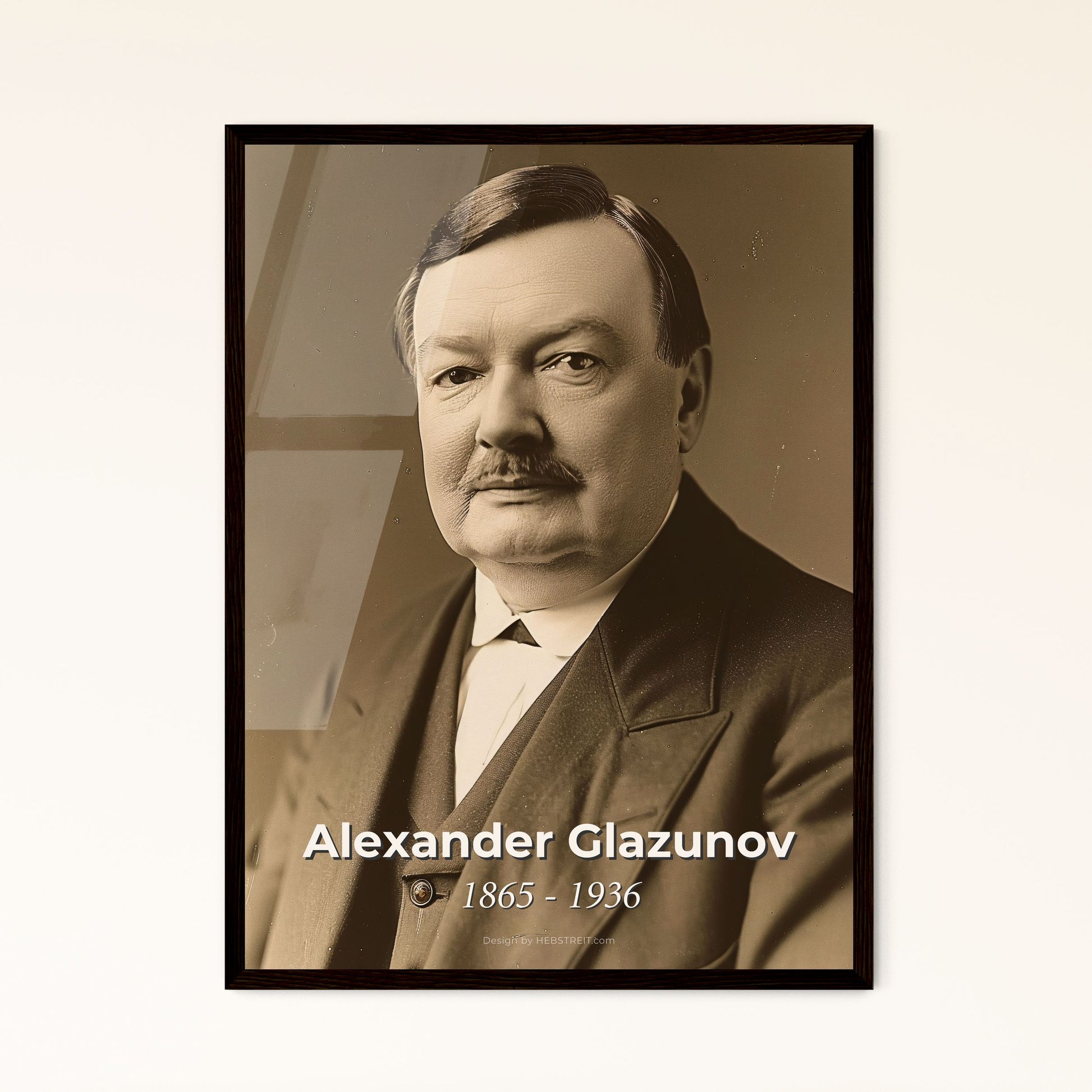
Alexander Glazunov
 Russia
composer•conductor•music teacher
Also known as: Little Glinka
Birthday
August 10, 1865
Birth Sign
Leo
Birthplace
Saint Petersburg, Russia
Age
Died at 70
About
Alexander Konstantinovich Glazunov was a Russian composer, conductor, and music teacher who left a significant mark on the late Romantic era. Born in Saint Petersburg on August 10, 1865, he skillfully combined nationalistic musical elements with broader European influences, creating a distinctive style that drew from the traditions of Balakirev and Borodin while also showcasing the orchestral brilliance of Rimsky-Korsakov and the lyricism of Tchaikovsky. His work included a body of symphonies, ballets, and concertos, many of which remain staples of the classical repertoire.
He was also an important figure in music education, serving as director of the Saint Petersburg Conservatory from 1905 until 1930. During his tenure, he guided the institution through the tumultuous years of the Bolshevik Revolution, ensuring its continuity and the well-being of its students. Glazunov passed away in Neuilly-sur-Seine, France, on March 21, 1936, at the age of 70, leaving behind a rich musical legacy that continues to be performed and appreciated worldwide.
Early Life & Background
Alexander Glazunov came into the world in Saint Petersburg, Russia, on August 10, 1865, born into a family that nurtured his early musical talents. His father, also named Alexander, ran a successful bookselling and publishing business, while his mother, Yelena, was a skilled pianist who had studied with Mily Balakirev. Their home was always filled with music, creating an ideal environment for a budding composer. From a very young age, Glazunov showed an extraordinary ear and a remarkable musical memory. He started taking piano lessons at nine years old with a teacher named Elenkovsky. By the time he was eleven, he was already putting together his first compositions.
The year 1879 proved pivotal for the fourteen-year-old Glazunov when he caught the attention of Mily Balakirev, a leading figure in Russian music. Balakirev, recognizing the young man's potential, advised him to expand his general musical studies. Following this guidance, Glazunov began studying composition with Nikolai Rimsky-Korsakov in 1880. He quickly became Rimsky-Korsakov's favorite student, progressing at an astonishing rate. Rimsky-Korsakov himself noted that Glazunov improved "not from day to day but from hour to hour."
At just sixteen years old, in 1882, Glazunov experienced his breakthrough moment. Balakirev conducted the premiere of his First Symphony, Op. 5, which was an immediate success and launched his public career. This early triumph was followed by a revised version of the symphony, published in 1886 by M.P. Belyayev, a wealthy timber merchant who would become a major patron and later founded the influential Belyayev music-publishing firm. Belyayev played another key role in Glazunov's early career when he took the young composer to Weimar, Germany, in 1884 to meet the legendary Franz Liszt. This encounter led to a performance of the First Symphony in Weimar, an event that significantly boosted Glazunov's international reputation and firmly placed him on the global musical map.
Career Growth
Following the successful premiere of his First Symphony, Alexander Glazunov continued his creative output at a rapid pace. During the 1880s and 1890s, he produced two string quartets, a pair of overtures based on Greek folk tunes, and the symphonic poem Stenka Razin. His Second Symphony, completed in 1886, solidified his standing as the recognized successor within the nationalist Russian musical group. A remarkable display of his prodigious memory came when he assisted Rimsky-Korsakov in completing Alexander Borodin's opera Prince Igor after Borodin's death. Glazunov could recall Borodin's Overture after hearing it just once, allowing him to transcribe it. By the age of 21, his compositions had already earned him considerable fame both within Russia and abroad.
The 1890s saw the creation of some of his most important works. He composed his Fourth, Fifth, and Sixth Symphonies during this period, alongside his acclaimed ballets: Raymonda, which premiered in 1898, followed by Les ruses d'amour and The Seasons, both introduced in 1900. He also arranged Chopin's Les Sylphides, further demonstrating his versatility.
A new phase of his career began in 1899 when he accepted a position as Professor of Instrumentation and Composition at the Saint Petersburg Conservatory. His dedication to the institution deepened, and in 1905, he became its Director, resigning briefly in protest over Rimsky-Korsakov's dismissal before being reinstated. Glazunov composed his widely cherished Violin Concerto in A Minor in 1904, a piece that remains a cornerstone of the violin repertoire. His Eighth Symphony, completed in 1906, was his last complete symphony. After 1906, his large-scale output became less frequent, though he still produced two piano concertos in 1911 and 1917, two string quartets in 1920 and 1930, the Concerto-Ballata for Cello and Orchestra in 1931, and the Concerto for Saxophone, Flute, and Strings in 1934.
He remained at the Conservatory's helm even after the Bolshevik Revolution of 1917, guiding the institution through its transformation into the Petrograd and then Leningrad Conservatories. He officially retired as head of the Conservatory in 1930, although he had already departed the Soviet Union in 1928, relocating to Paris. During the severe hardships of the revolutionary years, Glazunov played a critical role in supporting his students, ensuring they received scholarships and food allowances. Dmitri Shostakovich, one of his most famous students from that era, held Glazunov in high esteem throughout his life.
Career Timeline
Public Image & Style
Alexander Glazunov cultivated a public image as a stabilizing, rather conservative presence in Russian music during a particularly turbulent period of artistic and societal change. His musical style was renowned for successfully blending Russian nationalism with broader European cosmopolitanism, drawing on the epic scope of Borodin, the orchestral flair of Rimsky-Korsakov, the lyrical qualities of Tchaikovsky, and the intricate counterpoint of Taneyev. While he was respected for his sharp musical intellect and astonishing memory, younger composers like Prokofiev and Shostakovich eventually regarded his work as somewhat old-fashioned. However, they still acknowledged his imposing reputation and the steadying influence he exerted. Critic Leo Eylar aptly described Glazunov as "born in the middle," positioned between the initial wave of great Russian composers and the modernists who followed. He was seen as a figure who held the Saint Petersburg Conservatory together with notable integrity during challenging years. His music resonated with audiences who appreciated its rich orchestration and melodic beauty, representing a continuation of established traditions rather than a radical departure. No specific fandom name or fan-culture rituals were documented for him.
Fame & Fandom
Alexander Glazunov's legacy is sustained not by a modern, organized fanbase with specific names or rituals, but by the enduring study of his compositions and the academic reverence of musicologists who preserve his place in the late Romantic canon. While he enjoyed popularity during his lifetime as a leading Russian composer, there are no records of contemporary fans gathering for viral campaigns or adopting unique monikers; his audience remains a diffuse community of classical enthusiasts rather than a structured movement. Despite this lack of a formal fandom identity, his standing in the global hierarchy of musical figures remains significant. According to the iFANN Global Fame Rankings, he holds the position of the 67th most famous person in Classical, a placement that has held steady from the previous cycle. This ranking reflects a broad assessment of his cultural footprint across media coverage and historical consumption signals worldwide. His influence extends beyond mere composition to his role as an educator who shaped generations of musicians, ensuring his name persists in conservatories and concert halls long after his death. The data indicates that while he may not command the headline-grabbing attention of pop icons, his status within the classical sphere is robust and consistently recognized by authoritative metrics.
Interesting Facts and Legends
Alexander Glazunov composed eight complete symphonies but deliberately left a ninth unfinished, reportedly due to a superstition regarding the "curse of the ninth" that supposedly haunted composers like Beethoven and Schubert. He possessed a phenomenal musical memory, famously transcribing Borodin's Overture to Prince Igor from a single hearing. Early in his career, acquaintances affectionately dubbed him "Little Glinka." Although his conservative tastes once led him to walk out on a performance by his student Sergei Prokofiev, he later championed Prokofiev's First Symphony and secured its performance. Glazunov explored nearly every musical genre except opera. During his directorship at the Saint Petersburg Conservatory, students recalled him discreetly drinking vodka from a rubber tube during lectures. Born in 1865, he was a contemporary of Jean Sibelius and preceded Gustav Mahler by five years. Historical accounts also highlight a legendary moment involving the disastrous premiere of Rachmaninoff's First Symphony, where Glazunov's alleged alcoholism and lack of preparation contributed to a chaotic debut that haunted the young composer. His twenty-five-year tenure as director of the Saint Petersburg Conservatory is similarly legendary, marking a pivotal era in preserving Russian musical heritage during turbulent political times.
Notable Quotes
“Rimsky-Korsakov on Glazunov's progress: he improved "not from day to day but from hour to hour".”
“Shostakovich on Glazunov: he "was able to remember every student's name, their career and compositions".”
“Critic Leo Eylar: "Glazunov was 'born in the middle,' so to speak".”
Family & Personal Life
Alexander Glazunov grew up in Saint Petersburg within a musically inclined family. His father, Alexander Glazunov Sr., was a successful bookseller and publisher who also played the violin, ensuring music was a constant presence in their home. His mother, Yelena Glazunova, was a skilled pianist who had studied with Mily Balakirev. For a large part of his life, Glazunov remained unmarried and lived with his mother. She was known for her fiercely protective nature, often treating the adult composer as if he were still a child, even when he was well into his forties. The family faced material hardships during the revolutionary period, leading them to inhabit only two rooms of their once-large apartment. Glazunov eventually married in the late 1920s, around the time he emigrated to Paris. The available records do not mention any children from this marriage.
Notable Connections
Alexander Glazunov's career was shaped by important relationships with fellow musicians and patrons. Mily Balakirev was his first mentor, encouraging his early musical path. Nikolai Rimsky-Korsakov became his primary composition teacher and later a collaborator on Borodin's Prince Igor. M.P. Belyayev served as a crucial patron and publisher. Dmitri Shostakovich was a notable student and lifelong admirer, while Sergei Prokofiev also studied under Glazunov. He met Franz Liszt in 1884, an influential encounter for the young composer. His lyricism showed the influence of Pyotr Ilyich Tchaikovsky, and Marius Petipa choreographed his ballet The Seasons.
Relationships & Dating History
Alexander Glazunov's personal life, particularly his romantic relationships, remained largely private and is sparsely documented in historical records, a common characteristic for many classical composers of his era. For a significant portion of his life, he lived as a bachelor, residing with his mother, Yelena Glazunova. This close domestic arrangement meant that public romantic entanglements were not a prominent feature of his earlier years, as his mother was famously protective of him, even when he was well into adulthood. His focus appeared to be primarily on his prolific composing career and his demanding role at the Saint Petersburg Conservatory.
The available historical information indicates that Glazunov eventually married in the late 1920s. This significant life event occurred around the time of his emigration from the Soviet Union to Paris in 1928, marking a new chapter in his personal life alongside his professional shift. While sources confirm his marriage, the identity of his wife has not been widely recorded or publicized in the available historical accounts. This lack of detail is not unusual for the period, where the personal lives of public figures, especially those in classical music, were often kept out of the public eye unless they were scandal-ridden. No children from this union are mentioned in any of the historical documents. This marriage appears to have been his only publicly acknowledged romantic partnership. At the time of his death on March 21, 1936, Alexander Glazunov was married.
- MarriedUnknown1928 - 1936He married around the time he emigrated to Paris in 1928, but the identity of his wife was not widely recorded.
Death & Aftermath
Died
March 21, 1936 (aged 70)
Death Place
Unknown
Cause of Death
Unknown
Alexander Glazunov, born on August 10, 1865, passed away on March 21, 1936. Historical records confirm the date of his death but do not provide details regarding the specific location, medical cause, or circumstances of his final days. The exact nature of his passing remains unrecorded in the existing sources, leaving the specifics of his last public appearance and final weeks unknown.
While modern appreciation has grown significantly with recent recordings such as the Tippett Quartet's 2026 release of his Complete String Quartets and performances by the Utah Symphony in 2025, these posthumous acknowledgments reflect a continued recognition of his work rather than documented immediate reactions to his mortality.
The legacy of Alexander Glazunov persists through continuous releases and critical attention decades after his death. Recent activities include new album releases featuring his works, such as Forgotten Melodies by Alexander Malofeev in 2026, and ongoing concert programming by orchestras like the Bamberger Symphoniker. Although some search results incorrectly refer to him as active due to metadata about his catalog, historical consensus confirms his status as deceased since 1936.
Net Worth (Estate Value)
$5 Million
iFANN Editorial Team estimate
Alexander Glazunov's financial standing during his lifetime reflected the career of a successful, respected composer and educator. As the son of a prominent bookseller and publisher, he grew up in a comfortable household, which provided a stable foundation for his early musical pursuits. His income streams primarily came from his prolific compositions, including symphonies, ballets, and concertos, which were published and performed widely across Russia and internationally. His association with the Belyayev music-publishing firm, which he later helped direct, also likely provided a steady source of royalties. Later in his career, his role as Professor of Instrumentation and Composition, and subsequently as Director of the Saint Petersburg Conservatory from 1899 to 1930, provided a substantial salary. Even during the difficult years of the Bolshevik Revolution, he maintained his position, and while he advocated for his students' welfare over his own, his official status would have ensured a degree of financial security. After leaving Russia in 1928 and settling in Paris, he continued to compose and conduct, earning through new works and performances abroad. Since his passing in 1936, Glazunov's estate has continued to generate income primarily through the licensing, performance, and recording of his extensive catalog of works. His most popular compositions, such as the Violin Concerto in A Minor and the ballets Raymonda and The Seasons, remain frequently performed staples of the classical repertoire. Record labels like Hyperion and Naxos regularly release and re-release recordings of his work. Per iFANN's editorial analysis, Alexander Glazunov's net worth is estimated at $5 Million.
Awards & Accolades
View 8 records, honours and achievementsKnown For
Violin Concerto in A Minor
1904 · Composer
Raymonda
1898 · Composer (Ballet)
The Seasons
1900 · Composer (Ballet)
First Symphony
1882 · Composer
Keywords
Sources
Quick Facts
- Profession
- composer, conductor, music teacher
- Born
- August 10, 1865
- Birthplace
- Saint Petersburg, Russia
- Died
- March 21, 1936
- Death Place
- Neuilly-sur-Seine, France
- Gender
- Male
- Birth Sign
- Leo
- Full Birth Name
- Alexander Konstantinovich Glazunov
Personal Details
- Full Name
- Alexander Konstantinovich Glazunov
- Children
- Education
- Saint Petersburg Conservatory
Frequently Asked Questions
What was Alexander Glazunov best known for?
How many symphonies did Alexander Glazunov compose?
Did Alexander Glazunov teach Dmitri Shostakovich?
Why did Alexander Glazunov leave Russia?
Where was Alexander Glazunov buried?
Join the community
fans discussing