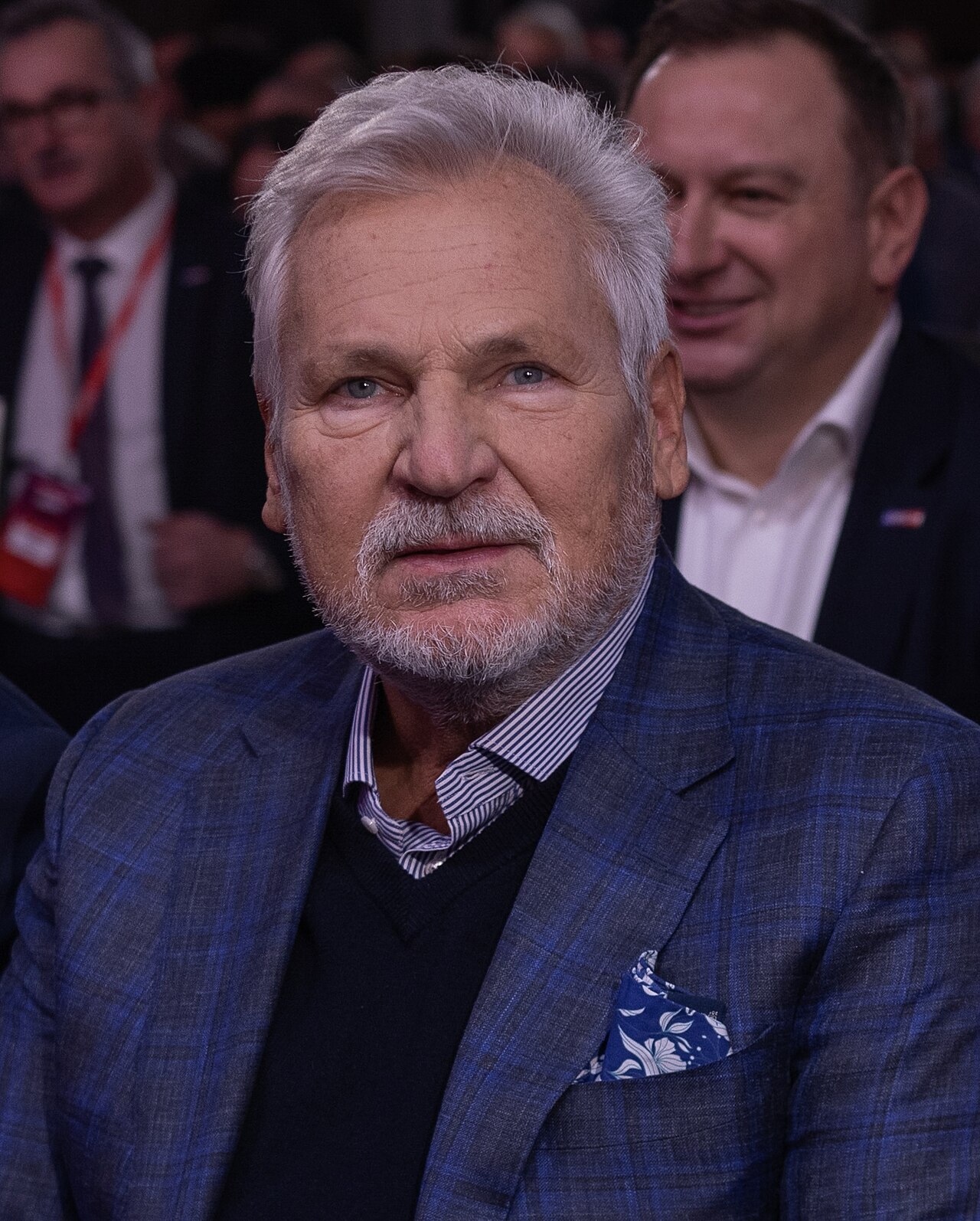
Aleksander Kwaśniewski
 Poland
Birthday
November 15, 1954
Birth Sign
Scorpio
Birthplace
Białogard, Poland
Age
71 years old
Height
5 ft 11 in (180 cm)
About
Aleksander Kwaśniewski is a Polish politician and journalist who served as the third president of Poland from 1995 to 2005. He is widely credited with steering the country through its post-communist transition, overseeing NATO and EU accession, and helping to draft a new constitution.
Today, Kwaśniewski remains an influential figure in international affairs. He sits on the boards of several global organizations, including the Global Commission on Drug Policy and the Yalta European Strategy, and serves as a board member of the Ukrainian energy company Burisma. His commentary on the war in Ukraine continues to draw attention, and he is frequently consulted on matters of European security.
Born in 1954, he is a politician and journalist by training who rose through the ranks of the communist-era political system before reinventing himself as a centre-left democratic leader. His presidency saw rapid modernisation and economic growth, with Poland's GDP doubling in ten years. He remains a respected elder statesman, known for his pragmatic approach and enduring popularity among Poles.
Early Life & Background
Born in the small town of Białogard in northwestern Poland on 15 November 1954, Kwaśniewski grew up under communist rule. He studied at the University of Gdańsk, where he became an activist in the student movement, eventually chairing the university council of the Socialist Union of Polish Students until 1982.
He joined the Polish United Workers' Party in 1977 and worked as a journalist before entering government. In the 1980s, he served as a minister in the communist administration, a role that would later shape his political identity.
Kwaśniewski participated in the historic Round Table negotiations of 1989, the talks between the communist government and the Solidarity opposition that paved the way for Poland's peaceful transition to democracy. This experience positioned him as a reformist within the old system and set the stage for his later career. His early political formation occurred within the structures of the Polish United Workers' Party, which he joined in 1977.
Career Growth
Kwaśniewski's breakthrough came in 1995 when he won the presidential election against the incumbent Lech Wałęsa. He was re-elected in 2000 in a decisive first-round victory.
His presidency was marked by major geopolitical milestones. In 1997, he oversaw the drafting of Poland's new constitution. In 1999, he led the country into NATO, and in 2004, into the European Union. That same year, he brokered a pro-democratic agreement during the Orange Revolution in Ukraine.
After leaving office in 2005, Kwaśniewski remained active in international affairs. He joined the Global Commission on Drug Policy, the Club de Madrid, and the Yalta European Strategy. In 2014, he became a board member of Burisma, the Ukrainian gas company. In recent years, he has been a vocal commentator on the Russian-Ukrainian war, predicting in late 2025 that a ceasefire could be possible within months while cautioning that Putin will not seek a just peace. He also noted that more than 1 million Ukrainian citizens reside in Poland and make a major contribution to the economy.
Career Timeline
Public Image & Style
Kwaśniewski is regarded in Poland as a skilled political operator who successfully navigated the country's transition from communism to democracy. Media portray him as a pragmatic centre-left figure. His public image has been shaped by his role in NATO and EU accession, which are widely seen as his greatest achievements. He has no organised fandom in the traditional sense, but he retains significant public respect in Poland, as evidenced by the 2020 poll naming him the best president since 1989. He is also known for his statesmanship and diplomatic skills, particularly in mediating international conflicts.
Fame & Fandom (iFAMOUS Rankings)
Aleksander Kwaśniewski remains a figure of significant historical weight in Central Europe, though his global celebrity status operates on a different axis than that of pop culture icons. The iFANN Global Fame Engine has evaluated this profile and determined that he does not currently hold a placement in the published rankings, meaning no specific ordinal rank or score is assigned to him within the Global Top 1,000 or any scope-based list. His influence is derived from diplomatic authority rather than viral consumption metrics. Unlike entertainers who cultivate organized fanbases with formal names, Kwaśniewski possesses no documented fandom moniker; his public engagement consists of voters, political allies, and international partners rather than a community dedicated to chart pushes or fan-funded projects. Social media activity reflects a modest following with approximately 22,500 likes on Facebook, indicating an audience interested in geopolitical commentary rather than a youth-driven movement. There are no recorded fan rituals, inside jokes, or subreddits operating under a specific brand name for his persona. While he frequently appears in discussions regarding European security and the war in Ukraine, these interactions remain within the realm of political analysis. The absence of a formal ranking underscores that his fame is rooted in statecraft and historical transition rather than the broad-scale cultural consumption signals that drive global celebrity charts.
Interesting Facts and Legends
Kwaśniewski served as a minister in the communist government during the 1980s before transitioning into a role as a democratic leader. He was a key participant in the Round Table negotiations that paved the way for Poland's democratic shift. During his presidency, the nation's GDP doubled over a ten-year period. In 2004, he brokered a pro-democratic agreement amidst Ukraine's Orange Revolution. A 2020 poll by Rzeczpospolita found that a plurality of Poles considered him the best president since 1989. He serves on the board of the Ukrainian gas company Burisma, a position that drew international scrutiny during the Trump impeachment proceedings in the United States. Additionally, he has been a member of the Global Commission on Drug Policy, advocating for reforms in drug policy. Beyond these established facts, his legacy includes the complex diplomatic incident in June 2026 where three former Ukrainian presidents renounced Poland's Order of the White Eagle. Recent narratives also highlight his continued warnings regarding Russia and his arguments that Poland cannot survive without the economic contribution of Ukrainians.
Notable Quotes
“As President of the Republic of Poland, and a friend of Israel, I am pleased with the very favorable development of relations between our two countries.”
“Ukrainians are extremely important for Polish economy and this is chance for them to earn well.”
“Putin will not seek a just peace.”
Family & Personal Life
Kwaśniewski married Jolanta Konty in the late 1970s. Jolanta served as First Lady of Poland from 1995 to 2005 and remains his wife. The couple has one daughter, Aleksandra, born in 1981, who is a journalist and television presenter in Poland. The family is known to be close-knit, and Jolanta has been a supportive presence throughout his political career. She was photographed waving during a family photo opportunity with US President George W. Bush during his 2001 visit to Poland.
Notable Connections
Relationships & Dating History
Kwaśniewski has been married to Jolanta Kwaśniewska since the late 1970s. The couple met before his political rise and have remained together throughout his career. Jolanta served as First Lady from 1995 to 2005, and they have one daughter, Aleksandra. No public records suggest any extramarital relationships, separations, or divorces. As of 2026, Kwaśniewski is married to Jolanta. Their marriage has endured through his presidency and post-presidency, and they are often seen together at public events.
- MarriedJolanta Kwaśniewska1978 - presentCurrentMarried since the late 1970s; she served as First Lady of Poland from 1995 to 2005.
Salary, Net Worth In 2026
$10 Million
iFANN Editorial Team estimate
No credible public estimates of Aleksander Kwaśniewski's personal net worth are available from celebrity-net-worth sites, financial outlets, or other sources. As a former head of state, he receives a presidential pension from the Polish government. His post-presidency income sources include board membership at Burisma, participation in international organisations such as the Global Commission on Drug Policy and Club de Madrid, and likely speaking fees from international engagements. While exact figures are not publicly disclosed, his financial standing reflects a comfortable post-presidential career. He has also been involved in various international initiatives that may provide honoraria, adding to his earnings. Per iFANN's editorial analysis, Aleksander Kwaśniewski's estimated net worth is $10 Million.
Awards & Accolades
View 3 records, honours and achievementsKeywords
Sources
Quick Facts
- Profession
- politician, journalist
- Born
- +1954-11-15
- Birthplace
- Białogard
- Gender
- Male
- Spouse
- Jolanta Kwaśniewska
- Birth Sign
- Scorpio
- Height
- 5 ft 11 in (180 cm)
Personal Details
- Full Name
- Aleksander Kwaśniewski
- Height
- 5 ft 11 in (180 cm)
- Spouse
- Jolanta Kwaśniewska
- Children
- Aleksandra Kwaśniewska
- Education
- University of Gdańsk
Frequently Asked Questions
How old is Aleksander Kwaśniewski?
What is Aleksander Kwaśniewski's net worth in 2026?
Who is Aleksander Kwaśniewski's wife?
What is Aleksander Kwaśniewski best known for?
Is Aleksander Kwaśniewski still active in politics?
Join the community
fans discussing