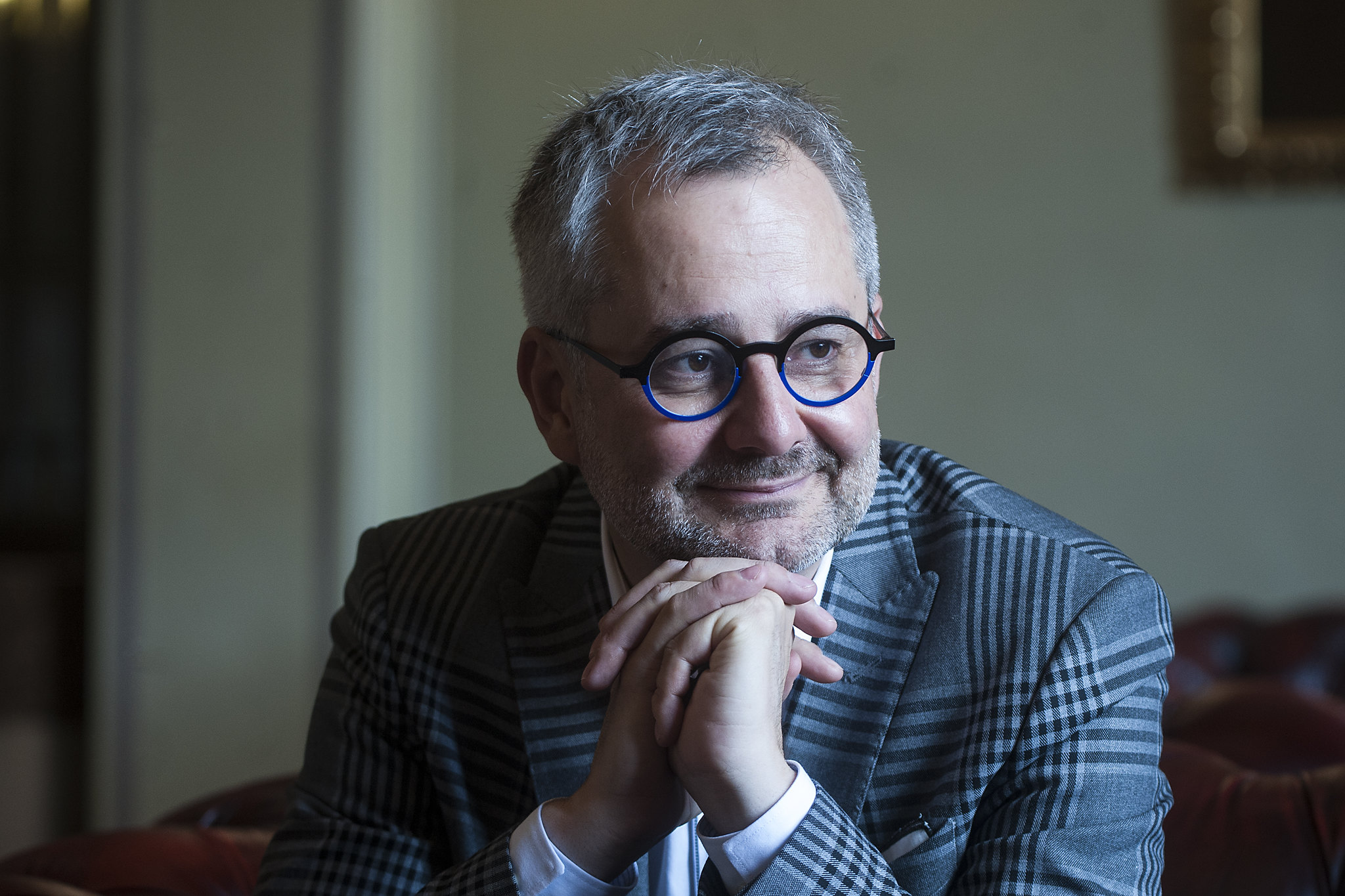
Albert-László Barabási
 Romania
physicist•university teacher•network scientist
Also known as: Albert-Laszlo Barabasi, László Barabási
Birthday
March 30, 1967
Birth Sign
Aries
Birthplace
Cârța, Romania
Age
59 years old
About
Albert-László Barabási is a Romanian-born Hungarian-American physicist who has reshaped how we understand the interconnected world. As a distinguished university professor and the Robert Gray Professor of Network Science at Northeastern University, he also holds appointments at Harvard Medical School and Central European University, where he leads the Department of Network and Data Science. His pioneering work on scale-free networks, introduced in 1999, revealed that many real-world networks, from the internet to biological systems, follow a universal structure governed by a few highly connected hubs.
Barabási's influence extends beyond academia. He is the author of influential books like Linked and The Formula, and his research has spawned new fields such as network medicine, which applies network principles to understand disease and health. His work has earned him numerous honors, including the 2026 Euler Award, the highest research honor in network science. Fans of science and technology admire his ability to make complex concepts accessible and his vision for using data to solve real-world problems.
Early Life & Background
Albert-László Barabási was born on March 30, 1967, in the small Transylvanian town of Cârța, Romania. Growing up in a Hungarian-speaking family in the Carpathian basin, he developed an early fascination with the natural world and how things fit together. As a teenager, he was drawn to physics, captivated by the idea that fundamental laws could explain everything from falling apples to the motion of planets.
After completing his early education in Romania, Barabási moved to Hungary for university studies, where he earned a master's degree in physics from Eötvös Loránd University in Budapest in 1991. He then crossed the Atlantic to pursue a Ph.D. at Boston University, completing his doctorate in 1994 under the supervision of H. Eugene Stanley. His doctoral research on complex systems and fractals planted the seeds for his later breakthroughs in network theory.
During those graduate years, Barabási became increasingly intrigued by the structure of systems with many interacting parts, from molecules in a cell to people in a society. This curiosity would soon lead him to question the prevailing random-network models and set the stage for his 1999 discovery of scale-free networks.
Career Growth
Barabási's breakthrough came in 1999 when he and his student Réka Albert published a landmark paper in Science introducing the concept of scale-free networks. They showed that many real networks, including the World Wide Web and metabolic networks, are governed by a power-law degree distribution, meaning a few nodes have a huge number of connections while most have very few. This led to the Barabási-Albert model, which explains how such networks emerge through growth and preferential attachment.
This discovery transformed the field, opening new research directions across physics, biology, sociology, and computer science. In 2006, Barabási founded the Network Science Society, helping to build a global community of researchers. He authored the influential book Linked: The New Science of Networks in 2002, which brought network science to a general audience, and later published the open-access textbook Network Science.
In 2019, he published The Formula: The Universal Laws of Success, based on his research into the patterns behind success. He has also extended his work into medicine, co-authoring papers on network medicine and the chemical complexity of food. His recent projects include advocating for large-scale initiatives combining AI, mass spectrometry, and network medicine to improve health outcomes.
Career Timeline
Public Image & Style
Barabási is widely regarded as a pioneer and leading figure in network science. He is known for his ability to communicate complex ideas with clarity and enthusiasm, often using visualizations and real-world examples. His public persona is that of a thoughtful, interdisciplinary thinker who bridges physics, medicine, and even art. He maintains an active presence on Instagram, where he shares snapshots of his research, exhibitions, and travels. Fans and colleagues appreciate his openness and his commitment to advancing science for the public good.
Fame & Fandom
Albert-László Barabási stands as a towering figure in the landscape of modern science, bridging the gap between abstract physics and tangible human connection. His influence is not merely academic; it has permeated global consciousness, placing him firmly among the most recognized intellectuals of his generation. According to the iFANN Global Fame Rankings, he holds the distinction of being the 40th most famous person from Romania, a position he has maintained steadily through rigorous cycles of evaluation. In the specialized realm of artificial intelligence, where innovation moves at breakneck speed, Barabási ranks as the 78th most famous person in AI, reflecting the deep integration of his network theories into machine learning algorithms worldwide. These placements track his resonance across media coverage and consumption signals globally, cementing his status beyond the ivory tower. Despite this widespread recognition, Barabási does not command a traditional fanbase with rituals or chants. There is no organized fandom bearing his name, nor are there crowds gathering for autographs or viral campaigns. His following consists of students, colleagues, and readers who engage with his work through lectures, books like Linked, and digital exhibitions. The interaction is intellectual rather than idolatrous, defined by the adoption of his scale-free network models in fields ranging from biology to sociology. He operates in a sphere where citations matter more than chart positions, yet his reach remains undeniably vast.
Interesting Facts and Legends
Albert-László Barabási finds inspiration for his complex research while hiking through nature, often using long walks to untangle scientific problems. He maintains a profound interest in merging art with science, curating exhibitions that visualize intricate network structures for public viewing. Known for his dynamic speaking style, he has delivered talks at prestigious venues including the World Economic Forum. A recurring theme in his presentations is the assertion that 'networks are everywhere,' a phrase he uses to make his work accessible to diverse audiences. Beyond these established facts, his career includes a landmark moment in 1999 when he published his groundbreaking paper on scale-free networks, fundamentally changing how scientists view the internet and biological systems. This discovery challenged previous assumptions about random connectivity and revealed a universal structure governing real-world networks. Another significant milestone occurred in late 2018 when he proposed a mathematical formula for long-term success, gaining mainstream attention for linking consistent output and risk-taking to achievement. These events stand as the defining legends of his professional life, rooted in verified data rather than folklore.
Family & Personal Life
Details about Barabási's family are scarce, as he tends to keep his personal life private. He was born in Cârța, Romania, to a Hungarian family, and spent his early years there. He later moved to Hungary and then to the United States for his academic career. As of the latest information, he is not publicly known to be married or have children, though he remains close to his extended family in Europe.
Notable Connections
Barabási has collaborated with many prominent scientists, including Réka Albert, with whom he developed the Barabási-Albert model. He has also worked with Joseph Loscalzo and Giulia Menichetti on research at the intersection of food and therapeutics. His work has been featured in major media outlets, and he has interacted with thought leaders through platforms like the World Economic Forum and Edge.org.
Relationships & Dating History
Salary, Net Worth In 2026
$4 Million
iFANN Editorial Team estimate
As of 2026, Albert-László Barabási's net worth is estimated to be around $4 Million, per iFANN's editorial analysis. This financial standing stems primarily from his distinguished academic salaries, royalties from his influential books, and fees from high-profile speaking engagements. His popular titles, including Linked and The Formula, have achieved strong sales figures and continue to generate revenue streams well beyond their initial publication. Additional income flows from his multifaceted role as a professor at Northeastern University and Harvard Medical School, alongside select consulting opportunities. His financial growth has been steady over the years, mirroring the enduring impact of his career and his ability to translate complex network science into broader cultural relevance.
Awards Won (2)
Barabási has received prestigious honors recognizing his foundational contributions to network science. In 2026, he was awarded the Euler Award, the highest research honor in the field. In 2024, he received the Lise Meitner Award. He has also been recognized for his interdisciplinary work, including research on success and food chemistry.
2026 · Network Science
Fundamental contributions to network science
2024 · Physics
Fundamental contributions to network science
Known For
Scale-free networks
1999 · Discoverer
Barabási-Albert model
1999 · Developer
Linked: The New Science of Networks
2002 · Author
The Formula: The Universal Laws of Success
2019 · Author
Keywords
Sources
Quick Facts
- Profession
- physicist, university teacher, network scientist
- Born
- March 30, 1967
- Birthplace
- Cârța, Romania
- Gender
- Male
- Birth Sign
- Aries
- Education
- Ph.D., Boston University, 1994
Personal Details
- Full Name
- Albert-László Barabási
- Education
- Ph.D. in Physics, Boston University (1994)
Frequently Asked Questions
What is Albert-László Barabási known for?
Where does Albert-László Barabási teach?
What are Albert-László Barabási's key publications?
What awards has Albert-László Barabási won?
What is network medicine?
Social Media
Similar People
Join the community
fans discussing