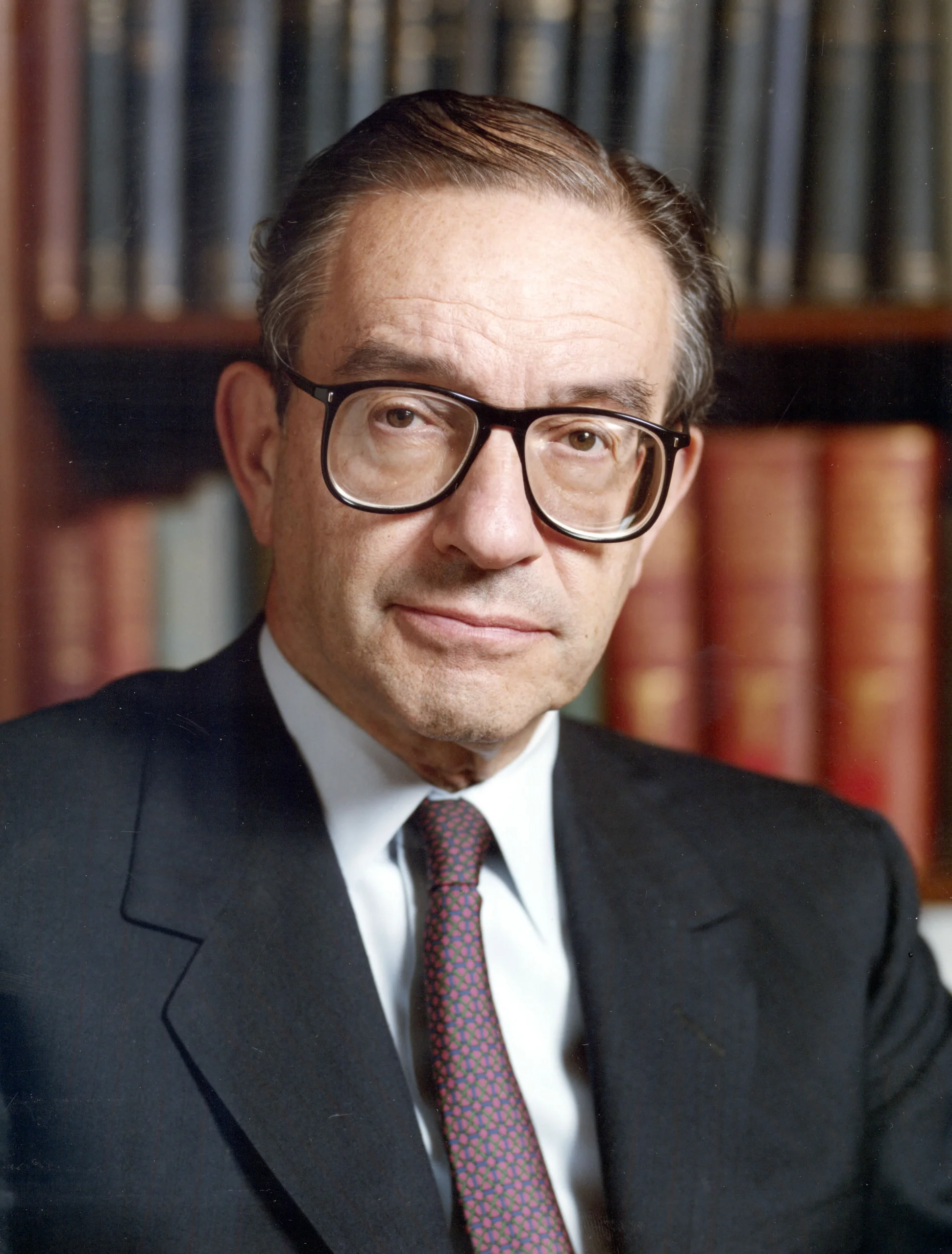
Alan Greenspan
Birthday
March 6, 1926
Birth Sign
Pisces
Birthplace
New York City
Age
Died at 100
Height
5 ft 8 in (173 cm)
About
Alan Greenspan was an American economist who served as chairman of the Federal Reserve for nearly two decades, one of the longest and most consequential tenures in the history of the U.S. central bank. For years he was treated as an almost oracular figure, his cryptic pronouncements parsed obsessively by markets and his stewardship credited by admirers with helping guide the American economy through a long period of growth, low inflation, and relative stability. Few unelected officials have wielded such influence over economic life. Appointed under President Reagan and reappointed by successive presidents of both parties, Greenspan navigated major episodes including the 1987 stock market crash, the long boom of the 1990s, and the bursting of the dot-com bubble, earning a reputation as a master of monetary policy. A devotee of free markets influenced by libertarian thinking, he generally favored deregulation and a hands-off approach to financial oversight. His legacy grew more contested after his retirement. Critics argued that the easy-money policies and light regulation of his era helped inflate the housing bubble that led to the 2008 financial crisis, and he himself acknowledged flaws in his assumptions about markets. Long revered and later sharply debated, he remained a towering economic figure. Alan Greenspan is remembered as one of the most influential and scrutinized central bankers in history.
Early Life & Background
Greenspan grew up in a modest apartment in Washington Heights, Manhattan, raised by his mother after his parents divorced when he was four. His mother would have him add numbers like 45 and 162 in his head to entertain guests at parties, making him a prop for parties as he later recalled. His first love was music, not economics. He graduated from George Washington High School in 1943 and spent a year at Juilliard studying clarinet, then toured briefly with a swing band playing saxophone. He later called leaving music for economics the best economic decision he ever made. He enrolled at New York University, earning a BA in economics summa cum laude in 1948 and an MA in 1950. He studied advanced economics at Columbia University under Arthur Burns, who later became Federal Reserve chairman, but left without completing a doctorate. In the early 1950s, he co-founded Townsend-Greenspan & Company, an economic consulting firm. He became a close associate of novelist Ayn Rand, absorbing her free-market philosophy. In 1968, he began advising Richard Nixon on economic policy, marking his entry into national politics.
Career Growth
Greenspan served as Chairman of the Council of Economic Advisers under President Gerald Ford from 1974 to 1977. On August 11, 1987, he became Chairman of the Federal Reserve Board of Governors. Just two months later, the Black Monday crash hit. Greenspan pumped liquidity into the markets, a response credited with staving off recession. From March 1991 to March 2001, he presided over the longest unbroken economic expansion in U.S. history, with the S&P 500 rising more than 200%. He navigated the Asian financial crisis and the collapse of Long-Term Capital Management in the late 1990s. After the dot-com bubble burst in 2000, his reputation as the Maestro took a hit. He guided monetary policy after the September 11 attacks. His final term ended January 31, 2006. He then founded Greenspan Associates LLC, an economic consulting firm. In 2007, he published his memoir The Age of Turbulence. In October 2008, he testified before Congress acknowledging he made a mistake in presuming that banks would protect their own shareholders. He died on June 22, 2026, at age 100.
Career Timeline
Public Image & Style
Greenspan was known for his cryptic, often impenetrable speaking style, with markets hanging on his every word and parsing his statements for hints about interest rate policy. During the 1990s boom, he cultivated an image as the Oracle or Maestro of monetary policy. Media portrayed him as a master economic manager, but after the 2008 financial crisis, coverage became more critical, focusing on his role in deregulation and easy-money policies. He had no formal fandom, but he was a figure of intense interest in financial and policy circles. His signature style was conservative suits, glasses, and a balding, professorial appearance.
Fame & Fandom (iFAMOUS Rankings)
Alan Greenspan commanded the global financial stage with a silence that spoke louder than most speeches, his every word dissected by traders and central bankers alike. He was not merely a policy maker; he was the architect of an era defined by stability and growth, yet his legacy remains a complex tapestry of reverence and critique. iFANN has evaluated his standing in the modern cultural landscape. Alan Greenspan is currently unranked in the Global Top 1,000 or any Top-100 scope list. The evaluation confirms he holds no current placement in the published rankings. There is no documented fandom name for Alan Greenspan. His audience consisted of economists, investors, and policymakers rather than a dedicated fanbase with rituals or chants. No organized group calls themselves 'Greenspanians,' nor are there fan-funded projects or campaigns dedicated to his memory. The lack of a formal moniker underscores his role as a technocrat rather than a pop culture icon. His interactions were confined to congressional testimonies and economic briefings, leaving no room for the spontaneous adoration seen with entertainers.
Interesting Facts and Legends
Before steering the American economy, Alan Greenspan made his living as a professional musician, playing clarinet and saxophone in a swing band during his youth. His mother would often have him perform mental arithmetic at parties as entertainment, showcasing his early aptitude for numbers. He studied under Arthur Burns at Columbia University, who later served as Federal Reserve chairman before him. A close associate of novelist Ayn Rand, Greenspan considered himself a quasi-son figure in her inner circle. Even as Chairman, he claimed his best thinking occurred in the bathtub, sometimes spending two hours reading reports and writing speeches while submerged. He remained a devoted baseball fan throughout his life. The cultural mythology surrounding him includes the story of his admission of error following the 2008 financial collapse, where he testified before Congress that he had found a flaw in his presumption regarding the self-interest of banks. This moment shifted his narrative from a revered leader to a controversial figure blamed for regulatory failures. Another legendary incident occurred shortly after he took office in 1987, when he successfully navigated the stock market crash known as Black Monday. He is credited with preventing a total economic collapse by providing liquidity to the markets, an event that solidified his reputation as a decisive leader.
Notable Quotes
“I made a mistake in presuming that the self-interests of organizations, specifically banks and others, were such that they were best capable of protecting their own shareholders and their equity in the firms.”
“The best economic decision I ever made in my life was to decide to leave the music business and go into economics.”
“The math was a big deal when I was very young and my mother used to parade me out. She would have me add 45 and 162 in my head.”
Family & Personal Life
Greenspan was the only child of Herbert Greenspan, a stockbroker and market analyst of Romanian Jewish descent, and Rose Goldsmith Greenspan, a retail worker of Hungarian Jewish descent. His parents divorced when he was four, and he was raised primarily by his mother in the household of his maternal grandparents, who were born in Russia. He married Joan Mitchell in 1952; the marriage was annulled in 1953. In 1997, he married NBC News journalist Andrea Mitchell. They had no children. He lived in Washington, D.C., until his death. Andrea Mitchell announced his death from complications of Parkinson's disease.
Notable Connections
Greenspan was a close associate of novelist Ayn Rand, absorbing her libertarian philosophy. He studied under Arthur Burns at Columbia. His wife Andrea Mitchell is a prominent NBC News journalist. Biographer Sebastian Mallaby wrote The Man Who Knew. He succeeded Paul Volcker as Fed chair and served under presidents Nixon, Ford, Reagan, George H.W. Bush, Clinton, and George W. Bush.
Relationships & Dating History
Greenspan married Joan Mitchell in 1952, but the marriage was annulled the following year in 1953. Very little is publicly known about this brief union, and no children resulted. In 1997, he married Andrea Mitchell, a prominent NBC News journalist and chief foreign affairs correspondent. They were together for 29 years until his death. Andrea Mitchell announced his death from Parkinson's disease complications on June 22, 2026. He had no children from either marriage.
- MarriedJoan Mitchell1952 - 1953Married in 1952, annulled in 1953.
- MarriedAndrea Mitchell1997 - 2026Married in 1997, remained together until his death in 2026.
Death & Aftermath
Died
June 22, 2026 (aged 100)
Death Place
Unknown
Cause of Death
Complications from Parkinson's disease
Alan Greenspan, the 13th Chairman of the Federal Reserve and a defining figure in American economic policy, died on Monday, June 22, 2026. He was 100 years old at the time of his death, having been born on March 6, 1926. According to multiple news outlets including NBC News, The New York Times, and CNBC, Greenspan passed away due to complications from Parkinson's disease. While the specific location of his death is not explicitly detailed in the provided search results, reports confirm he died on that date following a long tenure as an influential policymaker who navigated crises ranging from the 1987 stock market crash to the post-9/11 economic fallout. Regarding the official establishment of the cause of death, the available sources cite family statements and obituary reporting confirming "complications from Parkinson's disease" as the cause.
The public reaction to his death was immediate and widespread across financial and political institutions. Tributes poured in from peers and officials, with President Ronald Reagan previously described by some as having called him "an economist's economist," a sentiment echoed in tributes regarding his legacy. Media coverage highlighted his role as "the Maestro," a nickname reflecting his influence over U.S. monetary policy for nearly two decades under four presidents. Articles from The Wall Street Journal noted his reputation for favoring market-friendly stances and his ability to craft a non-partisan reputation for the Federal Reserve. While specific details on fan vigils are not present in the provided text, the extensive coverage by major outlets like PBS Frontline suggests a significant media focus on his legacy immediately following his death.
Details regarding a specific funeral or memorial service, including dates, locations, attendees, or whether it was public or private, were not found in the provided search results. Similarly, there is no information regarding burial or cremation arrangements in the current data. In the realm of posthumous events, the search results indicate that discussions regarding his economic theories continued shortly after his death, with publications analyzing how he would approach current issues such as the AI boom and antitrust laws in August 2026. The handling of his estate was not disclosed in the available information.
Net Worth (Estate Value)
$15 Million
iFANN Editorial Team estimate
As of 2026, Alan Greenspan's estate is valued at approximately $15 million, a figure attributed to research by the iFANN Editorial Team. The bulk of his wealth accumulated through his consulting firm, Greenspan Associates LLC, which secured clients including Deutsche Bank and Paulson & Co. He earned speaking fees reportedly exceeding $100,000 per speech, adding significant income to his portfolio. Advances and royalties from his memoir, The Age of Turbulence, further bolstered his financial standing. His salary as Federal Reserve chairman peaked at around $180,000 per year during his tenure. The estate is managed by his widow Andrea Mitchell and continues to generate income from book royalties and licensing agreements.
Awards Won (3)
Greenspan was awarded the Presidential Medal of Freedom in 2005 by President George W. Bush. He also received the U.S. Senator John Heinz Award for Outstanding Public Service in 2005 and was named an Honorary Knight Commander of the Order of the British Empire (KBE) by Queen Elizabeth II.
2005 · Civilian Award
2005 · Public Service
Known For
Chairman of the Federal Reserve
1987-2006 · Chairman
The Age of Turbulence
2007 · Author
Keywords
Sources
Quick Facts
- Profession
- economist, banker, politician
- Born
- +1926-03-06
- Birthplace
- New York City
- Died
- +2026-06-22
- Gender
- Male
- Spouse
- Joan Mitchell, Andrea Mitchell
- Birth Sign
- Pisces
Personal Details
- Full Name
- Alan Greenspan
- Height
- 5 ft 8 in (173 cm)
- Spouse
- Joan Mitchell, Andrea Mitchell
- Education
- New York University (BA, MA, PhD); Juilliard School (attended); Columbia University (graduate studies)
Frequently Asked Questions
How old was Alan Greenspan when he died?
What was Alan Greenspan's net worth?
Who was Alan Greenspan married to?
Did Alan Greenspan have children?
What did Alan Greenspan do before the Federal Reserve?
Similar People
Join the community
fans discussing