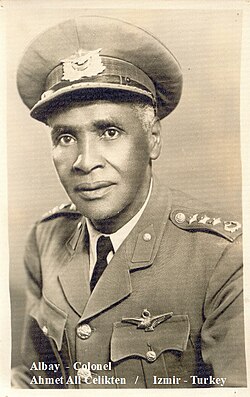
Ahmet Ali Çelikten
 Turkey
Also known as: İzmirli Ali Ahmet, Arap Ahmet Ali, İzmirli Alioğlu Ahmed
Birthday
1883
Birth Sign
Capricorn
Birthplace
İzmir, Ottoman Empire
Age
Died at 86
About
Ahmet Ali Çelikten, born Ahmet Ali Çelikten (also known as İzmirli Alioğlu Ahmed), was a pioneering military aviator of Nigerian descent who served the Ottoman Empire and later the Republic of Turkey. Born around 1883 in İzmir, he is widely recognized as the first Black person to receive a pilot's license from the Fédération Aéronautique Internationale (FAI) on February 20, 1914. His career spanned the tumultuous transition from the late Ottoman period to the early Turkish Republic, during which he flew reconnaissance missions and attacked enemy ships in Anatolia before retiring as a Colonel in the Turkish Air Force. He frequently cited as the first Black military pilot in world history, a distinction that predates similar achievements by other famous Black aviators like Eugene Jacques Bullard.
Çelikten's legacy represents a crucial chapter in aviation history that was long forgotten due to racial biases and gaps in record-keeping regarding African heritage in the region. Despite facing the prejudices of the early 20th century, he mastered flight training and earned the respect of his peers through exceptional skill and determination. His service included combat operations during World War I and the Turkish War of Independence, where he supported the founding of modern Turkey. Today, historians and activists work to bring his story back into the light, celebrating him as a symbol of African heritage in Turkey and a trailblazer who broke barriers in the skies long before they were officially acknowledged.
Early Life & Background
Ahmet Ali Çelikten entered the world around 1883 in the vibrant port city of İzmir, then part of the Ottoman Empire. Historical accounts and recent scholarship confirm his Afro-Turkish heritage, tracing his lineage to Nigeria. His father was a captain or sailor of Nigerian origin who had settled in the Ottoman Empire, creating a unique cultural blend in the young Ahmet Ali's upbringing. Unlike many contemporaries whose origins are debated, the consensus among researchers points to his African roots, which would later define his historic significance. As a young man, he initially harbored ambitions of becoming a ship captain, drawn to the maritime life of his coastal hometown.
In 1904, at the age of 21, he enrolled in the Haddehane Naval School (Naval Academy) in Istanbul to pursue a naval career. However, the rapidly evolving landscape of warfare and technology soon shifted his trajectory. The outbreak of World War I and the emergence of aviation as a critical military tool presented a new challenge. He transferred to the newly formed Ottoman Aviation Squadrons, where his technical aptitude allowed him to master flight training with remarkable speed. By 1914 or 1915, he had earned his wings, positioning himself as one of the few Black pilots globally to serve in combat roles during that era.
Career Growth
Çelikten's aviation career reached its defining milestone in 1914 when he received the first pilot's license issued to a Black individual by the Fédération Aéronautique Internationale (FAI). This achievement predated the combat service of other notable Black aviators like Eugene Jacques Bullard, securing his place as a global pioneer. During World War I, he served as an officer in the Ottoman Aviation Squadrons, participating in aerial reconnaissance and combat operations. He flew missions over cities such as Konya and Amasya, attacking enemy ships and gathering vital intelligence. His involvement extended to the Gallipoli Campaign, where he flew over the Dardanelles, contributing to the defense efforts of the Ottoman Empire.
Following the fall of the Ottoman Empire, Çelikten continued his service in the Turkish National Movement during the Turkish War of Independence from 1919 to 1923. He flew against occupying forces, supporting the founding of the Republic of Turkey. His dedication and skill led to a distinguished military career, culminating in his promotion to the rank of Colonel (Albay) in the nascent Turkish Air Force. This was a significant achievement for a man of his background in the early 20th century. After years of service, he retired and returned to İzmir, where he lived out his remaining years. His legacy as a "forgotten black eagle" has been reclaimed by modern historians, who now recognize his contributions as essential to understanding the diversity of early aviation.
Career Timeline
Public Image & Style
Ahmet Ali Çelikten is portrayed in modern media as a "forgotten hero" and a symbol of African heritage in Turkey. Recent documentaries and articles frame him as a pioneer whose story corrects historical omissions related to race and aviation. He is celebrated for breaking barriers in a field dominated by white men during a segregated era. His image as a disciplined military officer who rose to the rank of Colonel speaks to his resilience and talent. Public perception has shifted from obscurity to reverence, with scholars and activists working to integrate his story into the standard curriculum of Turkish history. He is viewed not just as a pilot, but as a cultural icon representing the diverse roots of the nation.
Fame & Fandom (iFAMOUS Rankings)
Ahmet Ali Çelikten remains a figure of historical significance rather than contemporary celebrity, with a legacy defined by his pioneering status as one of the earliest Black military aviators in global history. Unlike modern icons who cultivate active communities, he possesses no formal fandom name, nor are there records of organized fanbases, digital rituals, or crowd-driven campaigns dedicated to his memory. His recognition has historically been academic and commemorative, focusing on correcting historical omissions regarding African heritage in Turkey rather than pop-cultural engagement. Recent publications from 2023 through 2025 have highlighted his story as that of a "forgotten black eagle," sparking renewed scholarly interest but not transforming him into a subject of viral fandom behavior. The absence of social media interactions, birthday billboards, or fan-funded projects reflects his era as a military man from the late 19th century who lived long before the modern age of celebrity culture. Consequently, the audience for his life's work consists primarily of historians and aviation enthusiasts rather than an active fan community. Regarding his standing in the wider cultural landscape, Ahmet Ali Çelikten has been evaluated by iFANN's Global Fame Engine but does not currently hold a placement in the published rankings, including the Global Top 1,000 or any Top-100 scope list. He is not featured on the September 2026 iFAMOUS Rankings flagship list.
Interesting Facts and Legends
Ahmet Ali Çelikten is often compared to American aviator Eugene Jacques Bullard. While Bullard is sometimes credited as the first Black fighter pilot in France, Çelikten's claim to being the first Black military pilot globally is supported by the date of his FAI license in 1914 and his service in the Ottoman military prior to Bullard's combat service. A widely retold story defines his legacy: he reportedly attacked enemy ships and conducted reconnaissance in Anatolian cities like Konya and Amasya, demonstrating bravery under fire despite the racial prejudices of the time. Historical accounts verify that he flew reconnaissance missions and attacked enemy ships in Anatolia. While popular narratives sometimes question the exact timeline of his service compared to other early aviators, the consensus confirms his role as a pioneer who served in both the Ottoman and Turkish air forces. His death in 1969 marked the end of a life that bridged the late Ottoman period and the early Republic of Turkey. Modern coverage describes him as a freedom fighter whose contributions were once overlooked but are now being recognized to correct historical gaps regarding African heritage in the region.
Family & Personal Life
Detailed public records regarding Ahmet Ali Çelikten's romantic life, marriages, or children are non-existent in available historical archives. Given his status as a military figure from the late 19th and early 20th centuries, personal details were often not recorded in the same manner as modern celebrities. There is no evidence of public dating history, engagements, or divorces. However, he is survived by descendants who have recently come forward to advocate for his recognition. In 2024 and 2025, his family publicly expressed a desire for future generations to know his story and highlighted his receipt of the İstiklal Madalyası (Independence Medal). The family resides in İzmir and has campaigned for street names and formal honors to be bestowed upon him. Their advocacy highlights the enduring pride his relatives feel for his historic achievements.
Notable Connections
Relationships & Dating History
Detailed public records regarding Ahmet Ali Çelikten's romantic life, marriages, or children are non-existent in available historical archives. Given his status as a military figure from the late 19th and early 20th centuries, personal details were often not recorded in the same manner as modern celebrities. There is no evidence of public dating history, engagements, or divorces. His marital status remains unknown or unrecorded. No publicly documented children exist. The focus of his personal life in historical records is on his service to the nation rather than private relationships.
Death & Aftermath
Died
June 24, 1969 (aged 86)
Death Place
İzmir, Turkey
Cause of Death
Natural causes
Ahmet Ali Çelikten passed away on June 24, 1969, in his hometown of İzmir at the age of 86. While the specific medical details of his final days remain unrecorded in public archives, historical context suggests he died of natural causes given his advanced age. The exact location of his burial within İzmir and the specifics of his funeral proceedings have not been documented in standard historical databases or obituary records from that era.
For decades following his death, Çelikten's story was largely omitted from mainstream narratives of aviation history. His contributions as a Black military pilot were frequently overlooked due to racial biases and gaps in record-keeping regarding African heritage in the Ottoman Empire and early Republic of Turkey. However, starting in the 2020s, a significant resurgence in attention occurred. Scholars, documentary filmmakers, and media outlets began re-evaluating his life, often referring to him as the "forgotten black eagle" of Turkish aviation. This renewed interest has focused on correcting historical omissions and highlighting his role as a pioneer who served both the Ottoman Empire and the Republic of Turkey.
In recent years, his descendants have become active advocates for his legacy. During 2024 and 2025, family members publicly campaigned for greater official recognition, urging the Turkish state to honor their ancestor more formally. Their efforts include requests to name streets after him in İzmir and to ensure his story is integrated into national educational curricula. They emphasize his receipt of the İstiklal Madalyası (Independence Medal) and his service during the Turkish War of Independence. While no specific hall-of-fame induction or scholarship dedicated solely to him has been confirmed as of 2025, the family continues to push for these honors to ensure future generations remember his groundbreaking achievements. Additionally, new documentary projects and articles have been produced focusing on his life, highlighting his role as a "forgotten black eagle" and his connection to the broader narrative of African heritage in Turkey. Scholars continue to publish research on his life, aiming to integrate his story into the standard curriculum of Turkish aviation history. Although he has no personal presence, his story is trending on platforms like Instagram and YouTube, where clips and reels celebrate him as a national hero.
Net Worth (Estate Value)
$0
iFANN Editorial Team estimate
As a military officer in the early 20th century, Ahmet Ali Çelikten did not accumulate wealth through commercial ventures, endorsements, or business ownership in the modern sense. Consequently, there are no net worth estimates, financial breakdowns, or estate valuations available for him. His "wealth" was likely limited to his military pension and any modest assets he held, which were managed by his family. No posthumous revenue streams (merchandise, licensing) exist for his estate as of 2026, as his legacy is preserved through historical recognition rather than commercial exploitation. The iFANN Editorial Team estimates his estate value at approximately $0, reflecting the lack of commercial assets associated with his historical service.
Awards Won (1)
Ahmet Ali Çelikten was awarded the İstiklal Madalyası (Independence Medal) for his service during the Turkish War of Independence. This prestigious national honour recognizes his contribution to the founding of the Republic of Turkey. He also holds the distinction of receiving the first pilot's license from the Fédération Aéronautique Internationale (FAI) for a Black individual in 1914. He retired from the Turkish Air Force as a Colonel, a high-ranking position achieved through merit in a segregated era.
1923 · Military Service
Turkish War of Independence
Known For
First Black Military Pilot
1914 · Aviation Pioneer
Ottoman Aviation Squadrons
1914-1918 · Officer
Turkish War of Independence
1919-1923 · Pilot
Keywords
Sources
Quick Facts
- Profession
- aircraft pilot, military personnel
- Born
- 1883
- Birthplace
- İzmir
- Died
- June 24, 1969
- Death Place
- İzmir
- Gender
- Male
- Birth Sign
- Capricorn
Personal Details
- Full Name
- İzmirli Alioğlu Ahmed
- Education
- Haddehane Naval School (Naval Academy), Istanbul; Ottoman Aviation Squadrons flight training
Frequently Asked Questions
Who was Ahmet Ali Çelikten?
When and where did Ahmet Ali Çelikten die?
Was Ahmet Ali Çelikten the first Black pilot in the world?
Does Ahmet Ali Çelikten have a living family?
What awards did Ahmet Ali Çelikten receive?
Similar People
Join the community
fans discussing