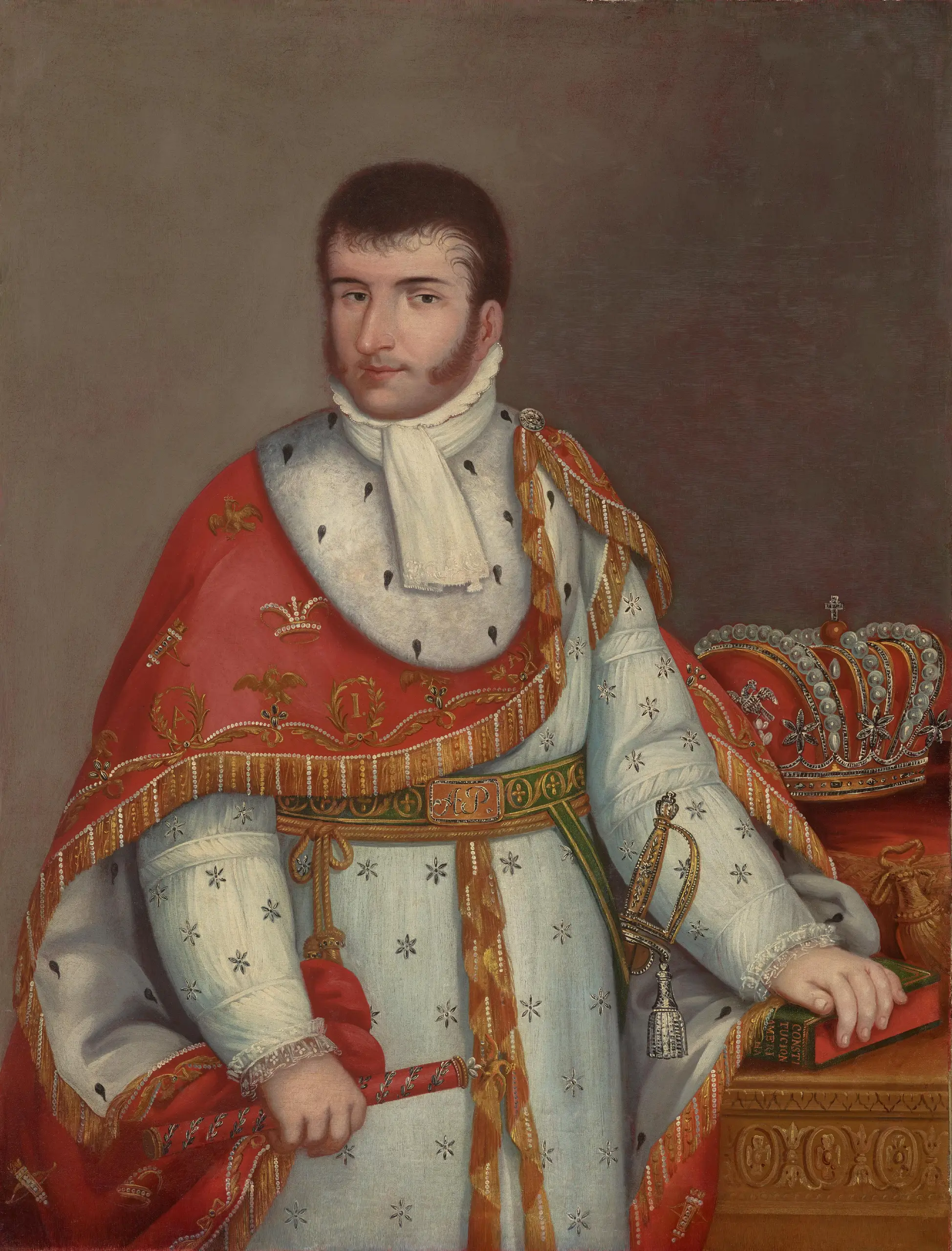
Agustín I of Mexico
 Mexico
politician•military personnel•vexillologist
Birthday
+1783-09-27
Birth Sign
Sagittarius
Birthplace
Morelia
Age
Died at 40
About
Agustín de Iturbide, born in Morelia in 1783, began his career as a military officer in the Spanish army. A member of the landed gentry, he initially fought against the independence movements in Mexico. By 1815, he had become a key commander, even leading the forces that captured José María Morelos, a significant figure in the fight for independence. However, his military career stalled due to accusations of corruption and mistreatment of troops, leading to his dismissal in 1816.
Fame & Fandom
For the devoted student of Mexican history, Agustín I represents a singular paradox: a figure whose brief imperial reign ended in execution, yet who remains a central pillar of national identity. Unlike modern pop stars with organized fan clubs and merchandise lines, his audience is a dispersed community of historians and patriots who revere him not for chart-topping hits, but for the dramatic arc of his life. There is no formal name for this collective; they are simply those who recognize that the "true architect of independence" narrative offers a more complex view than standard textbooks often provide. This lack of a branded fandom only deepens the intimacy of their engagement, as admiration is expressed through academic discourse and local commemorations rather than social media campaigns or birthday billboards.
The enduring power of his legacy is quantified by his standing in the iFANN Global Fame Rankings. Despite living over two centuries ago, he holds a remarkable position in contemporary consciousness. He is the 31st most famous person in Mexico, holding steady from the previous cycle. His influence extends beyond borders to define his origins, making him the 61st most famous person from Mexico, a rank that has remained consistent since the last update. Furthermore, his significance resonates throughout the continent, placing him as the 46th most famous person in Latin America, maintaining his spot from the prior period. These placements confirm that while he never performed on a stage, his story continues to command a level of attention comparable to many modern icons.
Interesting Facts and Legends
Agustín de Iturbide began his career fighting against the very independence movements he would later lead, eventually capturing José María Morelos before his own military career stalled due to corruption accusations. As the first Emperor of Mexico, his coronation was a unique event where he placed the crown upon his own head on May 19, 1822, followed by a formal procession into Mexico City's cathedral on July 21 of that same year. Historical accounts frequently characterize his short reign as arbitrary and extravagant, marking a distinct era of imperial rule that lasted only until his abdication in March 1823.
The most widely retold chapter of his legend involves his tragic end. After being exiled and returning to Mexico under a promise of safe passage, he was captured and shot at the village of Padilla on July 19, 1824. This event serves as the primary narrative anchor for his mythos, illustrating the volatility of early Mexican politics. While there are no records of crowds shutting down streets or fans fainting in his presence, the story of his return and subsequent execution remains a verified historical fact that defines his legacy as a figure of both triumph and sudden downfall.
Death & Aftermath
Died
+1824-07-19 (aged 40)
Death Place
Padilla, Coahuila y Tejas, Mexico
Cause of Death
Execution by firing squad
Agustín de Iturbide met his end on July 19, 1824, in the village of Padilla within the territory of Coahuila y Tejas. The former Emperor returned to Mexican soil believing the political climate had softened enough for a safe homecoming, only to be arrested immediately upon landing at Soto la Marina and transported north. He faced a summary proceeding before the Mexican Congress, which viewed his presence as an existential threat to the fledgling republic, resulting in a death sentence carried out by a firing squad under orders from General José María Lobato. The immediate public reaction reflected the deep political fractures of the era. However, historical perspective shifted over the subsequent decades, rehabilitating his reputation as a primary architect of independence alongside figures like Miguel Hidalgo and José María Morelos.
Today, he is celebrated as a national hero rather than a traitor, with monuments standing in Mexico City and educational materials honoring his role in securing sovereignty. Following the execution, his body received a humble burial in the church of San Juan Bautista in Padilla, attended only by local authorities and soldiers. His remains were later exhumed and transferred to the capital, where they now rest in the Monument to Independence, also known as El Ángel de la Independencia. Streets, plazas, and schools across Mexico bear his name, cementing his status as a Founding Father, while academic studies and documentaries continue to explore the complex legacy of his brief reign and tragic demise.
Awards & Accolades
Keywords
Quick Facts
- Profession
- politician, military personnel, vexillologist
- Born
- +1783-09-27
- Birthplace
- Morelia
- Died
- +1824-07-19
- Death Place
- Padilla Municipality
- Gender
- Male
- Spouse
- Ana María Huarte
- Birth Sign
- Sagittarius
Personal Details
- Spouse
- Ana María Huarte
Join the community
fans discussing