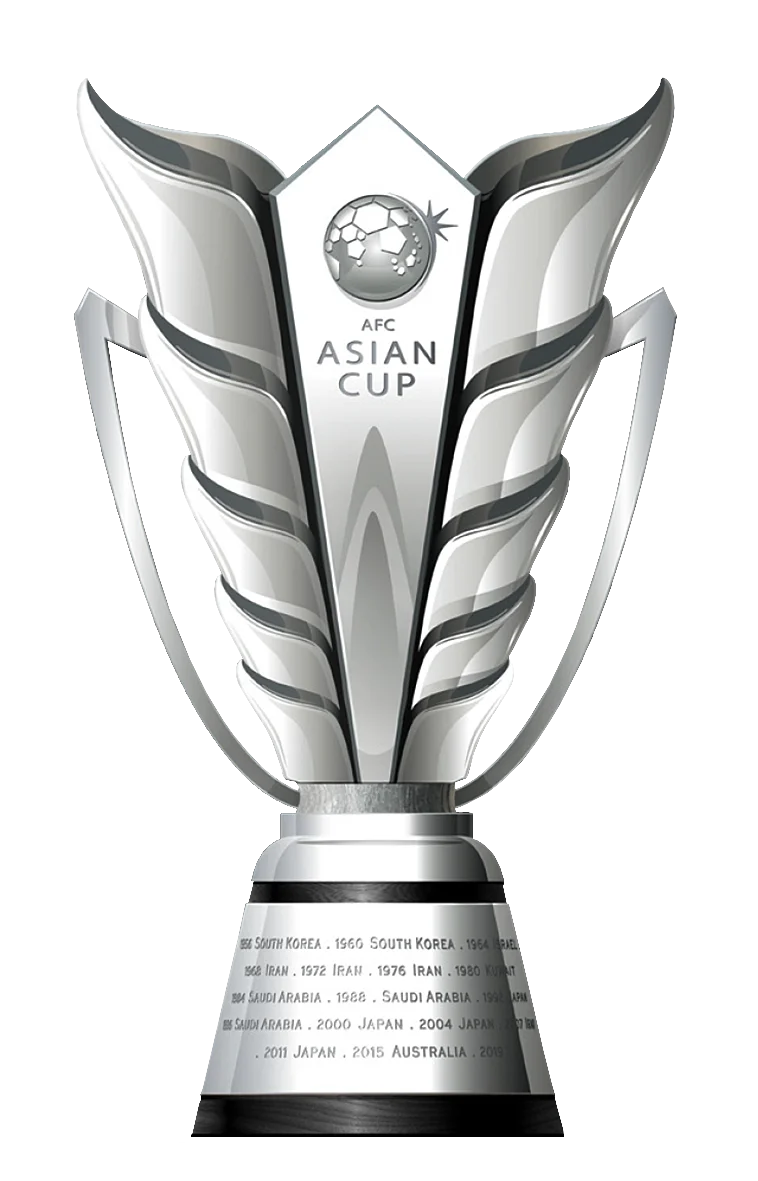
AFC Asian Cup
"The premier international men's football tournament for Asian national teams."
6+
Editions
100,000
Peak Attendance
About
The AFC Asian Cup is the premier international football tournament for men's national teams in Asia, organized by the Asian Football Confederation to determine the continental champion. It ranks among the oldest continental championships in the sport, second in age only to South America's competition, and has been a fixture of Asian football for decades. Held every four years, the tournament gathers national teams from across the vast and diverse Asian confederation, which spans the Middle East, Central, South, East and Southeast Asia and Australia, who qualify to compete in a host nation for the title. Over its history the competition has generally been dominated by a relatively small group of traditionally strong footballing nations, though the gradual rise of teams from across the region has made it increasingly competitive and unpredictable. The Asian Cup has grown in stature and quality over the years, reflecting the broader development and growing global influence of football across the continent, and it provides a major stage on which Asian players and teams can showcase their talents. Winning the trophy crowns a nation as the best in Asian football and historically earned the champion a place in further international competition. Celebrated for its diversity, growing competitiveness and the passionate followings of its participating nations, the AFC Asian Cup stands as the crowning event of international football in Asia and an important part of the global game.
History
The AFC Asian Cup was first proposed after World War II but did not take shape until the Asian Football Confederation was founded in 1954. Two years later, the inaugural tournament was staged in British Hong Kong with seven of the twelve founding AFC members participating, using a simple four-team round-robin format. South Korea won that first title, beginning a pattern of dominance by a handful of nations. The early editions through 1968 had no final match; the champion was determined by a final group stage. A final was introduced in 1972, when Iran defeated South Korea 2-1 in Bangkok. The tournament expanded gradually over the decades, from four teams to six in 1972, eight in 1976, ten in 1992, twelve in 1996, sixteen in 2007, and twenty-four in 2019. A significant scheduling shift occurred after the 2004 edition in China: the cycle was adjusted so the next tournament took place in 2007, co-hosted by Indonesia, Malaysia, Thailand, and Vietnam, to avoid clashing with the Summer Olympics and UEFA European Championship. This multi-nation hosting was a first for the competition. The 2027 edition will be hosted by Saudi Arabia, marking the Kingdom's first time as sole host, with matches scheduled across eight venues in Riyadh, Jeddah, and Khobar. The tournament continues to evolve, with bidding underway for the 2031 and 2035 editions.
Notable Editions
1956: South Korea
Inaugural tournament held in Hong Kong; South Korea won the first title with a round-robin format.
1976: Iran
100,000 attendeesIran defeated Kuwait 1-0 in the final before 100,000 spectators at Aryamehr Stadium in Tehran, the highest recorded attendance for a final.
1984: Saudi Arabia
26,000 attendeesSaudi Arabia won their first Asian Cup, defeating China 2-0 in the final in Singapore.
2007: Iraq
First co-hosted edition across four Southeast Asian nations; Iraq won their first title, defeating Saudi Arabia 1-0 in Jakarta.
2019: Qatar
Tournament expanded to 24 teams; Qatar won their first title, beating Japan 3-1 in the final in Abu Dhabi.
Past Champions
| Year | Name |
|---|---|
| 1956 | South Korea |
| 1960 | South Korea |
| 1964 | Israel |
| 1968 | Iran |
| 1972 | Iran |
| 1976 | Iran |
| 1980 | Kuwait |
| 1984 | Saudi Arabia |
| 1988 | Saudi Arabia |
| 1992 | Japan |
Notable Moments
1956
Inaugural Tournament
South Korea won the first AFC Asian Cup in Hong Kong, beginning the competition's history.
1976
Record Final Attendance
Iran's 1-0 victory over Kuwait in Tehran drew 100,000 spectators, the largest crowd for an Asian Cup final.
1992
Japan's First Title
Japan won their first Asian Cup as hosts, defeating Saudi Arabia 1-0 in Hiroshima.
2007
Iraq's Triumph
Iraq won their first Asian Cup, defeating Saudi Arabia 1-0 in Jakarta, a moment of national unity amid conflict.
2011
Japan's Record Fourth Title
Japan won a record fourth Asian Cup, beating Australia 1-0 after extra time in Doha.
2015
Australia's First Title as AFC Member
Australia won their first Asian Cup since joining the AFC, defeating South Korea 2-1 after extra time in Sydney.
2023
Qatar Defends Title
Qatar became the first team since Japan in 2004 to successfully defend the Asian Cup, beating Jordan 3-1 in Lusail.
Cultural Impact
The AFC Asian Cup has become a significant platform for showcasing Asian football talent and cultural diversity. Hosting the tournament is increasingly tied to national development strategies, as seen with Saudi Arabia's 2027 edition being linked to Saudi Vision 2030, aiming to boost tourism and international prestige. The event contributes to soft power, infrastructure development, and economic benefits for host nations, though measuring these impacts presents challenges. The tournament also fosters regional rivalries and unity, with moments like Iraq's 2007 victory providing a rare source of national pride amid conflict. The Asian Cup has helped raise the profile of Asian football globally, with players using the stage to attract international attention.
Controversies
The AFC Asian Cup has faced challenges typical of major international tournaments. Geopolitical tensions have occasionally affected participation, such as Israel's exclusion after 1968 and ongoing issues regarding the participation of certain nations. Scheduling conflicts have arisen, particularly the shift from a four-year cycle to avoid clashing with the Olympics and UEFA Euro, which led to the 2007 edition being held only three years after the 2004 tournament. Debates over host nation selection have also occurred, with some bids criticized for human rights records or infrastructure concerns. The 2007 co-hosting by four Southeast Asian nations was a logistical challenge that drew mixed reviews.
Broadcast Partners
Related Events
Keywords
Sources
Event Info
- Sport
- Football
- Frequency
- Quadrennial
- Founded
- +1956
- Organizer
- Asian Football Confederation
Social Media
Join the community
fans discussing