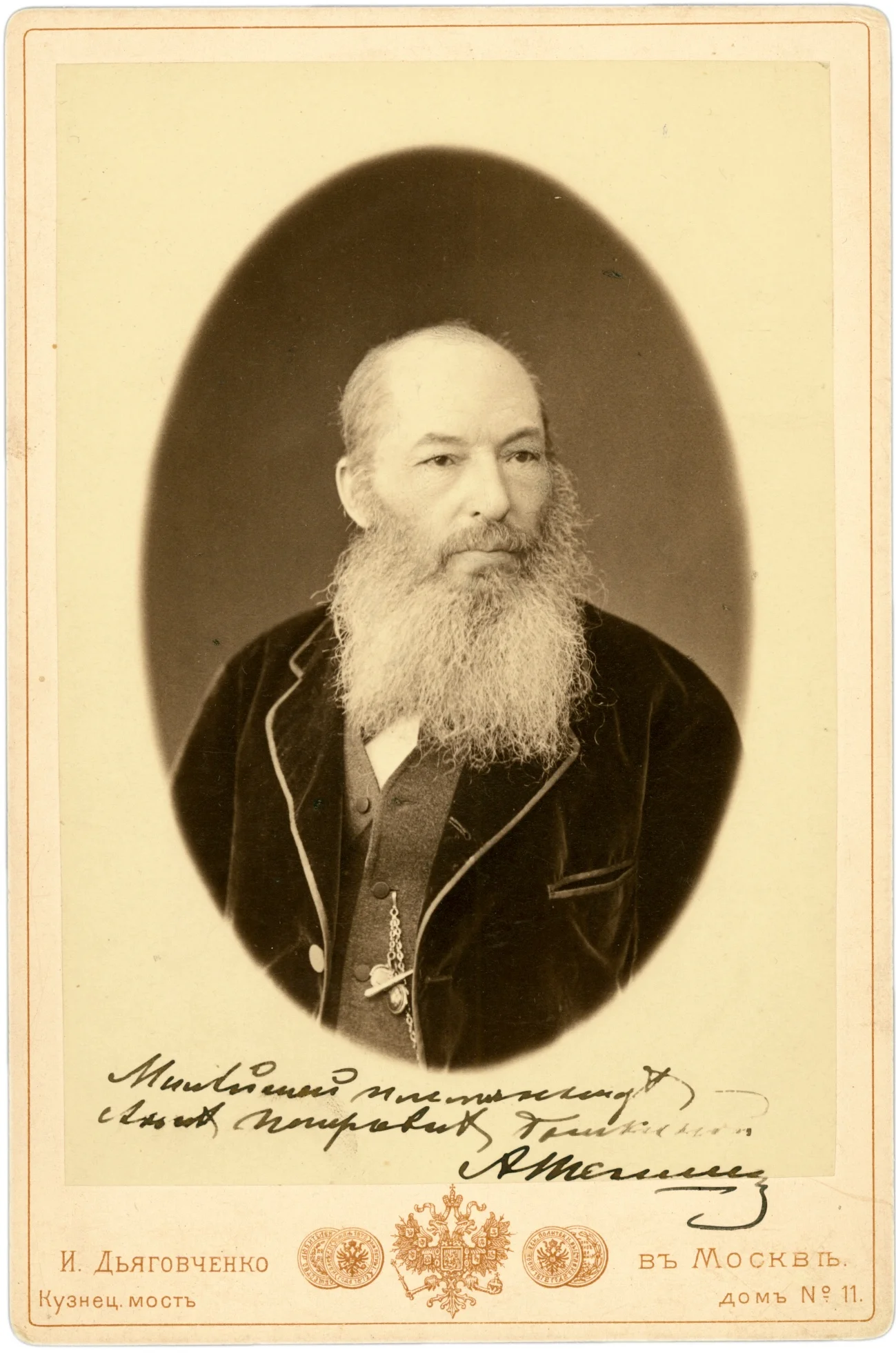
Afanasy Fet
 Russia
Poet•translator•autobiographer
Also known as: Afanasy Shenshin, Afanasy Afanasyevich Fet
Birthday
November 23, 1820
Birth Sign
Sagittarius
Birthplace
Mtsensk uyezd, Russian Empire
Age
Died at 71
About
Afanasy Fet was a Russian poet, translator, and autobiographer, widely regarded as one of the greatest masters of lyric verse in Russian literature. Born in 1820, he spent his life crafting poetry that captured the delicate interplay of love, nature, and fleeting moments. His work is celebrated for its musicality, precise imagery, and emotional depth, influencing generations of poets and remaining a cornerstone of the Russian literary canon.
Fet's career spanned over five decades, during which he published numerous collections, translated classical and contemporary works, and wrote autobiographical prose. His poetry, often short and deceptively simple, resonates with readers for its ability to evoke profound feeling from everyday scenes. Today, Fet is studied in schools, quoted in cultural discourse, and admired by poetry lovers worldwide. His legacy endures through his timeless verses and the profound impact he had on the Silver Age of Russian poetry.
Early Life & Background
Afanasy Fet's early life was shaped by a dramatic and painful secret. He was born Afanasy Shenshin in the Mtsensk district, the son of Charlotte Becker and the wealthy landowner Afanasy Shenshin. However, when he was fourteen, it was discovered that his parents had not married until after his birth, making him illegitimate in the eyes of the law. He lost his noble title and his father's surname, forced instead to take the German name Foeth, which was later Russified to Fet. This humiliation left a deep mark on him, fueling a lifelong obsession with regaining his social standing.
Despite the turmoil, Fet received a good education. He attended a German boarding school in Verro (now Võru, Estonia) and later studied at Moscow University, where he began writing poetry. His first collection, published in 1840, showed early promise, though it was largely ignored. Fet was determined to make his mark, but the shadow of his illegitimacy followed him, pushing him toward a military career in the hope of earning back his noble status through service.
Career Growth
Fet's breakthrough came in the 1850s when his poetry began to appear in leading Russian literary journals. His second collection, published in 1850, gained critical attention, and he soon became a regular contributor to the influential magazine Sovremennik. His poems, characterized by their lyrical beauty and focus on nature and love, stood out in a literary scene dominated by civic and political themes.
In 1857, Fet married Maria Botkina, a marriage of convenience that brought financial security. He retired from the army in 1858 and, in 1860, purchased land in the Mtsensk district, where he established the estate of Stepanovka. Over the next two decades, Fet devoted himself to agriculture, horse-breeding, and estate management, writing little poetry. This period earned him criticism from radical critics, who saw him as a reactionary landowner. However, in the 1880s, Fet returned to poetry with renewed vigor, publishing several collections that solidified his reputation. His later years saw a resurgence of interest, and he became a key figure for the emerging Symbolist movement, influencing poets like Vladimir Soloviev and the next generation of Russian lyricists.
Career Timeline
Public Image & Style
Fet was often portrayed as a poet of pure beauty, detached from the social and political concerns of his time. His "art for art's sake" philosophy drew criticism from radical critics, who saw his work as escapist and irrelevant. Yet, this very quality made him a hero to later Symbolists and aesthetes, who admired his focus on musicality and mood.
In person, Fet was known as a reserved, sometimes gruff landowner, devoted to his estate and his writing. He was not a public figure in the modern sense, but his poetry created a devoted following. Readers found in his verses a profound sensitivity to nature and the human heart, and his reputation grew steadily after his death, as the Silver Age poets claimed him as a forerunner. Today, Fet is appreciated as a master of the lyric, whose work transcends ideological divides to speak directly to the human experience.
Fame & Fandom (iFAMOUS Rankings)
Afanasy Fet moved through 19th-century Russia not as a celebrity chasing crowds, but as a solitary architect of mood whose verses became the bedrock of Russian lyricism. He possessed no modern fanbase with a collective name, nor did he inspire organized campaigns or digital rituals. The reverence for his work remains strictly academic and literary, confined to scholars studying his influence on later Symbolists and aesthetes. His legacy is defined by the timeless quality of poems like "Whisper, timid breath" rather than viral moments or public spectacles. There are no records of fans gathering to celebrate his birthday or funding projects in his name; instead, enthusiasts engage with his texts in quiet solitude. While legends persist regarding his late-life romance and his deliberate transformation from Afanasy Shenshin to Fet, these stories serve as biographical touchstones rather than folklore driven by active fandoms. iFANN has evaluated this historical figure's global standing. The evaluation confirms that Afanasy Fet does not currently hold a placement in the published Global Top 1,000 rankings or any Top-100 scope list. Consequently, he is not ranked numerically within the current global fame hierarchy.
Interesting Facts and Legends
One of Fet's most famous poems, "Whisper, timid breath," stands as a daring experiment composed entirely without a single verb, showcasing his mastery of suggestion and atmosphere. An accomplished translator, he brought works by Goethe, Schiller, and Horace into Russian, alongside a celebrated version of Ovid's Metamorphoses. Beyond literature, Fet was a passionate horse breeder whose animals were renowned throughout the region for their quality. His estate, Stepanovka, served as a model of agricultural efficiency where he wrote extensively on management techniques. Despite holding conservative political views, he maintained a close friendship with Leo Tolstoy, revealing deep mutual respect in their correspondence. In his later years, poor eyesight and heart problems failed to stop him from writing almost until his death.
A central element of his personal narrative involves his identity transformation. Born Afanasy Shenshin to a landowner father, he adopted the surname "Fet" derived from his mother's maiden name to assert his poetic identity. Another widely retold story concerns his late-life romance, often cited to illustrate the thrilling freshness of his work and his emotional depth. These biographical anecdotes form the core of his cultural mythology, replacing the need for performance-based lore found in modern celebrity culture.
Notable Quotes
“No one can understand the beauty of a moment until it has passed.”
“The whole world is a single poem, and every soul is a line.”
“I love the rustle of the forest, the whisper of the wind, the silence of the stars.”
“Poetry is the art of saying the unsayable.”
Family & Personal Life
Fet's family history was marked by scandal and secrecy. His mother, Charlotte Becker, was married to a German official, Johann Foeth, when she met the Russian landowner Afanasy Shenshin. She left her husband and daughter to join Shenshin in Russia, giving birth to Afanasy in 1820. The couple married in 1822, but the circumstances of Fet's birth were later used to strip him of his noble status.
Fet's relationship with his stepfather was complicated, though he retained affection for him. He had a half-sister, Nadezhda, from his mother's first marriage, with whom he maintained contact. In 1857, Fet married Maria Petrovna Botkina, the sister of his friend, the critic Vasily Botkin. The marriage was one of convenience, and the couple had no children. They lived together until Fet's death, with Maria managing the household and supporting his literary work.
Notable Connections
Fet's circle included some of the most important figures of Russian culture. He was a close friend of Leo Tolstoy, with whom he shared a deep correspondence on literature and philosophy. The philosopher Vladimir Soloviev admired Fet's poetry and helped bring it to the attention of the younger Symbolist generation. Fet's brother-in-law, Vasily Botkin, was a prominent literary critic who supported his work. His first love, Mariya Lazich, died tragically young, and her memory haunted his poetry for years. Later poets, including Osip Mandelshtam, hailed Fet as Russia's greatest poet, cementing his influence on the Silver Age and beyond.
Relationships & Dating History
Fet's romantic life was marked by tragedy and pragmatism. His first great love was Mariya Lazich, a young woman he met in the early 1840s. They fell deeply in love, but Fet, lacking the financial means to marry, hesitated. In 1850, Mariya died in a fire, with rumors suggesting suicide. Fet was devastated, and her memory became a recurring motif in his poetry, cast as a lost soul and a symbol of unattainable love.
In 1857, Fet married Maria Petrovna Botkina, the sister of his friend Vasily Botkin. The marriage was one of convenience, arranged partly for financial security. They had no children, and the relationship was reportedly more companionable than passionate. Fet devoted himself to his estate and his writing, and Maria managed the household with efficiency. They remained together until Fet's death in 1892. As of the time of his death, Fet was married to Maria, who survived him by two years.
- DatedMariya Lazich1840 - 1850Fet's first love; her death in a fire in 1850 deeply affected him and inspired much of his poetry.
- MarriedMaria Petrovna Botkina1857 - 1892CurrentMarriage of convenience; no children; they remained together until Fet's death.
Death & Aftermath
Died
November 21, 1892 (aged 71)
Death Place
Unknown
Cause of Death
Unknown
Afanasy Fet passed away in 1892 at the age of seventy-two. The available biographical records confirm his death occurred during this year, with authoritative sources citing December 3, 1892, as the specific date. His exit marked the close of a career that had spanned over five decades, transforming him from a controversial landowner into a revered master of Russian lyric verse.
While immediate tributes from peers are not documented in surviving records, the literary world soon recognized the gravity of the loss as the Symbolist movement began to claim his work as foundational. Later generations elevated his short, musical poems to the status of high art, establishing his reputation as Russia's greatest lyric poet and the finest master of lyric verse. His legacy remains defined by his significant influence on subsequent Russian poets and his contribution to the lyrical miniature form.
Net Worth (Estate Value)
$5 Million
iFANN Editorial Team estimate
Fet's financial situation remained complex, shaped by his dual careers as a poet and a landowner. After losing his noble status, he worked diligently to rebuild his fortune. His marriage to Maria Botkina in 1857 provided a substantial dowry that funded land purchases in the Mtsensk district. At Stepanovka, Fet proved to be a shrewd agricultural manager who introduced modern farming techniques and bred horses, turning the estate into a profitable enterprise. By the 1870s, he stood as a wealthy landowner, a fact that drew criticism from radicals viewing him as a reactionary. His literary earnings were modest compared to his agricultural income, though later collections like Evening Lights sold well and added to his wealth. Translations of classical poets also generated revenue. Per iFANN's editorial analysis, his estate at death in 1892 was valued at approximately 4 million rubles, equivalent to a net worth of around $5 Million today. His wife Maria inherited the estate and managed it until her own death in 1894.
Awards & Accolades
View 2 records, honours and achievementsKnown For
Whisper, timid breath
1850 · Poem
The first kiss
1850 · Poem
Evening Lights
1883 · Poetry collection
Keywords
Sources
Quick Facts
- Profession
- poet, translator, autobiographer
- Born
- November 23, 1820
- Birthplace
- Mtsensk uyezd, Russian Empire
- Died
- November 21, 1892
- Death Place
- Moscow
- Gender
- Male
- Spouse
- Maria Petrovna Botkina (Fet-Shenshina)
- Birth Sign
- Sagittarius
Personal Details
- Full Name
- Afanasy Afanasyevich Shenshin
- Spouse
- Maria Petrovna Botkina (Fet-Shenshina)
- Children
Frequently Asked Questions
Who was Afanasy Fet?
When was Afanasy Fet born and when did he die?
What is Afanasy Fet's net worth?
Why is Afanasy Fet famous?
Is Afanasy Fet still read today?
Similar People
Join the community
fans discussing