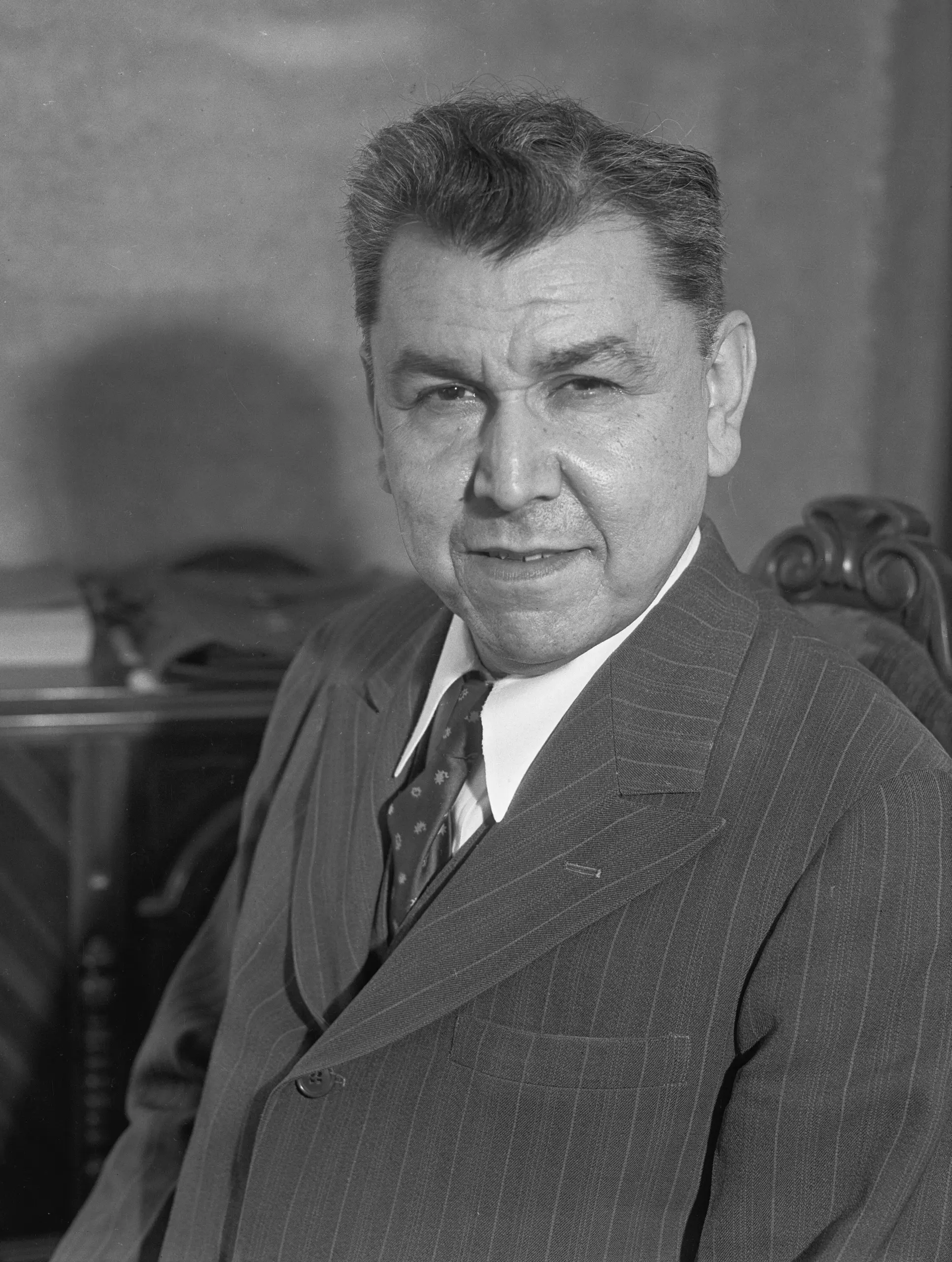
Adolfo de la Huerta
 Mexico
Birthday
May 26, 1881
Birth Sign
Gemini
Birthplace
Guaymas, Sonora, Mexico
Age
Died at 74
About
Adolfo de la Huerta was a Mexican politician and revolutionary who served as the 45th President of Mexico for a brief but pivotal six months in 1920. His full name was Felipe Adolfo de la Huerta Marcor, and he was born in the port city of Guaymas, Sonora, on May 26, 1881. A trained accountant who turned to politics, he rose to prominence during the Mexican Revolution as a key figure in the Constitutionalist faction.
De la Huerta's presidency came at a moment of national crisis. He took office on June 1, 1920, following the assassination of President Venustiano Carranza, and held power until November 30 of that year. His brief tenure marked a transitional period in Mexican history, as the country moved from the chaos of revolution toward a more stable political order under the Sonoran generals who dominated the era.
Though his time in office was short, de la Huerta left a lasting mark on Mexico's political landscape. He is remembered as a leader who sought to bring stability during a turbulent time, and his legacy is preserved through place names, schools, and archival efforts by Mexican cultural institutions.
Early Life & Background
Born in the coastal port of Guaymas, Sonora, Adolfo de la Huerta grew up in a Mexico on the brink of revolution. His family background is not well documented, but he pursued an education in accounting, a profession that would serve him well in his later political career. As a young man, he became increasingly interested in the political currents of his time, particularly the growing opposition to the long dictatorship of Porfirio Díaz.
In 1906, de la Huerta took his first formal step into politics by joining the Mexican Liberal Party, a radical group that advocated for social and political reform. This decision set him on a path that would lead him to the heart of the Mexican Revolution. The party's ideas, which included land reform and labor rights, resonated with him and shaped his political philosophy.
For the next several years, de la Huerta worked as an accountant while staying involved in political circles. The revolution that erupted in 1910 would soon draw him into full-time revolutionary activity, but his early years were marked by a quiet preparation that combined his professional skills with his growing political convictions.
Career Growth
Adolfo de la Huerta's political career reached its zenith in 1920, when he became interim president of Mexico. His rise to power was orchestrated through the Plan of Agua Prieta, a rebellion against President Venustiano Carranza that was led by Sonoran generals Álvaro Obregón and Plutarco Elías Calles. When Carranza was assassinated in May 1920, de la Huerta, as one of the rebellion's key figures, was chosen to serve as interim president until elections could be held.
His six-month presidency, from June 1 to November 30, 1920, was dedicated to stabilizing the country after years of revolutionary turmoil. He worked to pacify remaining rebel groups and oversaw the transition to Obregón's presidency. Though his time in office was brief, it was a crucial period of consolidation for the post-revolutionary state.
After leaving the presidency, de la Huerta remained a prominent political figure. In 1923, he led a rebellion against President Obregón, known as the De la Huerta Rebellion, which sought to challenge the government's policies. The revolt was unsuccessful, and de la Huerta went into exile. He later returned to Mexico and lived out his remaining years in relative obscurity, dying in Mexico City in 1955.
Career Timeline
Public Image & Style
Adolfo de la Huerta is remembered as a transitional figure in Mexican history, a Constitutionalist revolutionary who briefly held the presidency during a turbulent period. His public image is that of a pragmatic politician who sought to bring stability following Carranza's assassination. He is often portrayed as a moderate within the revolutionary movement, willing to work with different factions to achieve national unity.
His legacy is commemorated through place names, school names, and archival efforts by Mexican cultural institutions. The Mexican government's General Archive of the Nation has published articles honoring him, and the UNAM Filmoteca has preserved footage of his rebellion. There is no organized fandom associated with him, but he is respected as a historical figure who contributed to the foundation of modern Mexico.
Fame & Fandom (iFAMOUS Rankings)
Adolfo de la Huerta remains a figure of profound historical weight rather than modern celebrity, occupying a unique space where political legacy meets the quiet reverence of Mexican history. The iFANN Global Fame Engine has evaluated his standing as of August 2026 and determined that he currently holds no placement in the published rankings, meaning he does not appear within the Global Top 1,000 or any specific Top-100 scope list. This absence from the charts reflects his status as a statesman whose influence is measured in archival records and national memory rather than contemporary search volume or viral consumption signals. While he never commanded the chaotic adoration reserved for pop stars, the depth of his impact on the Constitutionalist faction and the transition of the Mexican Revolution ensures his name persists with dignity. There is no formal fandom name documented for De la Huerta, as the public interest surrounding him stems from civic duty and historical study rather than parasocial engagement. No fan rituals, birthday billboards, or organized campaigns exist to celebrate his life, because his relationship with the people was defined by governance and the turbulent politics of the 1920s rather than entertainment. The few mentions of his name in recent years typically concern the Colonia Adolfo de la Huerta in Hermosillo, where residents discuss local infrastructure, or obituaries of unrelated individuals sharing his surname. His legacy is one of sober reflection; historians and citizens alike remember him as the accountant who stepped into the presidency during a crisis, navigating the aftermath of Carranza's assassination with pragmatic steadiness before his own rebellion and subsequent exile. The lack of a digital fanbase underscores the reality that some figures are remembered not for their fame, but for their function in the arc of a nation.
Interesting Facts and Legends
Adolfo de la Huerta's full name, Felipe Adolfo de la Huerta Marcor, reflects his Spanish and possibly French heritage. He was one of the few Mexican presidents who had trained as an accountant, a background that gave him a reputation for fiscal prudence. He was part of the so-called Sonoran triumvirate, along with Álvaro Obregón and Plutarco Elías Calles, which dominated Mexican politics in the 1920s. After his death, numerous places in Mexico were named in his honor, including the colonia Adolfo de la Huerta neighborhoods in Hermosillo and a primary school in Sonora. The General Archive of the Nation has published commemorative articles about him, and the UNAM Filmoteca has featured archival footage of the De la Huerta Rebellion for World Audiovisual Heritage Day. A widely retold story from his later years involves his time in Los Angeles, California, following the failure of the Delahuertista revolt. After fleeing into exile, this former head of state worked as a voice teacher, a stark contrast to his earlier military and political roles, until he received a pardon from President Lázaro Cárdenas. Another enduring chapter in his biography concerns the Plan of Agua Prieta, the verified military-political campaign he led to end the presidency of Venustiano Carranza. This event is often cited by historians as the critical turning point that paved the way for his brief interim presidency, marking a definitive shift in the revolutionary landscape.
Family & Personal Life
Details about Adolfo de la Huerta's family life remain scarce in the historical record. He was born to a middle-class family in Guaymas, Sonora, but the names and occupations of his parents are not well documented. He had at least one sibling, but little is known about them.
De la Huerta married Clara de la Huerta, and the couple had several children, though their names are not widely recorded. His family lived in Mexico City during his later years, and he maintained a relatively private personal life away from the political spotlight.
His descendants have remained in Mexico, and some have contributed to preserving his historical legacy. However, the lack of detailed records means that much of his family story remains obscure.
Notable Connections
Adolfo de la Huerta was closely associated with the Sonoran generals Álvaro Obregón and Plutarco Elías Calles, with whom he formed the triumvirate that dominated Mexican politics in the 1920s. He also had a contentious relationship with President Venustiano Carranza, whose assassination led to his own brief presidency. His later rebellion against Obregón defined his post-presidential years.
Relationships & Dating History
Adolfo de la Huerta was married to Clara de la Huerta, but the details of their relationship are not well documented. They had several children together. There are no records of other public relationships or romantic involvements. As a private figure from the early 20th century, his personal life remained largely out of the public eye.
Death & Aftermath
Died
July 9, 1955 (aged 74)
Death Place
Mexico City
Cause of Death
Natural causes (undisclosed)
The passing of former Mexican President Felipe Adolfo de la Huerta Marcor was recorded by historical archives on July 9, 1955, within the capital city of Mexico City. At seventy-four years old, the veteran revolutionary and interim head of state died. The standard biographical sources list his death simply as occurring in Mexico City without elaborating on final days or hospitalization.
As the former President and a respected political figure who died in the capital city, his passing did not trigger the legal scrutiny seen in cases involving suspicious deaths or political assassinations. Public reaction included commemorative statements from the Mexican government and historical institutions. Notably, the National Archive of Mexico has issued retrospective tributes marking anniversaries of his death, such as a 2017 article commemorating the 62nd anniversary of his passing, highlighting his role as a politician and interim president.
His funeral followed standard state protocol for a former president, with burial taking place in Mexico City, though specific details regarding the ceremony's attendees or eulogists remain lost to time. Posthumously, de la Huerta's memory persists through his inclusion in major encyclopedias and geographical landmarks like the De la Huerta airport in Mazatlán. His legacy remains preserved through historical texts and educational resources rather than immediate foundations or scholarships established in his name.
Net Worth (Estate Value)
As a historical figure who died in 1955, Adolfo de la Huerta's net worth is not a contemporary topic. He lived as a politician and revolutionary, and his personal wealth was not publicly documented. His estate has no notable ongoing revenue streams, and no financial figures are available from the sources.
Awards & Accolades
Known For
Interim President of Mexico
1920 · President
Keywords
Sources
Quick Facts
- Profession
- Politician, Military Personnel
- Born
- May 26, 1881
- Birthplace
- Guaymas, Sonora, Mexico
- Died
- July 9, 1955
- Death Place
- Mexico City
- Gender
- Male
- Birth Sign
- Gemini
Personal Details
- Full Name
- Felipe Adolfo de la Huerta Marcor
- Education
- Trained as an accountant
Frequently Asked Questions
Who was Adolfo de la Huerta?
How long was Adolfo de la Huerta president of Mexico?
What was the De la Huerta Rebellion?
When and where was Adolfo de la Huerta born?
How did Adolfo de la Huerta die?
Join the community
fans discussing