
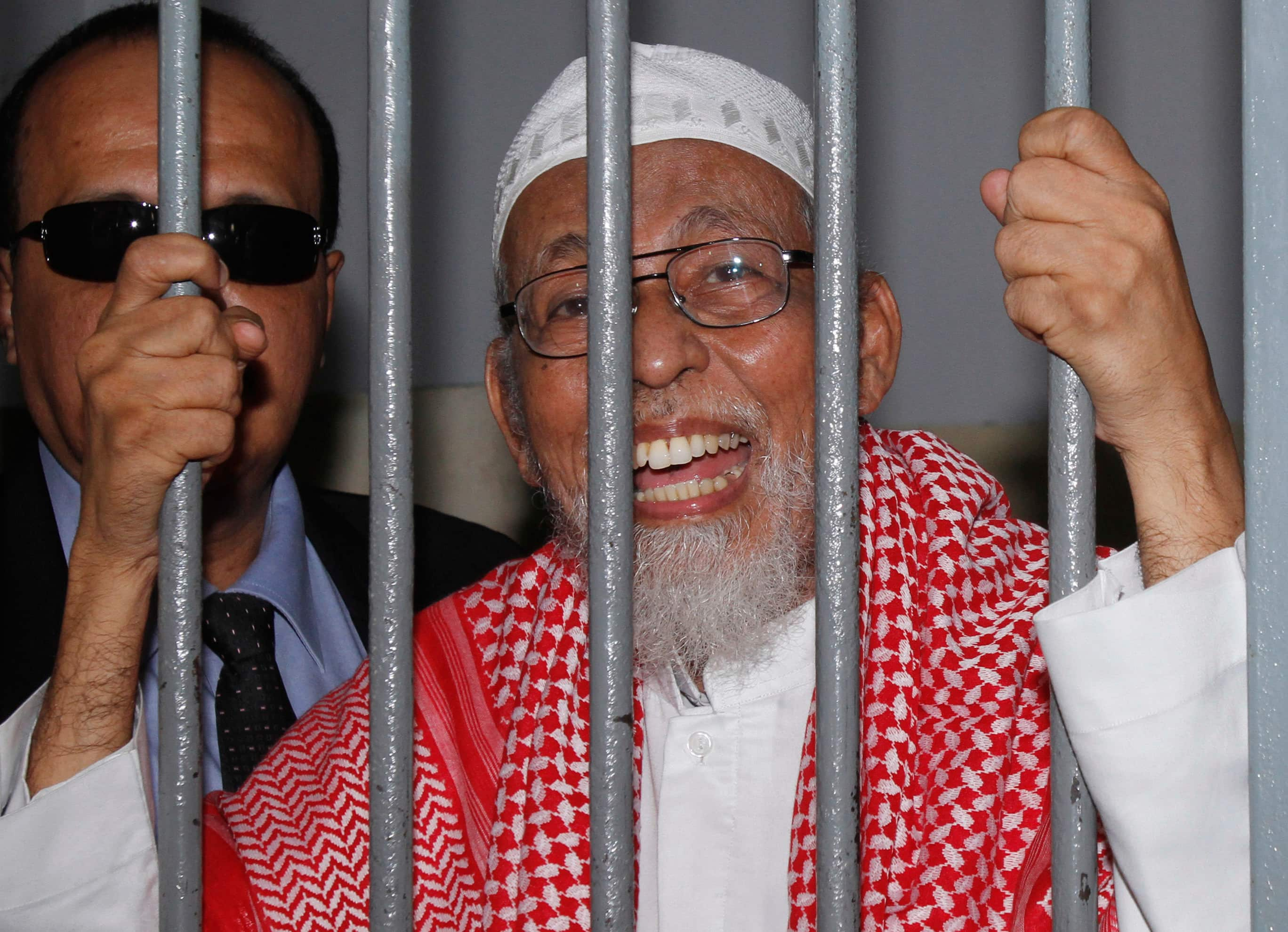
Abu Bakar Ba'asyir
 Indonesia
Islamic cleric•terrorist leader
Also known as: Abu Bakar Bashir, Abdus Somad, Ustad Abu
Birthday
August 17, 1938
Birth Sign
Leo
Birthplace
Jombang, East Java, Indonesia
Age
88 years old
About
Abu Bakar Ba'asyir is a senior Indonesian Islamic cleric and the spiritual leader of Jemaah Islamiyah, a militant network designated as a terrorist organization by the United Nations and numerous nations. Born Abu Bakar bin Abud in 1938, he adopted the name Ba'asyir later in life and is often referred to by his disciples as Ustad Abu or Guru. He is widely considered one of the most influential radical Islamist figures in Southeast Asia, known for orchestrating a vast network of religious education that served as an incubator for future militants.
Ba'asyir spent 17 years in exile in Malaysia between 1984 and 1998, where he refined his political theology and continued to mentor students. Upon returning to Indonesia following the fall of President Suharto, he emerged as the public face of Jemaah Islamiyah, a group seeking to establish a pan-Islamic caliphate across the region. Although intelligence agencies have consistently identified him as the spiritual authority behind the 2002 Bali bombings, he was acquitted of direct involvement due to lack of evidence linking him to the specific plot.
In 2011, he was convicted and sentenced to 15 years in prison for inciting terrorism and fundraising for a militant training camp in Aceh. In August 2014, while imprisoned, he publicly pledged allegiance to Abu Bakr al-Baghdadi and the Islamic State, a move that solidified his status as a global extremist icon. He was released in January 2021 after serving his sentence, sparking international criticism from allies like Australia. As of 2026, he remains a significant figure in Indonesia's security landscape, listed on UN sanctions lists and occasionally interacting with political leadership despite his advanced age.
Early Life & Background
Abu Bakar Ba'asyir entered the world on August 17, 1938, in Jombang, a city in East Java known for its deep-rooted Islamic traditions. His birth name was Abu Bakar bin Abud, and he grew up in an environment where religious scholarship held high social value. He pursued his early education at Pondok Modern Darussalam Gontor, one of Indonesia's most prestigious Islamic boarding schools, where he studied until approximately 1959. This institution provided him with a rigorous foundation in traditional Islamic sciences and Arabic literature.
Following his time at Gontor, Ba'asyir sought deeper religious engagement and eventually moved to Ngruki in Sukoharjo, Central Java. There, in 1972, he co-founded the Al-Mukmin boarding school alongside Abdullah Sungkar. The school was established not merely as an educational center but as a hub for conservative Islamic thought that challenged the secular policies of President Suharto's New Order regime. During these formative years, Ba'asyir began developing the ideological framework that would later define his career, emphasizing the implementation of Sharia law and opposition to Western influence in Indonesia.
The 1970s and early 1980s marked a period of increasing tension between Ba'asyir's circle and the government. Their advocacy for an Islamic state led to their arrest and subsequent banishment from Indonesia. Before gaining international notoriety, Ba'asyir was a respected but controversial figure within domestic Islamic circles, viewed by some as a devout scholar and by others as a dangerous radical. His early work focused on building a network of loyal students who would eventually become key figures in Southeast Asian militant movements.
Career Growth
Ba'asyir's transition from a religious educator to a global militant ideologue began in earnest during his exile in Malaysia from 1984 to 1998. Living there allowed him to expand his influence beyond Indonesia's borders, where he founded the Rabithah Alam Islami (Islamic World League) to train jihadists and spread his vision of a unified Islamic state. This period was crucial for the development of Jemaah Islamiyah, which he helped structure into a cohesive organization capable of executing large-scale operations. Upon returning to Indonesia in 1998 after the fall of Suharto, Ba'asyir stepped into the role of the public face of Jemaah Islamiyah. While he was never directly charged with planning the 2002 Bali bombings that killed 202 people, intelligence agencies and the United Nations have consistently identified him as the spiritual leader who authorized such operations.
His influence peaked in the early 2000s as the group carried out attacks in Bali and other locations, drawing intense scrutiny from international counter-terrorism forces. In 2010, Ba'asyir was arrested again and charged with inciting terrorism and fundraising for a militant training camp in Aceh. In 2011, a court convicted him and sentenced him to 15 years in prison. During his incarceration, he made headlines in 2014 by pledging allegiance to Abu Bakr al-Baghdadi and the Islamic State, signaling a shift in allegiance to a broader global jihadist movement. He served part of his sentence before being released in January 2021, though his release process had been delayed and controversial since 2019. Since regaining his freedom, he has maintained a low profile while remaining a focal point for security monitoring in Indonesia.
Career Timeline
Public Image & Style
Ba'asyir presents himself as a traditional Islamic scholar clad in white robes and a turban, projecting an image of piety and authority to his followers. To his disciples, he is a revered teacher and mujahideen elder whose words carry divine weight. However, to the international community and counter-terrorism experts, he is a symbol of violent extremism and the architect of Southeast Asia's deadliest attacks. His public image is deeply polarized: he is celebrated by hardline Islamists as a hero of resistance while being reviled globally as a terrorist mastermind.
He maintains a low-profile physical presence in public, often appearing only in controlled settings or during high-profile events like the Independence Day ceremony. His rhetoric consistently emphasizes the obligation of Muslims to establish an Islamic state and the illegitimacy of secular governments. This dual existence allows him to navigate the complexities of Indonesian society, maintaining a foothold in both religious and political spheres despite his criminal convictions.
Fame & Fandom
The narrative surrounding Abu Bakar Ba'asyir exists entirely outside the realm of celebrity culture or fan worship. While many public figures cultivate a devoted following that manifests in birthday campaigns, merchandise, and organized adoration, Ba'asyir commands no such fandom. The individuals aligned with him operate within rigid political and militant structures like Jemaah Islamiyah rather than as fans celebrating an entertainer or icon. His influence stems from his role as a radical ideologue and spiritual leader for terrorist networks, not from cultural popularity or a desire to be worshipped by the masses.
There are no documented fan rituals, charity drives organized by admirers, or public displays of adoration typical of a celebrity-fan relationship. Even high-profile interactions, such as his meeting with President Joko Widodo, were framed as seeking counsel on complex social issues rather than acts of fan devotion. His legacy is one of geopolitical tension and security concerns, defined by his leadership in orchestrating major attacks and his controversial reintegration into Indonesian society after imprisonment. He remains a figure of intense scrutiny rather than celebration. iFANN has evaluated his global standing thoroughly. Despite decades of activity and significant historical impact, Abu Bakar Ba'asyir does not currently hold a placement in the published rankings, including the Global Top 1,000 or any Top-100 scope list. The evaluation confirms he is not ranked among the world's most famous personalities.
Interesting Facts and Legends
His graduates from the Al-Mukmin Madrasa are frequently described in security reports as a 'who's who of Southeast Asian terrorism,' including many operatives involved in the 2002 Bali bombings. Ba'asyir holds the distinction of being the first Indonesian cleric to publicly pledge allegiance to ISIS leader Abu Bakr al-Baghdadi in 2014, a move that drew condemnation from moderate Muslims worldwide. The 2022 Independence Day Ceremony featured his attendance, an appearance noted for its symbolic weight given his status as a former terror convict and the complex relationship between the state and radical religious elements. Intelligence reports suggest he funded his activities through donations and charitable organizations, though specific financial records remain hidden from public view. Despite his age, he continues to be listed on the UN Security Council ISIL (Da'esh) and Al-Qaida Sanctions List as of 2026.
Notable Quotes
“Indonesia is a land of disbelief under the current regime.”
“Muslims must establish an Islamic state.”
Family & Personal Life
Public information regarding Abu Bakar Ba'asyir's romantic relationships and family life is extremely scarce and largely non-existent in the public domain. Unlike celebrities, his personal life has been kept private, likely to protect his family from retaliation by security forces or militant rivals. There are no credible reports of marriages, engagements, or public romances documented in news archives, biographies, or intelligence reports. Consequently, there is no data on partners, children, or divorce proceedings available to the general public.
His 'family' is primarily understood through his religious lineage and the network of students he mentored at Al-Mukmin. He is married, but the identity of his spouse is not publicly disclosed, and she does not appear in media coverage. Therefore, no chronological list of romantic relationships can be provided. As of 2026, his marital status is technically 'married,' but the details of his spouse remain unknown to the public. The focus of his personal narrative remains on his religious duties and leadership rather than domestic life.
Notable Connections
Relationships & Dating History
Public information regarding Abu Bakar Ba'asyir's romantic relationships, dating history, and family life is extremely scarce and largely non-existent in the public domain. Unlike celebrities, his personal life has been kept private, likely to protect his family from retaliation by security forces or militant rivals. There are no credible reports of marriages, engagements, or public romances documented in news archives, biographies, or intelligence reports. Consequently, there is no data on partners, children, or divorce proceedings.
His 'family' is primarily understood through his religious lineage and the network of students he mentored at Al-Mukmin. He is married, but the identity of his spouse is not publicly disclosed, and she does not appear in media coverage. Therefore, no chronological list of romantic relationships can be provided. As of 2026, his marital status is technically 'married,' but the details of his spouse remain unknown to the public.
Salary, Net Worth In 2026
$0
iFANN Editorial Team estimate
There is no verifiable data regarding Abu Bakar Ba'asyir's net worth. As a radical cleric operating outside the formal economy and under constant surveillance, his financial assets are not publicly disclosed. Estimates from celebrity net worth sites are non-existent or speculative. Intelligence reports suggest he may have funded his activities through donations and the management of charitable organizations, but specific dollar figures are unavailable. Any claim of a specific net worth would be purely conjectural. The iFANN Editorial Team estimates his current financial standing based on the lack of public assets and the nature of his illicit funding sources, concluding that no significant liquid wealth is tracked for him. His economic influence lies in his ability to mobilize funds for militant operations rather than personal accumulation.
Awards & Accolades
Known For
Jemaah Islamiyah
1998 · Spiritual Leader
Bali Bombings
2002 · Alleged Mastermind
Keywords
Sources
Quick Facts
- Profession
- ulema
- Born
- August 17, 1938
- Birthplace
- Jombang, East Java
- Gender
- Male
- Birth Sign
- Leo
Personal Details
- Full Name
- Abu Bakar bin Abud
- Children
- Education
- Pondok Modern Darussalam Gontor, Al-Mukmin Boarding School (Co-founder)
Frequently Asked Questions
Who is Abu Bakar Ba'asyir?
Is Abu Bakar Ba'asyir still alive?
Why was Abu Bakar Ba'asyir released?
Does Abu Bakar Ba'asyir have a wife?
What is Abu Bakar Ba'asyir's current status?
Similar People
Join the community
fans discussing