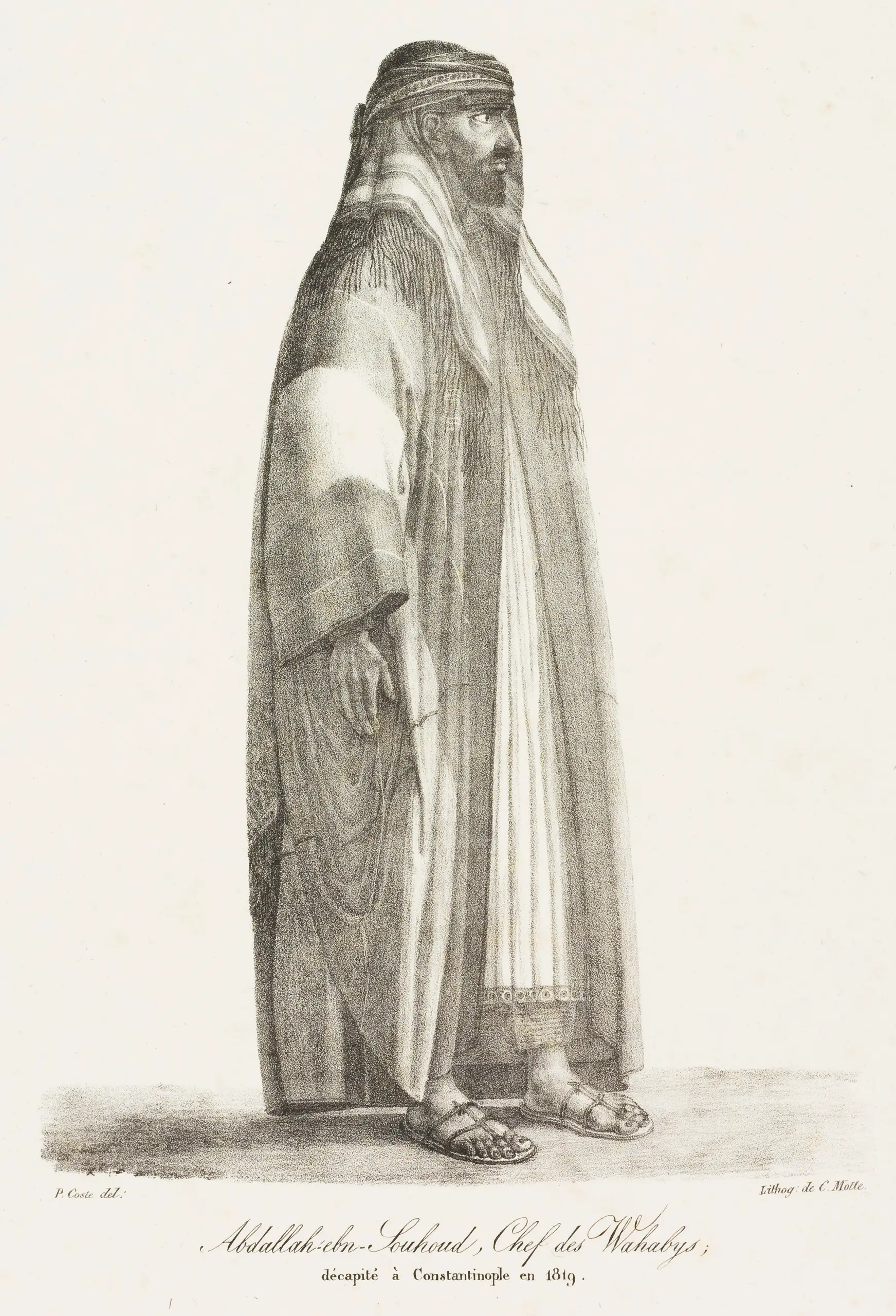
Abdullah bin Saud Al Saud
 Saudi Arabia
Ruler of the First Saudi State
Birthday
1785
Birth Sign
Capricorn
Birthplace
Diriyah, Arabian Peninsula
Age
Died at 34
About
Abdullah bin Saud Al Saud was the fourth and final Imam of the First Saudi State, ruling from 1814 until his defeat in 1818. Born in Diriyah around 1785, he came to power during a desperate war against the Ottoman Empire, which saw his capital fall and his reign end in tragedy. His execution in Istanbul in May 1819 marked the official end of the First Saudi State, but his story is one of resilience, as the dynasty he belonged to would rise again within a few years.
Today, Abdullah is remembered in Saudi historiography as a defender of the state against overwhelming odds. His defeat did not extinguish Saudi ambitions; instead, it set the stage for the Second Saudi State under Turki bin Abdullah, and eventually the modern Kingdom of Saudi Arabia. His life represents a pivotal chapter in the long history of the House of Saud.
Early Life & Background
Abdullah bin Saud was born into the House of Saud, the ruling dynasty of the First Saudi State, which had been established by his grandfather Abdulaziz bin Mohammad bin Saud. His father, Saud bin Abdulaziz, ruled from 1803 to 1814 and expanded the state significantly, controlling Mecca and Medina and extending influence across the Arabian Peninsula. Abdullah grew up in Diriyah, the capital, during a period of rapid territorial expansion and consolidation of Wahhabi religious authority.
His upbringing was steeped in the strict religious and political doctrines of the Wahhabi movement, which formed the ideological foundation of the Saudi state. As a prince, he would have received training in governance and military affairs, preparing him for leadership. The pivotal moment leading to his eventual fate came in 1811 when the Ottomans tasked Muhammad Ali Pasha, the Ottoman governor of Egypt, with crushing the Saudi state. Abdullah's formative years thus coincided with the zenith of the First Saudi State's power and the beginning of its existential threat.
Career Growth
Abdullah bin Saud succeeded his father as the fourth Imam and ruler of the First Saudi State upon Saud bin Abdulaziz's death in 1814. He inherited a realm already under existential military threat from the Ottoman-Egyptian campaign, which had been underway since 1811. The war against the forces of Muhammad Ali Pasha, led initially by Tusun Pasha and later by Ibrahim Pasha, defined his entire reign.
After a prolonged siege, the Saudi capital of Diriyah fell to Ibrahim Pasha's forces in September 1818. Abdullah was forced to surrender, effectively ending the First Saudi State. He was taken to Istanbul, the Ottoman capital, where he was executed in May 1819. According to some accounts, the Ottomans forced him to witness the decapitation of his own companions before his execution. A striking detail reported in popular accounts notes that Abdullah had issued rulings declaring music haram (forbidden) during his rule; the Ottomans, as a deliberate humiliation, forced him to listen to music before and during his execution.
Despite the Ottoman victory, the Saudi state was revived within a few years. Turki bin Abdullah, a member of the Saudi family who had survived the fall of Diriyah, established the Second Saudi State in 1824. Abdullah's defeat thus did not extinguish Saudi political ambitions; rather, it set the stage for a revival that would ultimately culminate in the modern Kingdom of Saudi Arabia.
Career Timeline
Public Image & Style
As a historical figure, Abdullah bin Saud Al Saud is portrayed in Saudi national historiography as a defender of the First Saudi State who faced overwhelming Ottoman military power. Within Saudi historical narratives, he is remembered as a legitimate ruler and Imam who fought to preserve Saudi sovereignty. His portrayal in Western and Ottoman sources is naturally more critical, viewing him as a rebel against Ottoman authority. There is no modern fandom, fan culture, or social media presence associated with him.
Fame & Fandom
Abdullah bin Saud Al Saud remains a figure of historical gravity rather than modern celebrity, with no organized fanbase, social media campaigns, or contemporary fandom rituals attached to his legacy. As the final Imam of the First Saudi State, his story is preserved in academic texts and national historiography rather than through the mechanisms of pop culture engagement that define modern fame. There is no documented name for a fan community, as the concepts of fan clubs, streaming drives, or viral moments are anachronistic to a ruler who died over two centuries ago. His enduring presence is defined by the narrative of his execution in Istanbul and the resilience of the dynasty he led, which resurfaced shortly after his death to establish the Second Saudi State. While recent publications have revisited his life, these efforts reflect scholarly interest rather than active fandom participation. The iFANN Global Fame Engine has evaluated his standing against current global metrics and determined that he does not hold a placement in the published rankings, including the Global Top 1,000 or any Top-100 scope list. Abdullah bin Saud Al Saud is currently unranked within the iFANN system, reflecting the absence of contemporary consumption signals required for inclusion in the database.
Interesting Facts and Legends
Popular accounts report that Abdullah bin Saud had declared music haram (forbidden) during his rule, and the Ottomans forced him to listen to music as a humiliation before his execution. He was approximately 33–34 years old when he was executed. His execution symbolized the complete destruction of the First Saudi State, yet the dynasty's survival through other branches led to the eventual founding of the modern Kingdom of Saudi Arabia in 1932. Despite the Ottomans stationing garrisons across the Nejd after their victory, they were unable to prevent Turki bin Abdullah from establishing the Second Saudi State in 1824. A persistent narrative in regional folklore describes his capture as a journey from Diriyah to Istanbul that became the definitive end of an era. Some historical retellings emphasize the irony of his strict religious governance clashing with the cultural practices of his captors, a detail often cited in biographies published as recently as 2024. These stories serve as the primary legends surrounding his life, framing him as a martyr for sovereignty rather than a figure of entertainment.
Family & Personal Life
Abdullah bin Saud was a member of the Al Saud dynasty, the family that continues to rule Saudi Arabia today. His full lineage is given as Abdullah bin Saud bin Abdulaziz bin Mohammad bin Saud. His father, Saud bin Abdulaziz, was the second ruler of the First Saudi State, reigning from 1803 to 1814. His grandfather, Abdulaziz bin Mohammad bin Saud, established the state. The House of Saud's genealogical records from this period are limited, and detailed information about Abdullah's wives, children, and extended family is sparse. His cousin or kinsman Turki bin Abdullah would go on to found the Second Saudi State.
Notable Connections
Abdullah bin Saud's father, Saud bin Abdulaziz, was the second ruler of the First Saudi State. Muhammad Ali Pasha, the Ottoman governor of Egypt, orchestrated the military campaign that destroyed the state, while his son Ibrahim Pasha led the forces that captured Diriyah. Turki bin Abdullah, a kinsman, founded the Second Saudi State in 1824, continuing the dynasty.
Relationships & Dating History
As a historical figure from the early 19th century, Abdullah bin Saud Al Saud's personal and romantic relationships are not documented in accessible historical records. Contemporary sources focus on his political and military role. No reliable information exists regarding his spouses, concubines, or romantic relationships.
Death & Aftermath
Died
May 1819 (aged 34)
Death Place
Istanbul, Turkey
Cause of Death
Beheading by sword
The execution of Abdullah bin Saud marked the definitive end of the First Saudi State. While he was later celebrated in modern Saudi historiography as a defender of the state and a martyr for the Wahhabi cause, his death in May 1819 was treated as a judicial necessity rather than a national tragedy by the ruling powers of the time. Following his surrender to Ibrahim Pasha in December 1818 after the fall of Diriyah, Abdullah was transported first to Cairo and then to Constantinople, where he faced an immediate trial before Ottoman military tribunals charged with treason and rebellion against the Sultan. The legal proceedings were a formality that resulted in a sentence of death without appeal, culminating in his beheading on May 20, 1819, at the Bab-ı Hümayun near the Topkapı Palace under the order of Sultan Mahmud II.
His body was reportedly buried in the Eyüp Cemetery in Istanbul, while his head was displayed publicly, a standard practice for executed rebels in the empire. Upon his death, his estate was confiscated by the Ottoman authorities, and his family members were dispersed into exile across the realm or returned to the Najd region under strict supervision. The ruins of his capital, Diriyah, now stand as a UNESCO World Heritage site commemorating the era of his rule, ensuring his legacy is preserved through historical texts and educational materials.
Net Worth (Estate Value)
N/A
iFANN Editorial Team estimate
Abdullah bin Saud Al Saud died in 1819, over two centuries ago. No estate, ongoing revenue streams, royalties, or managed assets exist. The modern Saudi royal family's vast wealth, frequently estimated in the hundreds of billions of dollars collectively, descends from the dynasty he belonged to, but Abdullah himself left no personal estate that can be valued today. iFANN's editorial research confirms the absence of any individual financial legacy attributable to the former Imam.
Awards & Accolades
Known For
Ruler of the First Saudi State
1814–1818 · Fourth Imam and Ruler
Keywords
Sources
Quick Facts
- Profession
- Ruler
- Born
- c. 1785
- Birthplace
- Diriyah
- Died
- May 1819
- Death Place
- Istanbul
- Gender
- Male
Personal Details
- Full Name
- Abdullah bin Saud bin Abdulaziz bin Mohammad bin Saud Al Saud
Frequently Asked Questions
Who was Abdullah bin Saud Al Saud?
How did Abdullah bin Saud Al Saud die?
When did the First Saudi State end?
Who ruled after Abdullah bin Saud Al Saud?
Is Abdullah bin Saud Al Saud related to the current Saudi royal family?
Join the community
fans discussing