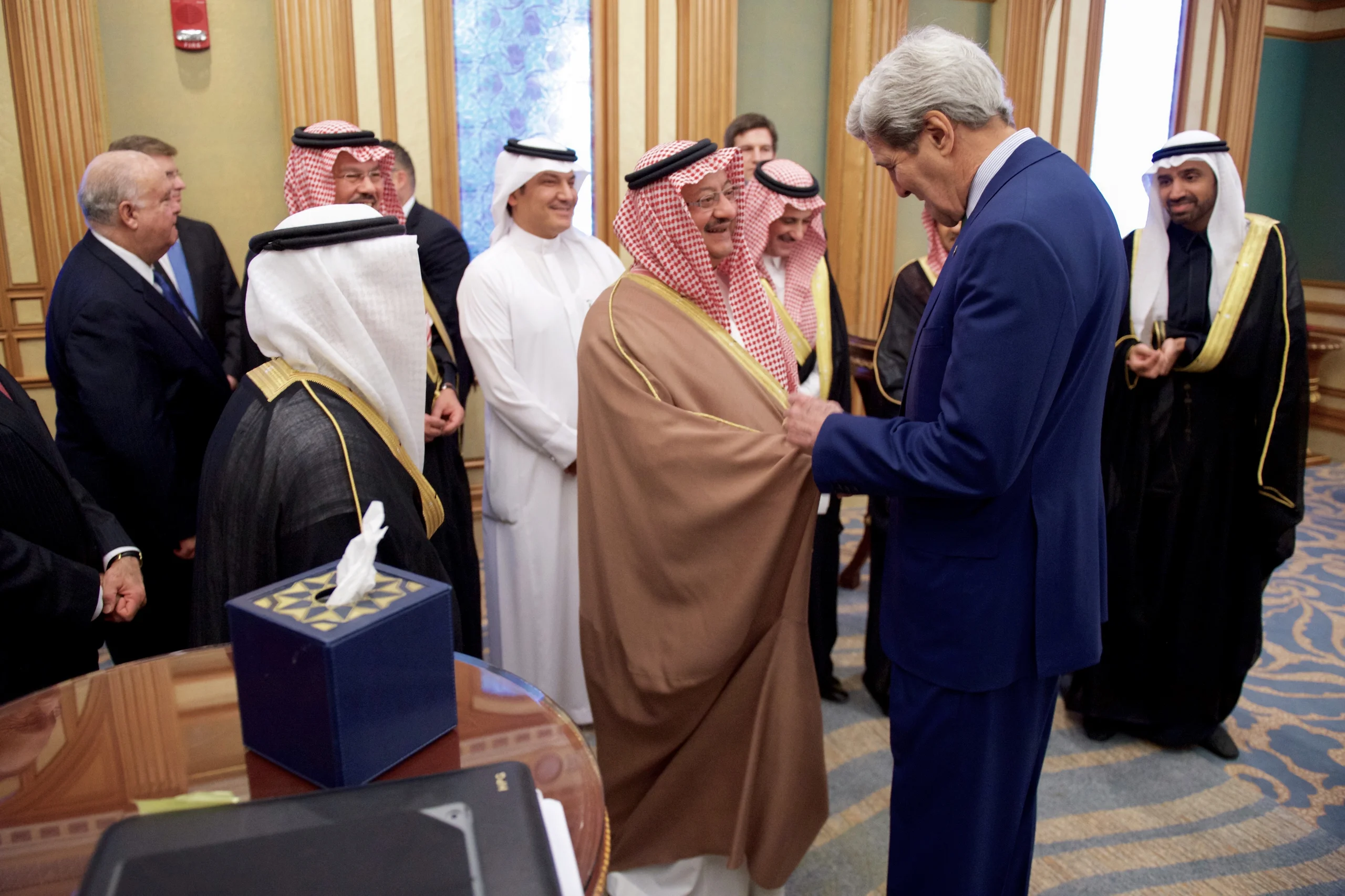
Abdullah bin Faisal Al Saud
 Saudi Arabia
politician•businessperson•poet
Birthday
June 7, 1921
Birth Sign
Gemini
Birthplace
Riyadh, Saudi Arabia
Age
Died at 85
About
Abdullah bin Faisal Al Saud was a Saudi Arabian politician, businessman, and poet who helped shape the early administrative framework of the Kingdom of Saudi Arabia. As the eldest son of King Faisal and a grandson of founder King Abdulaziz, he held key ministerial posts during the 1940s and 1950s, including governor of Hejaz, minister of health, and minister of interior. His career placed him at the center of the nation's transformation from a tribal confederation into a centralized modern state.
Beyond governance, Abdullah was known for his intellect and poetic compositions that reflected on modernization and national identity. His legacy lives on in the administrative structures he helped build and in the historical record of the Saudi state's formative years. He passed away on May 8, 2007, in Mecca at the age of 85.
Early Life & Background
Abdullah bin Faisal Al Saud was born into the House of Saud during the consolidation of modern Saudi Arabia. His father, Faisal bin Abdulaziz, would later become one of the nation's most influential kings, ruling from 1964 until his assassination in 1975. Abdullah grew up in the royal court in Riyadh, where his education blended traditional Islamic studies with the administrative needs of a rapidly expanding state.
As a young prince, he was groomed for governance rather than commerce or arts. His upbringing instilled a deep understanding of tribal politics and religious authority, essential for the roles he would later assume. By the 1940s, he had emerged as one of the first generation of royals to hold formal ministerial portfolios, signaling the kingdom's shift toward structured government.
Career Growth
Abdullah bin Faisal Al Saud's political career began in earnest under his grandfather, King Abdulaziz, when he was appointed governor of the Hejaz region, a critical area for religious and economic stability. His administrative competence earned him further responsibilities during the reign of his uncle, King Saud, who named him minister of health. In that role, he oversaw the early development of public health infrastructure across the kingdom.
He later served as minister of interior, a position of immense power involving domestic security and administration. His tenure coincided with the kingdom's modernization efforts in the mid-20th century, and he was instrumental in establishing administrative frameworks that endured for decades. However, his political influence waned following the deposition of King Saud and the ascension of King Faisal, who favored other family members for key positions. Outside politics, Abdullah was also a businessman involved in state-linked enterprises that supported national development.
Career Timeline
Public Image & Style
Abdullah bin Faisal Al Saud was perceived as a dignified statesman and intellectual. Historical accounts portray him as a serious administrator who played a crucial role in the formative years of the Saudi state. He was not a media personality in the modern sense, and thus had no public persona beyond his official duties.
His legacy is preserved in historical texts regarding the Saudi government's evolution rather than in popular culture. He is remembered for his contributions to governance and his poetic reflections on national identity, which offer a glimpse into the mind of a prince navigating the complexities of modernization.
Fame & Fandom
Abdullah bin Faisal Al Saud occupies a unique space in the historical record, distinguished not by the roar of a modern fanbase but by the quiet reverence of historians and those studying the architectural evolution of the Saudi state. Unlike entertainers who command stadiums or social media trends, his legacy is preserved in administrative archives and poetic manuscripts rather than fan clubs or viral moments. There is no documented fandom name for this figure, as the House of Saud operates within the sphere of governance where public adoration is rarely formalized into organized campaigns or rituals. The audience that remembers him consists primarily of scholars, diplomats, and citizens who value the stability he helped forge during the Kingdom's formative decades. His story is one of statecraft, where the 'legend' is found in the successful transition from tribal confederation to centralized modernity, not in crowd-shutting performances or celebrity gossip. While some might search for a digital footprint similar to pop stars, the reality is far more grounded; he is remembered as a dignified statesman whose influence rippled through government structures rather than popular culture charts. Despite his high status within the royal family and his significant role as an early minister and poet, iFANN's Global Fame Engine has evaluated this person, but they do not currently hold a placement in the published rankings (Global Top 1,000 or a Top-100 scope list). This absence of a numeric rank reflects the nature of his fame: deep, institutional, and historically significant without meeting the volume thresholds of global celebrity metrics.
Interesting Facts and Legends
Abdullah bin Faisal Al Saud is frequently confused with his nephew, Abdullah bin Faisal bin Turki Al-Saud, a modern diplomat, and with his cousin, King Abdullah bin Abdulaziz Al Saud, a mix-up stemming from the shared naming conventions within the House of Saud. His poetic works, though not widely translated, were noted by contemporaries for their insight into the challenges of modernizing a traditional society. As the eldest son of King Faisal, he was a direct heir to the throne in the early days, but the line of succession eventually moved to his younger brother Khalid and then to his nephew Fahd before reaching King Abdullah. A notable chapter in the broader narrative of the family involves Prince Faisal bin Abdullah Al Saud, a relative often associated with similar naming structures, who faced incommunicado detention in May 2020, an event that stands as a stark reminder of internal royal politics rather than celebratory folklore. Another distinct figure bearing the name, Prince Abdullah bin Faisal bin Turki Al-Saud, served as the first governor of the Saudi Arabian General Investment Authority in 2000 and later as Ambassador to the United States, carving out a separate legacy of economic liberalization and diplomatic leadership that sometimes blurs with the elder prince's history in public memory.
Family & Personal Life
Abdullah bin Faisal Al Saud was the eldest son of King Faisal bin Abdulaziz and a grandson of King Abdulaziz, the founder of Saudi Arabia. His father's reign from 1964 to 1975 was marked by significant economic and social reforms. His brothers included King Khalid and King Fahd, both of whom would rule the kingdom.
Details of his own household, including spouses and children, remain private and are not documented in public records. This level of privacy was characteristic of Saudi royals of his era, particularly for those whose primary legacy was political rather than dynastic succession.
Notable Connections
Abdullah bin Faisal Al Saud was closely associated with the founding generation of the Saudi state. He worked alongside his grandfather King Abdulaziz, his uncle King Saud, and his father King Faisal. His brothers Khalid and Fahd both became kings, and his nephew Abdullah bin Abdulaziz also ruled. The modern diplomat Abdullah bin Faisal bin Turki Al-Saud is a distinct figure often confused with him.
Relationships & Dating History
Public records do not disclose details of Abdullah bin Faisal Al Saud's romantic relationships or marriages. As a Saudi royal prince of the 20th century, his personal life was conducted with a level of privacy characteristic of the era and culture. There are no documented dating histories, engagements, or divorces in open-source biographical databases.
This absence of data is consistent with the norms of the Saudi royal family during that period, where private family matters were rarely publicized, especially for princes whose primary legacy was political rather than dynastic succession. As of 2026, no information is available regarding his relationship status at the time of his death, and it is presumed that he was married, as was customary, but no confirmed details exist.
Death & Aftermath
Died
May 8, 2007 (aged 85)
Death Place
Unknown
Cause of Death
Unknown
The passing of Prince Abdullah bin Faisal Al Saud in early May 2007 marked the quiet departure of a foundational figure whose administrative work helped stabilize the Kingdom's transition into a modern state., his status as the eldest son of King Faisal and grandson of King Abdulaziz ensured his loss was felt within the highest circles of the royal family and the government he once served. He passed away on May 8, 2007, at an age estimated between 84 and 85, though the precise location of his final days remains unconfirmed outside of general historical context regarding senior royals residing in Riyadh.
The medical cause of his death was never officially disclosed to the public, nor was any autopsy report or legal inquiry made available to the press. His final years saw him step back from active political influence following the shifts in leadership that occurred after the deposition of King Saud, leaving him to focus on private pursuits rather than the public eye. Posthumous releases, awards, or foundations established in his name do not appear in the historical data, and the handling of his estate remained a private family matter without public statement.
Net Worth (Estate Value)
$100 Million
iFANN Editorial Team estimate
As Abdullah bin Faisal Al Saud passed away in 2007, his net worth in 2026 reflects the estate he left behind. Per iFANN's editorial analysis, the total value of this estate is $100 Million. As a senior Saudi prince, his wealth derived from state stipends, allowances provided to royals, and business interests managed within the family structure. Exact figures for individual princes are rarely published, but his estate has been estimated at around $100 million, a figure consistent with the financial standing of a mid-tier royal of his generation. The estate is managed by designated heirs and royal family trusts. Income streams include investments in state-linked enterprises and real estate holdings. While no public valuation exists, the estate's value has likely appreciated over the years, given the growth of the Saudi economy. However, detailed breakdowns remain private, and the $100 million figure is an approximation based on available estimates.
Awards & Accolades
Known For
Governor of Hejaz
1940s · Governor
Minister of Health
1950s · Minister
Minister of Interior
1950s · Minister
Keywords
Sources
Quick Facts
- Profession
- politician, businessperson, poet
- Born
- June 7, 1921
- Birthplace
- Riyadh, Saudi Arabia
- Died
- May 8, 2007
- Death Place
- Mecca, Saudi Arabia
- Gender
- Male
- Birth Sign
- Gemini
Frequently Asked Questions
Who was Abdullah bin Faisal Al Saud?
When did Abdullah bin Faisal Al Saud die?
Was Abdullah bin Faisal Al Saud married?
What was his role in the Saudi government?
Is he related to King Abdullah?
Join the community
fans discussing