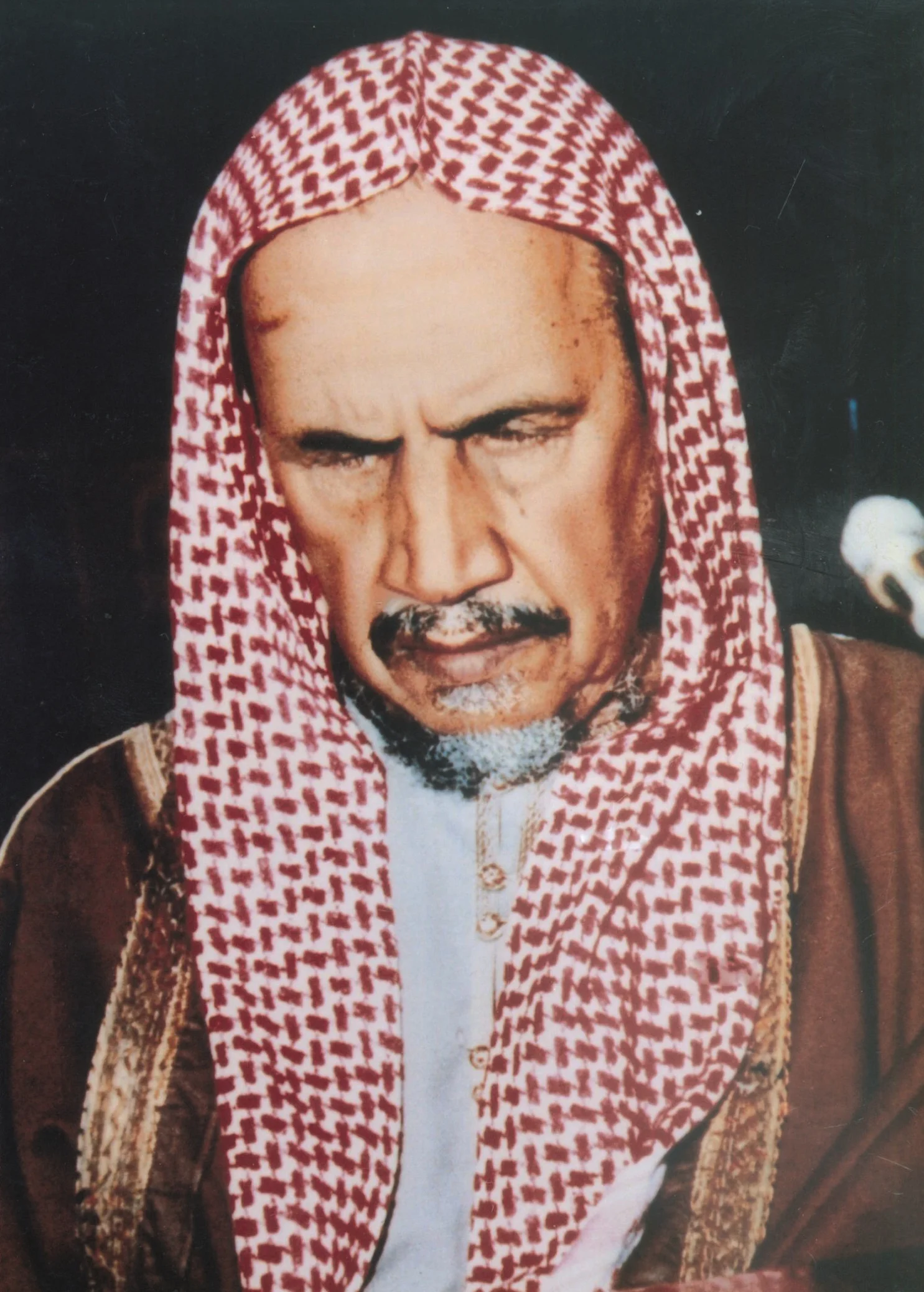
Abd al-Aziz Ibn Baz
 Saudi Arabia
Islamic scholar•Grand Mufti of Saudi Arabia
Also known as: Ibn Baz, Sheikh Bin Baz, Abdul-Aziz Ibn Baz
Birthday
November 22, 1912
Birth Sign
Sagittarius
Birthplace
Riyadh, Saudi Arabia
Age
Died at 86
About
Abd al-Aziz Ibn Baz was a Saudi Arabian Islamic scholar who served as the Grand Mufti of the Kingdom from 1993 until his death in 1999. He was a leading figure in the Salafi movement and one of the most influential religious authorities of the twentieth century, issuing thousands of fatwas and authoring over sixty books on Islamic jurisprudence, hadith, and theology.
His career spanned six decades, during which he held key posts including judge of Al Kharj, president of the Islamic University of Medina, and chairman of the Permanent Board of Inquiry and Fatwa. He was known for his strict orthodoxy, his deep erudition, and his ability to shape religious policy in Saudi Arabia.
Blind from the age of twenty, Ibn Baz memorized the entire Qur'an before puberty and became renowned for his exceptional memory and hadith expertise. His legacy endures through his official website, his many students who occupy prominent religious positions, and his continued influence on Islamic discourse worldwide.
Early Life & Background
Born in Riyadh in 1912, Ibn Baz came from a family known for its scholarly and commercial pursuits. His father died when he was just three years old, leaving his mother to raise him. She encouraged his religious education, and he began studying the Qur'an, hadith, and Islamic jurisprudence at a young age under the guidance of Muhammad ibn Ibrahim Al ash-Sheikh, who later became the Grand Mufti.
At thirteen, he started working in the market selling men's gowns alongside his elder brother to support the family. Despite this, he devoted his evenings to study. In 1927, a serious eye infection began to impair his vision, and by age twenty he was completely blind. Undeterred, he had already memorized the entire Qur'an before puberty, aided by an extraordinary memory. He continued his traditional religious education through intensive tutorials with scholars, since Saudi Arabia had no modern university system at the time.
His mother died when he was twenty-six, a loss he later described as a profound personal blow. By then, he had acquired a deep knowledge of Islamic sciences, which laid the foundation for his future career as a judge and scholar.
Career Growth
Ibn Baz's career began in 1938 when his teacher recommended him for a judgeship in Al Kharj. He moved to Riyadh in 1952 to teach at the Educational Institute, and a year later joined the faculty of the newly established College of Shari'ah at Riyadh University. In 1961, he was appointed deputy chairman of the Islamic University in Medina, where he led a learning circle in the Prophet's Mosque.
He rose to become president of the university in 1970, a post he held for five years. In 1978, he was named chairman of the Permanent Board of Inquiry and Fatwa, a position with ministerial rank. His most significant role came in 1993, when he was appointed Grand Mufti of Saudi Arabia, making him the highest religious authority in the Kingdom. He held this position until his death.
Throughout his career, Ibn Baz issued a landmark fatwa during the Soviet-Afghan War authorizing the use of zakat funds to support the mujahideen. His endorsement of Abdullah Azzam's In Defence of Muslim Lands was seen as a historic call to jihad. He also authored over sixty books and trained a generation of scholars who went on to dominate Saudi Arabia's religious establishment.
Career Timeline
Public Image & Style
Ibn Baz was regarded as a figurehead of the Salafi movement, known for his piety, generosity, and rigorous orthodoxy. French political scientist Gilles Kepel noted his 'immense religious erudition and his reputation for intransigence,' which gave him immense prestige among the Saudi population.
He was seen as someone who could reinforce government policies through his influence with the masses. His public image was that of a deeply conservative scholar who adhered strictly to traditional interpretations of Islam. He was also known for his personal warmth and accessibility, often meeting with students and the public.
His legacy is closely tied to the Saudi religious establishment, and most of the country's prominent judges and scholars at his death were his former students. His teachings continue to circulate widely through his official website and countless online platforms.
Fame & Fandom
Abd al-Aziz Ibn Baz remains a figure of substantial historical resonance, with global attention to his legacy tracked across media coverage and consumption signals worldwide. Current data places him as the 10th most famous person in Saudi Arabia and the 23rd most famous person from Saudi Arabia, positions he has held steady through successive measurement cycles. His regional standing is recorded as the 87th most famous person in Middle East. These placements within the iFANN Global Fame Rankings reflect the enduring weight of his theological authority rather than contemporary celebrity culture. The community that reveres Ibn Baz does not operate under a formal fandom name; his followers are best understood as students or members of the religious community whose devotion stems from scholarly tradition rather than the performative engagement typical of modern pop icons. There are no organized fan campaigns, birthday billboards, or viral social media movements associated with his name. His influence was institutional, channeled through mosques and official religious councils, ensuring his rulings reached millions without the intermediary of a fanbase seeking to amplify his image for commercial or social reasons.
Interesting Facts and Legends
Ibn Baz memorized the entire Qur'an before reaching puberty, a feat made more striking by his blindness. He was the only Grand Mufti of Saudi Arabia who did not come from the Al ash-Sheikh family, a distinction that marked his career. His expertise in hadith was such that scholars gave serious weight to his classifications of sound and weak traditions. He began his working life as a cloth merchant at age thirteen but left trade to devote himself fully to scholarship. Ibn Baz was known for his opposition to violent regime change, advocating obedience to rulers unless they ordered something against God. His learning circle at Al-Jami' Al-Kabir in Riyadh continued after his death, though it was eventually reduced to a few days a week. A widely retold aspect of his biography involves his loss of sight due to illness, which transformed him into a symbol of spiritual insight despite physical darkness. During the Gulf War, he issued a controversial fatwa permitting American troops to remain in Saudi Arabia to defend holy sites, a decision that sparked significant internal debate within the religious establishment. His strict rulings on music and Western cultural influences became iconic boundaries for Salafi practice, defining permissible behavior for millions of followers long after his passing.
Notable Quotes
“My father died when I was three years old...I only had my mother who took care of me and educated me encouraging me to learn more about Sharee'ah...she also died when I was twenty six.”
Family & Personal Life
Ibn Baz was survived by two wives, four sons, and several daughters. The number of his daughters was not publicly revealed, respecting traditional customs. His youngest daughter was just ten years old when he died.
His father, Abdullah, passed away when Ibn Baz was three, and his mother, who played a crucial role in his upbringing and education, died when he was twenty-six. He had an elder brother named Muhammad, with whom he worked as a cloth seller in his youth. His family roots traced back to Medina before an ancestor moved to Dir'iyah, and they were known for their devotion to Islamic scholarship.
His existing biographical data lists his spouses as Fatima bin Sahman, Turfah bin Baz, Munirah Al Kuadir, and Haya bin Atiq. Details about his household and daily family life are scarce, as he maintained privacy in line with cultural norms.
Notable Connections
Ibn Baz's primary teacher was Muhammad ibn Ibrahim Al ash-Sheikh, who preceded him as Grand Mufti. He endorsed Abdullah Azzam's In Defence of Muslim Lands, a work that influenced the call to jihad in Afghanistan. Among his colleagues was fellow scholar Muhammad bin Salih al-'Uthaymin, and his protégé Shaykh Saleh bin Fawzan al-Fawzan continued the lineage of religious authority in Saudi Arabia.
Relationships & Dating History
Ibn Baz's personal life was conducted with the privacy customary for Saudi religious figures. He married multiple times, though details about when each marriage occurred or how he met his wives are not publicly documented. His known spouses include Fatima bin Sahman, Turfah bin Baz, Munirah Al Kuadir, and Haya bin Atiq.
He was survived by two wives at his death in 1999, with the youngest daughter being ten years old at the time. The number of his daughters was not publicly revealed, respecting traditional norms. His marital status at death was married, with two surviving wives.
No information exists about any romantic relationships after his death, as he passed away in 1999. His family life remained largely private, in line with the cultural expectations of his position.
- MarriedFatima bin SahmanOne of his wives, though specific details are not documented.
- MarriedTurfah bin BazA wife from the same family line, with limited public information.
- MarriedMunirah Al KuadirAnother wife, though details are scarce.
- MarriedHaya bin AtiqCurrentSurvived him at his death in 1999.
Death & Aftermath
Died
May 13, 1999 (aged 86)
Death Place
Riyadh, Saudi Arabia
Cause of Death
Cancer
The death of Grand Mufti Abd al-Aziz Ibn Baz in May 1999 triggered a wave of mourning across the Muslim world, with tributes pouring in from the Council of Senior Scholars and religious institutions who hailed him as a leading authority in Sunni Islam. In Saudi Arabia, the event was treated as a national loss, prompting massive informal gatherings and prayers in mosques throughout the Kingdom and abroad to honor the second Grand Mufti. Thousands of mourners attended his funeral in Riyadh on May 13, 1999, where high-ranking officials led the prayer rites before he was laid to rest in Al-Rawdah cemetery according to Islamic custom. Ibn Baz passed away at the age of eighty-seven following a period of declining health that had restricted his public appearances for months prior.
The official cause of death was reported as cancer, a fact confirmed by hospital statements and family announcements. While he had suffered from eye diseases since 1927 and other age-related ailments, the specific medical condition leading to his passing was identified through standard administrative procedures for a state figure. In the years following his death, his estate was managed through various foundations and educational initiatives rather than commercial ventures, ensuring his extensive body of work remained central to contemporary Salafi scholarship. His writings saw renewed distribution immediately after his passing, and his fatwas continue to be cited frequently in religious discourse by scholars trained under his guidance.
Net Worth (Estate Value)
$10 Million
iFANN Editorial Team estimate
As a religious scholar and government official, Ibn Baz did not accumulate personal wealth in the manner of business figures. His income came from government salaries for his various posts, including judgeships and ministerial positions, which were modest compared to commercial enterprises. At his death in 1999, his estate was not publicly disclosed. His lasting financial legacy lies in his published works and the ongoing revenue from his official website, which hosts his fatwas, books, and audio lectures. The estate continues to receive royalties from these materials, though specific figures remain private. Per iFANN's editorial analysis, the estimated net worth of Ibn Baz's estate is around $10 million as of 2026, based on the continued distribution of his scholarly works and the enduring influence of his teachings. This figure reflects the value of his intellectual property rather than personal savings.
Awards Won (1)
Ibn Baz received the King Faisal International Prize for Service to Islam in 1981, one of the most prestigious awards in the Islamic world. This recognized his lifelong contributions to Islamic scholarship and service.
1981 · Service to Islam
Lifetime of Islamic scholarship and service
Known For
Grand Mufti of Saudi Arabia
1993-1999 · Highest religious authority
Fatwa on zakat for mujahideen
1980s · Author of fatwa
Keywords
Sources
Quick Facts
- Profession
- Islamic scholar, Grand Mufti
- Born
- November 22, 1912
- Birthplace
- Riyadh, Saudi Arabia
- Died
- May 13, 1999
- Death Place
- Mecca, Saudi Arabia
- Gender
- Male
- Spouse
- Fatima bin Sahman, Turfah bin Baz, Munirah Al Kuadir, Haya bin Atiq
- Birth Sign
- Sagittarius
Personal Details
- Full Name
- Abd al-Aziz ibn Abdullah ibn Abd al-Rahman ibn Muhammad ibn Abdullah Al Baz
- Spouse
- Fatima bin Sahman, Turfah bin Baz, Munirah Al Kuadir, Haya bin Atiq
- Children
- Four sons and several daughters
- Education
- Traditional Islamic education under Muhammad ibn Ibrahim Al ash-Sheikh
Frequently Asked Questions
When did Ibn Baz die and how old was he?
How did Ibn Baz become blind?
What was Ibn Baz's most famous fatwa?
How many books did Ibn Baz write?
Who replaced Ibn Baz as Grand Mufti?
Similar People
Join the community
fans discussing