“Rob Reiner has directed a film that is both a courtroom drama and a character study, with Jack Nicholson delivering a performance that is both terrifying and mesmerizing.”
Roger Ebert
Chicago Sun-Times
 United States
"One man will stop at nothing to keep his honor, another will stop at nothing to find the truth."
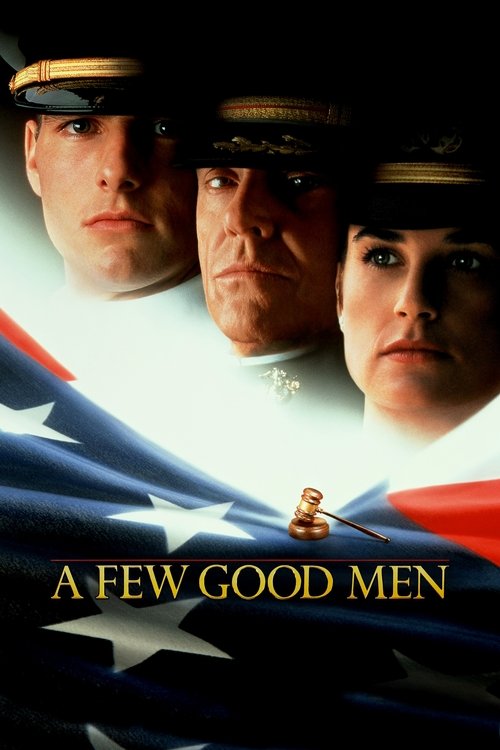
Released in December 1992, this legal thriller adapts Aaron Sorkin's 1989 stage play into a gripping cinematic experience. The film follows Lt. Daniel Kaffee, a Navy JAG officer who specializes in plea bargains rather than courtroom battles. His career takes a sharp turn when he is assigned to defend two Marines accused of murdering a fellow service member at Guantanamo Bay. The case quickly escalates beyond a simple murder trial into a confrontation with military hierarchy and the hidden costs of maintaining order.
Rob Reiner directs the production with a focus on the tension between individual conscience and institutional authority. The script balances procedural details with high-stakes dialogue that has become a staple of modern cinema. Tom Cruise and Jack Nicholson anchor the cast with performances that define the era's legal drama genre. The movie grossed over $243 million against a $40 million budget, proving its commercial appeal while earning critical respect for its writing and acting.
Stream
Availability and pricing can change. Confirm on the provider's site before purchasing.
Lieutenant Daniel Kaffee operates within the Naval Justice Corps with a reputation for closing cases before they ever reach a judge. He prefers negotiation over the unpredictability of a trial, a strategy that keeps his record clean and his stress low. This comfortable existence shatters when he receives orders to travel to Cuba to defend Lance Corporal Harold Dawson and Private First Class Louden Downey. Both men are charged with the premeditated murder of Sergeant William Santiago, whose body was discovered beaten to death on the base. The initial investigation suggests an accident or suicide, but the families and some officers suspect a ritualistic beating known as a Code Red.
Kaffee teams up with Lieutenant Commander JoAnne Galloway, a lawyer whose ambition drives her to treat this case as a career-defining opportunity. She pushes Kaffee to look past the surface narrative and investigate the chain of command. Their inquiry reveals that the defendants were following orders from their platoon leader, Lieutenant Jonathan Kendrick, who acted under the authorization of higher-ranking officers. The trail leads directly to Colonel Nathan R. Jessep, the commanding officer of the base. Jessep is a legendary figure known for his fierce dedication to protecting his Marines, even if it means bending regulations or breaking the law.
As the defense team digs deeper, they uncover a pattern of intimidation and cover-ups designed to protect the reputation of the unit. The prosecution, led by Captain Jack Ross, works tirelessly to pin the entire blame on the two low-ranking soldiers. Kaffee realizes that winning the case requires exposing the existence of the Code Red and admitting that Colonel Jessep authorized it. This revelation threatens to destroy the morale of the Marine Corps and implicate the highest levels of leadership. The preparation for the court-martial becomes a psychological battle where Kaffee must decide whether to protect his own future or risk everything to reveal the truth about how the system actually functions.
The tension builds as the trial begins, with both sides preparing their arguments for a jury of military peers. Kaffee gathers witnesses and evidence that point toward a systematic abuse of power sanctioned from the top down. He faces pressure from his superiors to drop the case and silence the investigation. The narrative focuses on the moral dilemma faced by the young Marines who believed they were doing their duty versus the reality that they may have committed a crime based on illegal orders. The story sets the stage for a final confrontation where the facts of the case will clash with the entrenched beliefs of the military establishment.
Official Trailer
TV Spot
Behind the Scenes
Critical Consensus
A Few Good Men combines a tight script with powerhouse performances to create a compelling legal drama. The film explores complex themes of military justice and moral ambiguity through intense courtroom scenes. While the dialogue occasionally feels theatrical, the strong direction and acting make it a memorable entry in the genre.
“Rob Reiner has directed a film that is both a courtroom drama and a character study, with Jack Nicholson delivering a performance that is both terrifying and mesmerizing.”
Roger Ebert
Chicago Sun-Times
“Mr. Sorkin's script is a model of how to adapt a stage play for the screen, with dialogue that crackles and characters that leap off the page.”
Janet Maslin
The New York Times
“A taut, intelligent courtroom drama that benefits greatly from the chemistry between Cruise and Nicholson, making it a standout in the legal thriller genre.”
Variety Staff
Variety
Tom Cruise
Lt. Daniel Kaffee
Jack Nicholson
Col. Nathan R. Jessep
Demi Moore
Lt. Cdr. JoAnne Galloway
Kevin Bacon
Capt. Jack Ross
Kevin Pollak
Lt. Sam Weinberg
James Marshall
Pfc. Louden Downey
J.T. Walsh
Lt. Col. Matthew Markinson
Kiefer Sutherland
Lt. Jonathan Kendrick
Christopher Guest
Dr. Stone
J.A. Preston
Judge Randolph
Matt Craven
Lt. Dave Spradling
Wolfgang Bodison
Lance Cpl. Harold W. Dawson
Director
Rob Reiner
Writer
Aaron Sorkin
Composer
Marc Shaiman
Cinematographer
Robert Richardson
Producers
Andrew Scheinman, Rob Reiner, David Brown
Academy Awards (1993)
Best Supporting Actor: Nominated
Academy Awards (1993)
Best Adapted Screenplay: Nominated
Golden Globe Awards (1993)
Best Supporting Actor – Motion Picture: Nominated
MTV Movie Awards (1993)
Best Male Performance: Won
MTV Movie Awards (1993)
Best On-Screen Duo: Won
MTV Movie Awards (1993)
Best Fight: Won
Join the community
fans discussing