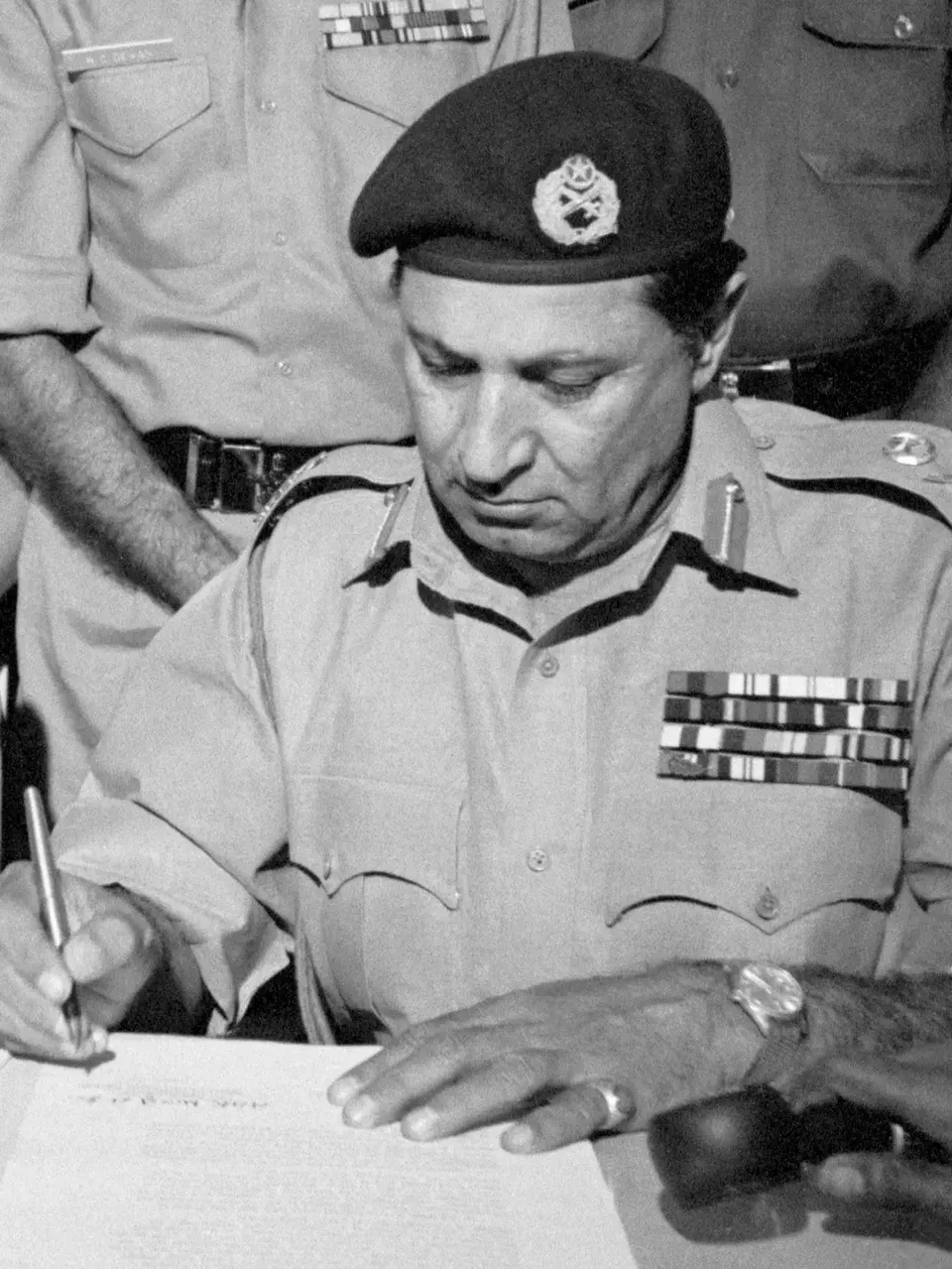
A. A. K. Niazi
 Pakistan
Also known as: General Niazi, Tiger Niazi
Birthday
January 1, 1915
Birth Sign
Capricorn
Birthplace
Lahore, British India
Age
Died at 89
About
Amir Abdullah Khan Niazi, known as General Niazi, was a Pakistani military officer who served as the last governor of East Pakistan. He commanded the Eastern Command during the 1971 Bangladesh Liberation War and signed the instrument of surrender on 16 December 1971, an event that led to the creation of Bangladesh. His name is permanently linked to that surrender, which involved around 93,000 troops, the largest such capitulation since World War II.
Niazi's military career included service in the British Indian Army during World War II and the Indo-Pakistani War of 1965. After the 1971 defeat, he was held as a prisoner of war in India until 1975. Following his return, he was dishonourably discharged after the Hamoodur Rahman Commission blamed him for military failure and alleged atrocities. He spent his later years in politics and wrote a book presenting his side of the story. He died in Lahore in 2004 at age 89, leaving a legacy that remains fiercely debated across South Asia.
Early Life & Background
Born in 1915 in Lahore, Niazi came from a military family, though details of his early childhood are sparse. He joined the British Indian Army and served in the Burma Campaign during World War II, earning the Military Cross for gallantry. After partition in 1947, he opted for Pakistan and continued his army career. He fought in the 1965 war against India, where he gained a reputation as a tough and aggressive commander. That performance helped propel him to higher ranks, eventually leading to his appointment as head of the Eastern Command in East Pakistan.
Career Growth
Niazi's career reached its defining moment during the 1971 war. As commander of Eastern Command, he faced the combined forces of the Indian Army and Bengali resistance. On 16 December 1971, he signed the surrender document in Dhaka, handing over his forces to Lieutenant General Jagjit Singh Aurora. The surrender of approximately 93,000 troops remains the largest since World War II. Niazi was then taken to a POW camp in Jabalpur, India, where reports suggest he lived in comfortable conditions. He was repatriated on 30 April 1975 under the Delhi Agreement.
After his return, the Hamoodur Rahman Commission held him responsible for the defeat and alleged human rights abuses. He was dishonourably discharged, but he consistently argued that he had followed orders from Rawalpindi and demanded a court-martial that never took place. Later, he became politically active with the Pakistan National Alliance against Zulfikar Ali Bhutto. In 1998, he published The Betrayal of East Pakistan, laying out his version of events.
Career Timeline
Public Image & Style
Niazi's public image is deeply polarized. In Pakistan, some view him as a scapegoat for leadership failures, while others see him as a failed commander. In Bangladesh, he is widely condemned as 'the butcher' for alleged atrocities during the war. Indian media remembers him as the defeated general who surrendered, with the event celebrated annually on Vijay Diwas. His surrender is frequently referenced in political trolling and commentary, and his legacy remains a point of contention in South Asian discourse.
Fame & Fandom
A. A. K. Niazi commands a legacy defined by historical gravity rather than the adoration typical of pop culture icons, as no formal fandom or organized fanbase exists to claim him. His audience consists instead of historians, military analysts, and citizens of South Asia engaged in ongoing debates regarding the 1971 war, where his surrender remains a central, polarizing chapter rather than a source of collective celebration. While he lacks the ritualistic following of modern entertainers, his name retains a specific resonance that places him within global historical rankings. Current data from the iFANN Global Fame Rankings indicates that Niazi holds the position of the 21st most famous person in Pakistani Dramas, a placement reflecting how his life story continues to be dramatized in regional media. This standing is noted as holding steady from the previous cycle, suggesting a consistent level of cultural interest in his narrative across decades. The ranking system, which tracks global attention across media coverage and consumption signals worldwide, identifies this persistent relevance despite the absence of active fan campaigns or digital rituals associated with his memory.
Interesting Facts and Legends
Niazi's nickname 'Tiger' reflected his aggressive military style during his service in the British Indian Army and subsequent conflicts. He famously handed over his epaulets and revolver during the surrender ceremony, a moment captured in Indian Air Force commemorations. During his captivity in Jabalpur, he reportedly enjoyed relatively comfortable conditions, including access to amenities, though stories circulated about indulgences like wine and women that fueled post-war accusations of moral laxity. He demanded a court-martial to clear his name, but it never happened. In 2022, a commentator drew parallels between Niazi and Imran Khan, noting both faced military-establishment opposition. Historical narratives also fixate on the quote attributed to him, 'Hum toh surrender karne ko tayyar hain,' which characterizes his leadership as pragmatic to some and cowardly to others. The sheer scale of his capitulation, involving approximately 93,000 troops, has evolved into a modern internet folklore known as the 'Pants ceremony,' used in recent years to mock the event. These elements combine with the verified fact of his death on February 1, 2004, to create a complex portrait of a man whose final act defines his entire existence.
Family & Personal Life
Details about Niazi's family remain scarce in public records. He was born in Lahore to a military family, but information about his parents, siblings, or his own spouse and children is not well-documented. His personal life was largely overshadowed by his military career and the events of 1971. He died in Lahore on 1 February 2004.
Notable Connections
Niazi is associated with Lieutenant General Jagjit Singh Aurora, who accepted his surrender, and with Pakistani leaders General Yahya Khan and Zulfikar Ali Bhutto, whose actions shaped his fate.
Relationships & Dating History
There is no documented public dating history for Niazi. He was a career military officer born in 1915, and his personal romantic life was not a subject of public record. He was married at some point, as indicated by his status as widowed at the time of his death, but details are unknown. No credible sources mention any relationships, marriages, or divorces involving him.
Death & Aftermath
Died
February 1, 2004 (aged 89)
Death Place
Unknown
Cause of Death
Unknown
Lieutenant General A. A. K. Niazi passed away on February 1, 2004, at the age of 89. Available records confirm this date and his age, though the specific location within Pakistan where he spent his final days remains unrecorded in public sources. The documents do not contain any official medical statement, coroner's ruling, autopsy report, or family confirmation regarding the specific cause of death. There are no records indicating a disputed account of his passing, nor is there information regarding his last public appearance prior to his death.
The legal and historical aftermaths described in the sources pertain exclusively to his role in the 1971 Indo-Pakistani War and the subsequent surrender, not his mortality. Details regarding the funeral service, burial site, or any formal memorial event attended by family or state officials are absent from the existing documentation.
Posthumous releases, new honors, or foundations established in his name immediately after his death have not been reported. Recent news articles from 2021 through 2025 continue to reference him in the context of the 1971 war history and comparisons to contemporary political figures, but these are retrospective analyses rather than reactions to his 2004 death. The handling of his estate is not reported, as the sources state nothing regarding his financial affairs or family statements concerning his will.
Net Worth (Estate Value)
$1 Million
iFANN Editorial Team estimate
As a military officer, Niazi's income derived primarily from his army salary and pension throughout his career. Following his discharge and return to Pakistan, he did not pursue major business ventures or commercial enterprises. His book, The Betrayal of East Pakistan, may have generated some royalties, though no specific financial figures are available for publication earnings. His estate remained modest, reflecting a career dedicated to soldiering rather than wealth accumulation. Per iFANN's editorial analysis, the total value of his estate is estimated at $1 Million as of 2026.
Awards Won (3)
Niazi received several military decorations during his career, including the Hilal-i-Jurat and Sitara-i-Pakistan from Pakistan, and the British Military Cross for his service in World War II. These awards recognized his bravery and service, though they are overshadowed by the events of 1971.
Military
Military service
Civil
Military service
Known For
Instrument of Surrender
1971 · Signatory for Pakistan
Eastern Command
1971 · Commander
The Betrayal of East Pakistan
1998 · Author
Keywords
Sources
Quick Facts
- Profession
- military personnel
- Born
- January 1, 1915
- Birthplace
- Lahore, British India
- Died
- February 1, 2004
- Death Place
- Lahore, Pakistan
- Gender
- Male
- Birth Sign
- Capricorn
Personal Details
- Full Name
- Amir Abdullah Khan Niazi
- Education
- British Indian Army training
Frequently Asked Questions
What happened to General Niazi after the 1971 surrender?
Why did General Niazi surrender in 1971?
Was General Niazi a traitor to Pakistan?
How many soldiers surrendered with General Niazi in 1971?
What did General Niazi write in his book The Betrayal of East Pakistan?
Similar People
Join the community
fans discussing