 United States
“The movie's most unlikely and most successful element is the pairing of Nick Nolte and Eddie Murphy... They are a perfect match.”
Janet Maslin
The New York Times
Part of a Collection
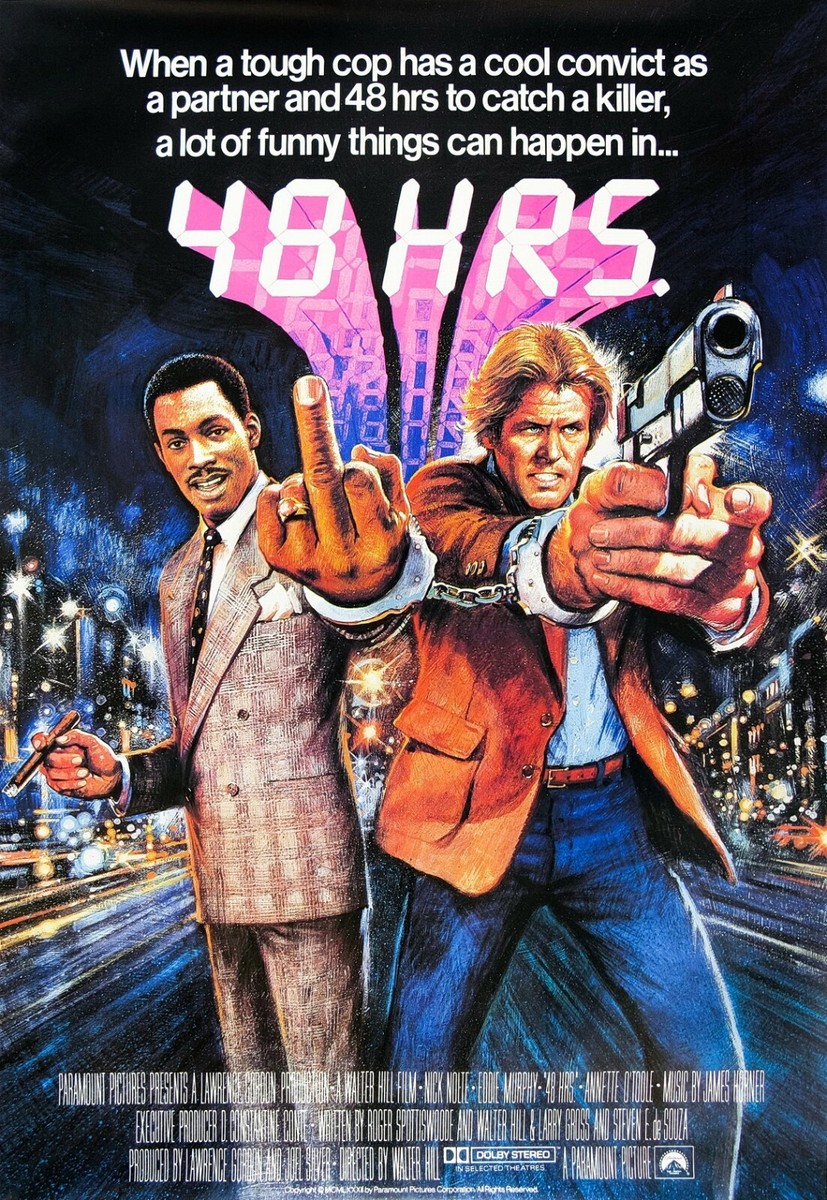
In 1982, director Walter Hill dropped a genre-defining action comedy that paired a gruff cop with a fast-talking convict for a 96-minute race against the clock. 48 Hrs. stars Nick Nolte as Jack Cates, a no-nonsense San Francisco detective, and Eddie Murphy in his explosive film debut as Reggie Hammond, a charismatic prisoner on temporary release. The plot hinges on a simple premise: Cates needs Hammond's help to track down two ruthless killers, and he has just two days to do it. The film's script, co-written by Hill, Larry Gross, Steven E. de Souza, and Roger Spottiswoode, crackles with tension and humor. Supporting players include Annette O'Toole, James Remar, Frank McRae, and David Patrick Kelly. James Horner provided the score. Produced by Joel Silver in his first producing role, the film was made for a modest budget and went on to earn over $78 million at the domestic box office, becoming one of the year's biggest hits. Critics praised its sharp dialogue and the electric chemistry between Nolte and Murphy. Often cited as the first true buddy cop movie, it paved the way for franchises like Lethal Weapon and Bad Boys. Murphy earned a Golden Globe nomination for New Star of the Year. A sequel, Another 48 Hrs., followed in 1990.
Stream
Paramount+ with Showtime
MGM+
Rent
Amazon Prime Video
3.99
Buy
Apple TV
9.99
Availability and pricing can change. Confirm on the provider's site before purchasing.
San Francisco detective Jack Cates is a hard-drinking loner with a chip on his shoulder. When a cop is murdered during a prison break, Cates catches the case. The killers are Albert Ganz and Billy Bear, two violent criminals who are now on the loose. Cates learns that Ganz once worked with a man named Reggie Hammond, who is currently serving time for robbery. Hammond knows where Ganz might be hiding and, more importantly, he knows about a stash of half a million dollars from their last heist.
Cates gets a court order to release Hammond for 48 hours, under the condition that he helps the police. From the moment they meet, the two men clash. Cates is a racist, burnt-out cop who trusts no one. Hammond is a slick, fast-talking convict who enjoys pushing Cates's buttons. Their partnership is forced and uneasy. They start by visiting old haunts and contacts from Hammond's past, including a dive bar called Torchy's, where Hammond single-handedly intimidates a room full of hostile rednecks. The scene is a turning point, showing that Hammond is more than just a wise guy.
As the hours tick by, Cates and Hammond follow a trail of violence and deception through San Francisco's underbelly. Ganz and Billy Bear are always one step ahead, leaving bodies behind. Cates's superiors, including Captain Haden, grow impatient. Hammond's freedom hangs in the balance. The two partners must learn to trust each other, or they will both lose everything. The film builds to a tense standoff at a hotel where Ganz has taken a hostage. With time running out, Cates and Hammond must put aside their differences for a final confrontation.
Critical Consensus
48 Hrs. is a landmark action-comedy that launched Eddie Murphy's film career and redefined the buddy cop genre. While its pacing and some elements feel dated, the electric chemistry between Nolte and Murphy and Walter Hill's gritty direction make it a classic.
“The movie's most unlikely and most successful element is the pairing of Nick Nolte and Eddie Murphy... They are a perfect match.”
Janet Maslin
The New York Times
“This is a good, tough, funny movie... It's also a movie that knows exactly what it wants to do, and does it.”
Roger Ebert
Chicago Sun-Times
“The movie is a model of tight, efficient storytelling, with a fine, hard edge of humor.”
Richard Schickel
Time Magazine
“The real star of '48 HRS.' is the script, which is filled with crackling dialogue and a story that never lets up.”
Gene Siskel
Chicago Tribune
“Walter Hill directs with a lean, mean efficiency, and the movie has a terrific, lived-in look.”
David Ansen
Newsweek
Nick Nolte
Jack Cates
Eddie Murphy
Reggie Hammond
Annette O'Toole
Elaine
Frank McRae
Captain Haden
James Remar
Albert Ganz
David Patrick Kelly
Luther
Sonny Landham
Billy Bear
Brion James
Ben Kehoe
Jonathan Banks
Algren
Denise Crosby
Sally
Chris Mulkey
Officer
Jim Haynie
Old Prospector
Director
Walter Hill
Writers
Roger Spottiswoode, Walter Hill, Steven E. de Souza, Jeb Stuart, Larry Gross
Composer
James Horner
Cinematographer
Ric Waite
Producers
Joel Silver, Lawrence Gordon
Golden Globe (1983)
New Star of the Year – Actor: Nominated
Saturn Award (1983)
Best Actor: Nominated
NAACP Image Award (1983)
Outstanding Motion Picture: Nominated
Join the community
fans discussing