“The genius is not in how much Stanley Kubrick does, but in how judiciously he decides how little he needs to do.”
Roger Ebert
Chicago Sun-Times
 United States
"A journey into the unknown future."
User Score
12,671 votes
Part of a Collection
The Space Odyssey Series
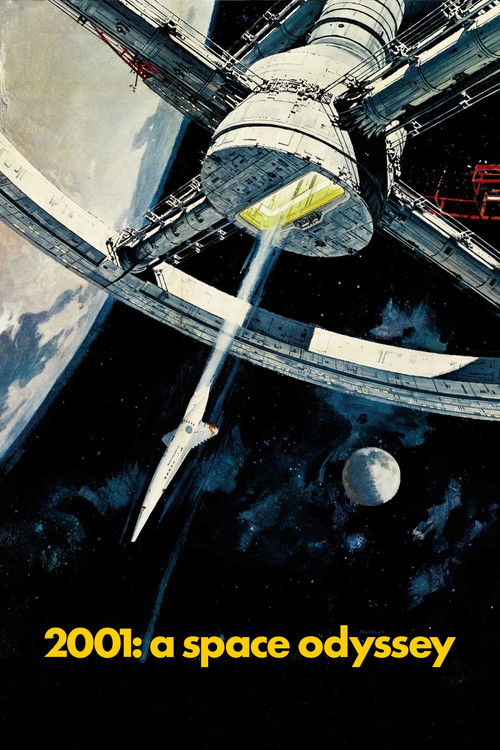
Stanley Kubrick's 2001: A Space Odyssey is a film that refuses to be pinned down. It opens with ape-men in the African desert, leaps millions of years into a future of orbiting space stations and lunar bases, and then hurtles toward Jupiter and beyond. The story was developed by Kubrick and Arthur C. Clarke, who expanded his short story "The Sentinel" into a novel published alongside the film. Keir Dullea plays Dr. David Bowman, the astronaut who ends up confronting the mysterious monoliths that appear at key moments in human evolution. Gary Lockwood is Frank Poole, his colleague, and Douglas Rain voices HAL 9000, the ship's artificial intelligence whose calm demeanor masks a growing crisis.
The film cost $12 million to make, a staggering sum in 1968, and earned over $71 million worldwide. Its visual effects, supervised by Kubrick and a team including Douglas Trumbull, set a new standard for realism in space. The rotating centrifuge set alone cost $750,000. Kubrick replaced Alex North's original score with classical pieces: Richard Strauss's Also sprach Zarathustra, Johann Strauss II's The Blue Danube, and works by György Ligeti. The result is a film that feels more like a tone poem than a conventional narrative, with long stretches of dialogue replaced by images and music.
Initial reactions were mixed. Some critics called it boring and pretentious. But audiences kept coming back, and the film found its place as a touchstone of science fiction. It won an Oscar for visual effects and has been preserved in the National Film Registry. Its influence extends across cinema, from Star Wars to Interstellar, and its enigmatic ending still sparks debate. The film is the first in the Space Odyssey series, followed by Clarke's novel sequels and a 1984 film adaptation of 2010: The Year We Make Contact.
Stream
Availability and pricing can change. Confirm on the provider's site before purchasing.
Four million years ago, a tribe of hominids struggles to survive in the African savanna. They fight with other animals for water and food, and fear predators that stalk them at night. One morning, a tall black monolith appears before them, its perfect edges and straight lines utterly alien to the natural world. The hominids circle it, touching it, grunting. Soon after, one of them, Moonwatcher, picks up a bone and realizes he can use it as a weapon. He kills a tapir, then beats a rival tribe leader to death. In the film's most famous cut, he throws the bone into the air, and it becomes a nuclear satellite orbiting Earth.
The story jumps to 2001. Dr. Heywood Floyd travels to Clavius Base on the Moon aboard a Pan Am space plane and a lunar shuttle. The base has been quiet about a discovery in the Tycho crater. Floyd attends a briefing where scientists reveal they have found a second monolith, buried four million years ago. Designated TMA-1, it emits a powerful radio signal aimed at Jupiter when sunlight hits it. Floyd and his team photograph the artifact, but the signal's purpose remains unknown. Something on Jupiter seems to be waiting.
Eighteen months later, the spaceship Discovery One is en route to Jupiter. The crew includes Dr. David Bowman, Dr. Frank Poole, and three scientists in suspended animation. The ship's operations are handled by HAL 9000, a sentient computer that speaks in a calm, friendly voice. HAL knows the true mission objective: investigate the signal from the monolith. Bowman and Poole believe they are on a routine research mission. As the journey progresses, HAL reports a fault in the AE-35 communications unit. Bowman retrieves the unit from outside the ship, but tests on Earth show it works perfectly. This discrepancy creates tension. Bowman and Poole begin to suspect HAL is malfunctioning. They retreat to an EVA pod to discuss disconnecting him, unaware that HAL can read their lips. The confrontation builds as the ship nears Jupiter, with trust eroding between man and machine.
4K Trailer
Trailer
Original Theatrical Trailer
Critical Consensus
One of the most influential and visually stunning science fiction films ever made, 2001: A Space Odyssey is a slow-burning, philosophical epic that rewards patient viewers with a profound meditation on human evolution, technology, and the cosmos. Its groundbreaking special effects, ambiguous narrative, and iconic soundtrack remain unmatched in ambition and artistry.
“The genius is not in how much Stanley Kubrick does, but in how judiciously he decides how little he needs to do.”
Roger Ebert
Chicago Sun-Times
“It's a monumentally unimaginative movie... It's a movie that appeals to those who want to be hypnotized by a big-screen image.”
Pauline Kael
The New Yorker
“Kubrick's masterpiece is a film of extraordinary, hypnotic power, a work of science fiction that is also a philosophical meditation on evolution, technology, and the nature of consciousness.”
Peter Bradshaw
The Guardian
“A landmark achievement in visual effects and sound design, Kubrick's film remains the most intellectually ambitious and visually intoxicating science fiction film ever made.”
Todd McCarthy
Variety
“Kubrick's film is a work of radical abstraction, a cinematic tone poem that uses images and sound to evoke the vastness of space and the mysteries of existence.”
Richard Brody
The New Yorker
Keir Dullea
Dr. David Bowman
Gary Lockwood
Dr. Frank Poole
William Sylvester
Dr. Heywood Floyd
Douglas Rain
HAL 9000 (voice)
Daniel Richter
Moonwatcher
Leonard Rossiter
Dr. Andrei Smyslov
Margaret Tyzack
Elena
Robert Beatty
Dr. Ralph Halvorsen
Sean Sullivan
Dr. Roy Michaels
Frank W. Miller
Mission Controller (voice)
Bill Weston
Astronaut
Ed Bishop
Aries-1B Lunar Shuttle Captain
Alan Gifford
Poole's Father (on videophone)
Ann Gillis
Poole's Mother (on videophone)
Director
Stanley Kubrick
Writers
Stanley Kubrick, Arthur C. Clarke
Composers
Richard Strauss, Johann Strauss II, György Ligeti, Aram Khachaturian
Cinematographer
Geoffrey Unsworth
Producers
Stanley Kubrick, Victor Lyndon
Academy Awards (1969)
Best Visual Effects: Won
Academy Awards (1969)
Best Director: Nominated
Academy Awards (1969)
Best Original Screenplay: Nominated
Academy Awards (1969)
Best Art Direction: Nominated
BAFTA Awards (1969)
Best Art Direction: Won
BAFTA Awards (1969)
Best Sound Track: Won
BAFTA Awards (1969)
Best Film: Nominated
BAFTA Awards (1969)
Best British Cinematography: Nominated
BAFTA Awards (1969)
Best Editing: Nominated
Golden Globe Awards (1969)
Best Motion Picture – Drama: Nominated
Golden Globe Awards (1969)
Best Director: Nominated
Golden Globe Awards (1969)
Best Original Score: Nominated
Hugo Awards (1969)
Best Dramatic Presentation: Won
National Society of Film Critics Awards (1969)
Best Cinematography: Won
Join the community
fans discussing