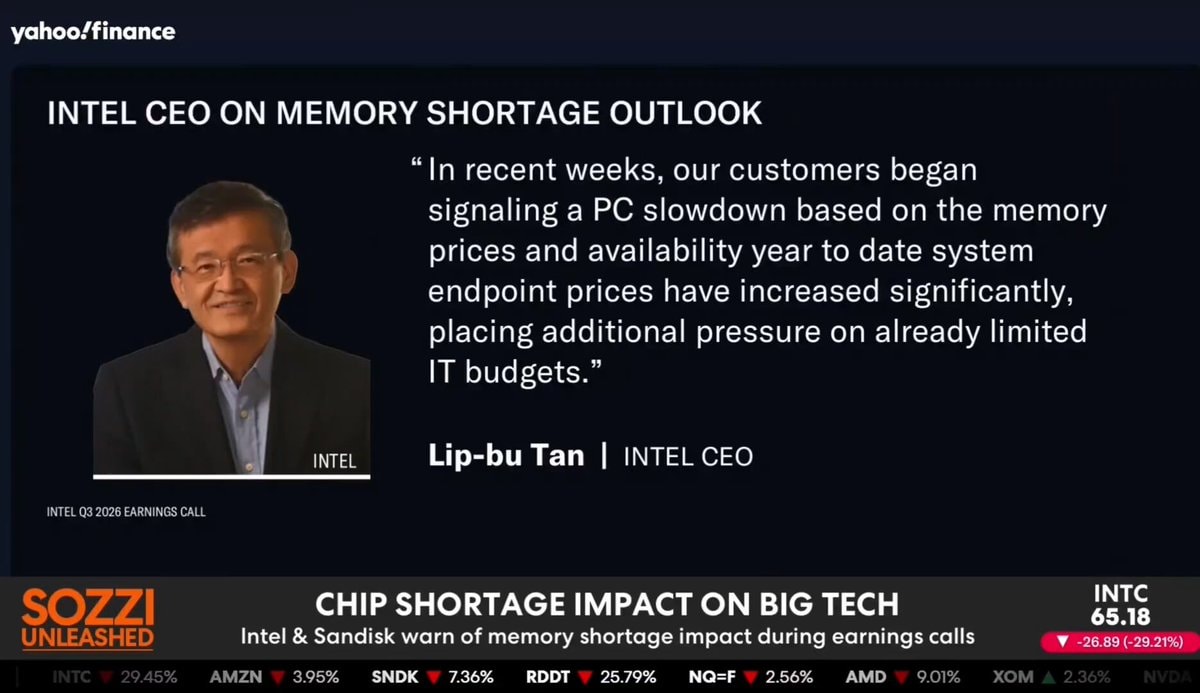
Intel CEO Lip-Bu Tan on memory shortage
SK Hynix's operating profit rose 632% last quarter to about $62.8 billion. Samsung's went up 783% to roughly $80.5 billion. Those two lines are the whole story hiding under the Intel headlines, because the money is relocating from the companies that build computers and phones to the ones supplying the memory AI keeps buying. Intel was just the first to say it out loud on an earnings call. Friday's session took 28.58% off the stock, the worst since 1974, and the US government's 10% position bled around $12 billion in one day. Guidance for the fourth quarter came in at $15 billion to $16 billion versus the $17 billion expected, with gross margin sliding from 43% to 37%. Lip-Bu Tan pointed at demand, not weather: customers started signaling a PC slowdown because of memory prices and availability. Follow that memory. It's headed to AI data centers, and the labs locked it in early. Samsung and SK Hynix struck deals in October 2025 to supply OpenAI's Stargate with as much as 900,000 memory wafers monthly, which Tom's Hardware put at roughly 40% of global output. Long-term contracts with only 14 buyers already cover over half of SK Hynix's 2027 and 2028 output, and the company expects the shortage to run until at least 2030. Everyone downstream eats the difference. Gartner sees memory and storage climbing 130% by the end of this year, PC prices up 17%. Counterpoint had global PC shipments down 21% in the third quarter. Per the WSJ, flash memory has roughly quintupled, and Apple's new touchscreen MacBook Pro landed at $2,899, $400 above the current M5 Pro. Tan added that units fell this year and should be slightly down next year in low single digits, with the two calendar quarters right now forming the trough of the year-over-year compares. That's where the impact lands hardest for Intel. So the number to watch isn't sentiment, it's gross margin. Apple reports Monday under John Ternus, AMD Tuesday. Apple is among the biggest memory buyers anywhere, so its margin reveals whether the AI memory grab has arrived at the most profitable hardware company in the world. And SK Hynix's forecast reaches 2030, a long stretch of PC, phone and console makers paying more for the same parts. Memory is the cost the AI build-out is pushing up, and gross margin is where it shows first.
Transcript (en)
In recent weeks, our customers began signaling a PC slowdown based on the memory prices and availability. Year-to-date system endpoint prices have increased significantly, placing additional pressure on already limited IT budgets. The pace of this PC correction has accelerated over the last two months, as our OEM partners are aggressively managing inventory to match the softer sell-through. We expect the current environment to persist until memory availability and prices begin to normalize. We know that units were down this year. They're going to be slightly down next year, you know, low single digits. I mean, these two calendar quarters right now are really the trough of the year over year compares where they're the most negative. And so, you know, this is where we're feeling the biggest impact.