Scroll Engineer Higgsfield Content Factory
The next wave of 20-year-olds will get rich off videos they never filmed. they’re already running educational Сontent Factories while you sleep. here’s why it works: > a video costs less than lunch > you can post every single day > you only need one to hit this page already proved it: > 25 posts > 136K followers > 5.4M views on one reel all made on Higgsfield Content Factory. most people will keep scrolling a few will turn the scroll into millions.
Transcript (en)
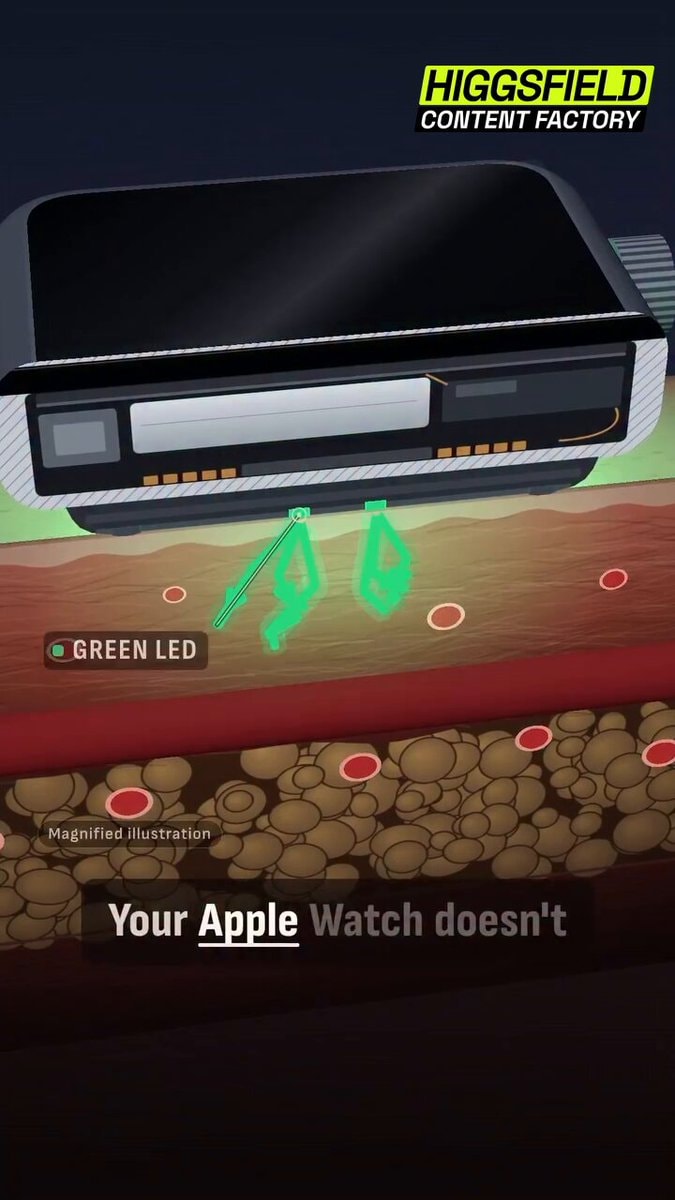
Your Apple Watch doesn't actually feel your heartbeat. It watches your blood, using green light. Sounds strange, right? Imagine you're halfway through a run. Your heart is racing, and your Apple Watch shows your heart rate climbing. But how can something sitting on your wrist know what your heart is doing? Underneath the watch, tiny green LEDs are flashing hundreds of times every second. That light enters your skin, where some gets absorbed by your blood, and some reflects back into tiny light sensors. But here's where it gets clever. Every time your heart beats, it pushes more blood through the vessels in your wrist. And blood absorbs green light. So when your heart beats, less light makes it back to the watch. Between beats, more light returns. To your eyes, that difference is invisible. But to the sensors, it's a repeating pattern. And by measuring how quickly that pattern repeats, the watch can calculate your heart rate. But there's another problem. What happens when you're running and your arm is swinging everywhere? All that movement can interfere with the reading. So the watch uses motion sensors and software to help separate your actual pulse from the noise. And all of this happens while you're running. So those little green lights underneath your Apple Watch? They're actually measuring tiny changes in your blood flow using reflected light. Did you know that's what those green lights were doing?