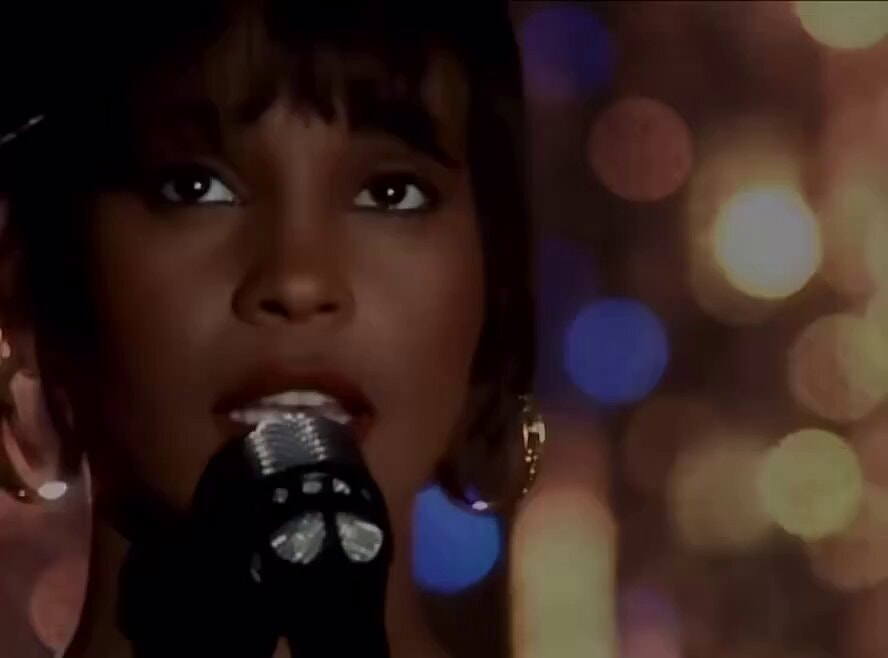
Whitney Houston I Will Always Love You
Dolly Parton wrote a simple country tune in 1973. Whitney Houston and producer David Foster reshaped that composition into a majestic power ballad for the 1992 film The Bodyguard. They kept the opening verses at a measured tempo. Then they unleashed the full force of her voice during the climactic passages. This contrast between silence and surging sound forms the emotional core of the recording. In 1992, Houston stood at the peak of her artistic powers. The track did more than serve as a soundtrack. It became a global phenomenon. For the cultural landscape of that era, it marked a rare instance where an R&B and pop artist lifted pure emotion to cinematic stature without losing essential authenticity. The visual narrative interweaves with images from The Bodyguard. We see a slow rotation of an aircraft wheel on the tarmac. An empty theatre appears. There is a final embrace. Kevin Costner offers a distant gaze. Through these scenes, Houston stands before the microphone with eyes gently closed under warm golden lights. She performs the song as an extended farewell. Her vocal technique is extraordinary. Yet what truly distinguishes this performance is her disciplined containment of emotion. She does not cry out. Instead, she maintains a delicate balance. Tears are held back, but the listener feels a tightening in the chest. Her lowered eyelids, the slight tremor of her lips, and her firm grip on the microphone all convey a woman determined to say goodbye with dignity. Pay close attention to how she handles the phrase "And I…" just before the soaring high notes. This moment is not about showing off virtuosity. It is the instant when one swallows back tears, takes a deep breath, and resolves to speak everything that has been restrained. Listeners recognize themselves in that split second. They understand the necessity of release and the desire to leave behind a final expression of love that is both complete and graceful. "I Will Always Love You" is not a song about keeping another person. It is about loving enough to accept departure. Love here does not demand possession. It seeks only to endure in memory, in blessing, and in the quiet certainty that affection does not diminish even when two lives separate. Sometimes the noblest form of love is not holding on. It is the capacity to take leave while still offering warmth. To love does not always mean staying at any cost. At times, it means releasing with grace.
Transcript (en)
If I should stay, I would only be in your way. So I'll go But I know I'll think of you Every step of the way And I I will always love you Will always love you You my darling you bittersweet memories that is all I taking with me So goodbye Please don't cry We both know I'm not what you need And I Will always love you I will always love you I hope Life treats you kind And I hope you have all you dreamed of And I wish you joy and happiness But above all this I wish you love And I will always love you. I will always love you I will always love you I will always Love you I will always love you I will always love you I will always love you You, darling I love you I'll always love you