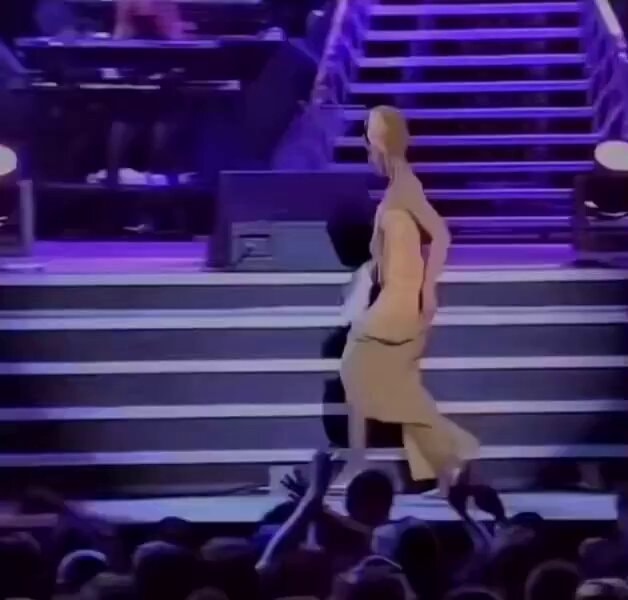
Whitney Houston Bow Stage Moment
Whitney Houston delivered a bow that transcended the standard polite gesture expected of performers. It stood as a complete and iconic stage moment, seamlessly blending elegance with humility and raw emotional power. Watching the sequence reveals the intention behind every movement. She crosses the stage with visible energy, arms open wide, her body still vibrating with the music she has just poured out for the crowd. Then, without any rush, the energy softens. The momentum slows deliberately. She lowers herself with total control, allowing her long golden dress to settle around her as she sinks into a deep position that borders on kneeling. Her head drops low, coming closer to the stage floor than most artists ever allow themselves to go. She holds this posture not for a fleeting second, but long enough for the silence between her and the audience to thicken into something shared and tangible. That specific depth is what makes the moment unforgettable. Many other artists might offer a polite incline of the head or a modest bend at the waist to acknowledge applause. Whitney goes further. The bow becomes an act of genuine humility rather than routine protocol. In that lowered position, she seems to communicate that the voice, the applause, and the lights do not belong solely to her. Instead, these elements are being returned and offered back with gratitude. The gesture carries the weight of someone who understands both the magnitude of the gift she has been given and the size of the audience receiving it. Yet there is nothing awkward or diminished in the movement itself. The same body that can fill a stadium with sound now folds itself with absolute elegance. Every detail remains composed throughout the action, including the fringe of her dress, the headwrap, and the way her hands rest near the fabric. When she rises, the transition is just as controlled as the descent. She does not scramble back to full height. She unfolds, finds her center, and only then lifts her arm toward the crowd while smiling. The smile is warm and almost intimate, as if the private moment of the bow has now opened outward again to include everyone watching. This represents stagecraft of a rare kind. It is not choreography designed merely to look impressive or flashy. It serves as an emotional full stop that completes the performance. The power she has just displayed is balanced by a visible willingness to make herself small in that moment. That balance is magnetic. Audiences do not merely clap for a great singer in instances like this. They respond to a human being who can hold both majesty and humility in the same breath. Years later, the clip still stops people mid-scroll. Part of the reason is technical beauty, seen in the clean lines, the timing, and the control. The deeper reason is recognition. In an era that often confuses volume with presence, Whitney’s bow reminds us that true presence can also be quiet. It can lower itself. It can linger in silence. And in that silence, it can say more than another chorus ever could. The bow is not an afterthought. It is the last gift she offers before leaving the light. And that is why so many of us can watch it again and again. It feels less like a performer thanking the room and more like a soul briefly and beautifully touching the ground.
Transcript (en)
Music