Cisco Q4 Earnings Analysis
by Huda Thomas: Cisco
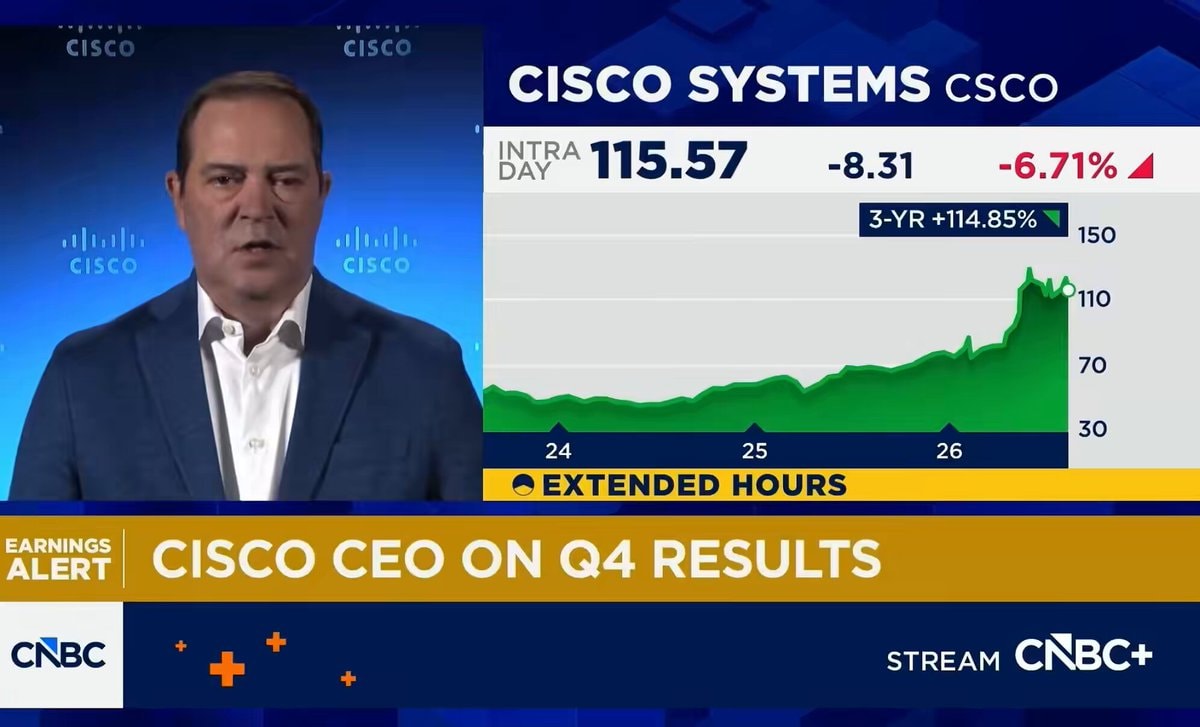
Cisco is effectively selling the shovels for the entire AI buildout, yet the latest financial results suggest this boom is actively worsening its own business fundamentals. The last time the company served as the primary infrastructure provider during a technology surge, it became the most valuable entity on Earth, only to leave its shareholders waiting 25 years to break even. That company is Cisco. It just posted the best quarter in its corporate history. Revenue reached $17.25 billion, an 18% increase from a year ago, beating the $16.82 billion Wall Street expected. Adjusted earnings came in at $1.22 per share against a $1.17 consensus. Total product orders jumped 35%, while networking orders surged 40%. Hyperscalers placed $4 billion in AI infrastructure orders in that single quarter, bringing the fiscal year total to $9.3 billion. Cisco then guided 2027 revenue to a range of $72.2 billion to $73.4 billion, which is far above what analysts had modeled. The company set records on both revenue and orders, then raised its guidance on top of those achievements. But the stock fell 9%. It was the worst single day for Cisco in six months. So what did investors see that the headlines missed? The answer lies right below the revenue line. Cisco's adjusted gross margin came in at 66.3%. A year earlier, it was 68.4%. The company attributed part of that drop to the rising cost of components inside its AI hardware, specifically naming memory. Then it guided margins down again, to a range of 65% to 66%. Here is the mechanism you need to understand. Cisco buys memory in the same market its own customers are draining. Every hyperscaler racing to fill a data center is bidding for the same parts Cisco needs to build the switches it sells them. The boom is raising Cisco's costs faster than Cisco can raise its prices. It is shipping more hardware than ever but keeping less of every dollar. There is a second number that got almost no attention. Cisco booked $9.3 billion of AI orders across the fiscal year, then guided to $7.5 billion of AI revenue for the year ahead. The forecast came in below the order book. That $7.5 billion works out to roughly 10% of everything Cisco expects to sell. The stock ran 60% this year on a story that is one tenth of the business at a worse margin than the rest of it. On March 27, 2000, Cisco passed Microsoft to become the most valuable publicly traded company in the world. It held roughly $555 billion of market value. Shares closed at $80.06. Cisco was the picks and shovels play for the internet. Every company that wanted to get online bought its routers and its switches. By October 2002, the stock traded near $9, a decline of about 88%. And the business did not collapse. Revenue ran about $19 billion in fiscal 2000, $22 billion in 2001, and about $19 billion in 2002, and it grew past $57 billion over the following two decades. The revenue kept arriving, but the shareholders still waited. Cisco did not close above that March 2000 price again until December 10, 2025, when it hit $80.25. That is 25 years and 8 months to get back to one number. That recovery is 8 months old. The stock trades near $113 today, which means every dollar above the 2000 peak has been earned since December, most of it on the AI trade. What is important here is what really happened in 2001. Because Cisco's orders did not slow down first. Its customers were dot-coms and telecom startups that had borrowed heavily to buy the gear, and when their financing dried up, the orders vanished after the money did. Right now, every hyperscaler funding this buildout is doing it with record amounts of debt. I don't think I need to tell you what this means.
Transcript (en)
We're effectively one of three companies that can provide the networking layer for these large AI training exercises and also the networking that our customers are going to need as they move deeply into inferencing. And we made that decision a decade ago. And then we also made a decision on some strategic acquisitions in optics and optical, which are, you know, Acacia had another billion-dollar quarter in coherent optics. And so the strategy that we've had to design our own silicon, to build systems, to have a direct relationship with TSMC, to have our dedicated capacity already set up for the year, we've already got the components, our silicon and everything lined up to deliver on the technology for the number, for the year that we guided, and candidly for upside on top of that if we need it. And I think the biggest thing is like the business model that we're running right now, the operating margins at the highest level I think we've maybe ever seen in Q4, the guide on the operating margins, the guide on the EPS, I think would indicate that the business model decisions we're making and the business that we're taking from the hyperscalers and the growth that we're seeing there is a prudent decision.