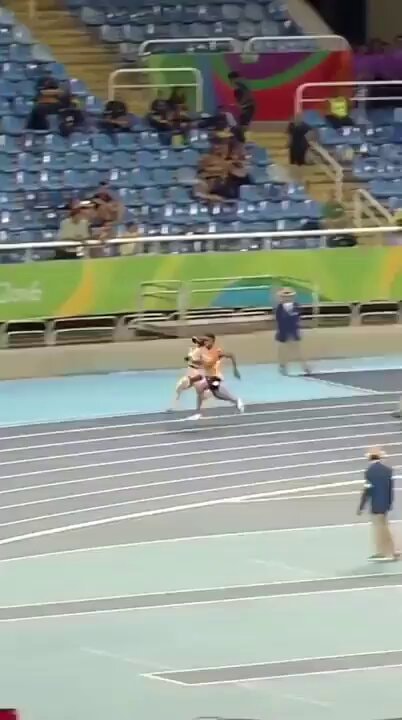
Blind sprinter and guide at Rio 2016 Paralympics
by Felix P: Summer Paralympics
The footage from the Rio 2016 Paralympics shows a female sprinter who is completely blind racing with her male guide. She wears a black eye mask and they run side by side, linked by a short tether. They navigate the curve and drive toward the finish line before collapsing into an emotional embrace after the race. This moment captures the result of overcoming difficulties that most athletes do not face. For the blind runner, the track is an invisible world. She cannot see lane lines, the bend of the curve, other competitors, or the finish line. All critical information comes through the guide’s voice and the tension of the tether held between their wrists. At elite sprint speeds, one misjudged step can lead to colliding with another runner, stepping on the line, or falling. The runner must maintain powerful form and rhythm while one arm is restricted by the short cord. She processes constant verbal cues about distance, direction, and when to lean at the line. The psychological burden is immense. Absolute trust is required between the partners because any doubt or hesitation can destroy the race. The guide carries an equally demanding load. He must match the athlete’s exact pace and stride length without pulling her forward or holding her back. Rules require the guide to stay slightly behind or precisely level with the runner. He is forbidden from crossing the finish ahead of her. While running at full sprint, he continuously scans the track. He calls out instructions such as 'straight', 'curve', 'twenty meters', and 'dip'. He uses gentle tether signals when crowd noise drowns out his voice. The guide must synchronize every movement of arms and legs with the runner so the tether never tangles or jerks. One mistimed cue on the bend can throw both runners off balance. The physical effort of racing at that intensity is compounded by the mental responsibility for another person’s safety and performance. Together they face the challenge of becoming one unit. Hours of daily training are needed to develop the instinctive connection that makes the guide almost invisible. This allows the runner to move with confidence. The short tether is usually only thirty to fifty centimeters long. It demands perfect coordination. Any difference in fitness, timing, or focus becomes immediately obvious due to the tether. On race day, wind, track conditions, and the roar of the crowd add further variables. False starts, block exits, and the final lean all require flawless partnership under pressure. These obstacles make the emotional finish-line hug in the video even more meaningful. It is not simply the joy of winning. It is the release of months or years of shared work. It represents placing complete faith in another human being. It proves that vision is not required to run with power and precision. In that embrace, the invisible difficulties of the race dissolve into something visible. The strength of absolute trust becomes clear.
Transcript (en)
Thank you.