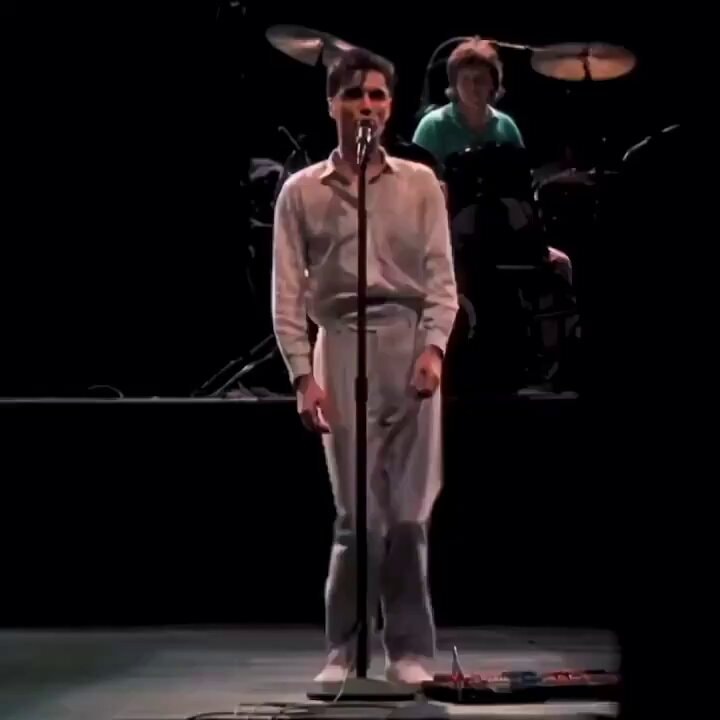
David Byrne Stop Making Sense dance
David Byrne's dance in Stop Making Sense, the 1984 Talking Heads concert film directed by Jonathan Demme, remains one of the most striking physical performances ever captured on stage. The now-famous clip opens with Byrne walking out alone, boom box in hand, before the band builds around him over two hours. What separates him from almost every other rock frontman is how he moves: no swagger, no seduction, no rehearsed cool. Instead his body locks into angular, mechanical jolts, shoulders snapping, arms slicing the air, knees bending at strange angles while his torso tilts like a puppet on a rhythm. The effect is awkward and precise at once, comic in one moment and almost unnervingly intense the next. Byrne never tries to look effortless; he lets the beat take over completely. That movement vocabulary wasn't an accident. Byrne developed it with choreographer Toni Basil, studying religious rituals, tribal dances, trance states, and even the involuntary movements of seizures. He took those raw, unpolished physical languages and turned them into something that feels both ancient and hyper-modern, like ceremonial energy running through a self-conscious contemporary body. The dancing never sits on top of the music as decoration. Talking Heads' sound in that era was built on tight funk grooves, brittle new-wave textures, and sudden bursts of ecstatic release, and Byrne's body mirrors every shift. When the rhythm tightens he runs in place or circles the stage; when the arrangement opens up his gestures widen into something more fluid. The movement becomes an extension of the sound itself. The staging makes the whole thing even more hypnotic. There are no elaborate lighting tricks or pyrotechnics, just a deliberately sparse setup that forces your eye onto Byrne's body. Later he appears in the now-iconic oversized suit, and every twitch gets amplified by the fabric so the suit itself seems to dance. That minimalism is part of why the performance still works. There's nothing to hide behind, no spectacle to distract from the strange, honest relationship between a body and a rhythm. What makes it endure is the honesty. Byrne commits completely to a physical expression that matches the band's intellectual, slightly alienated sensibility without ever trying to look graceful or powerful in a conventional way. The dancing feels liberating because it gives permission to move without worrying about looking perfect. More than forty years later, the same footage still stops people mid-scroll. Total commitment, an unexpected physical vocabulary, and perfect musical alignment create a hypnotic power that most stagecraft never touches.
Transcript (en)
Let's get the message to the receiver, both of them are nice to someday. I got three passports, a couple of visas, don't even know my little names. I'm on the hillside, talks of loading, everything's ready to roll up. Sleep in the daytime, work in the nighttime. I got the damn, I'll get home.