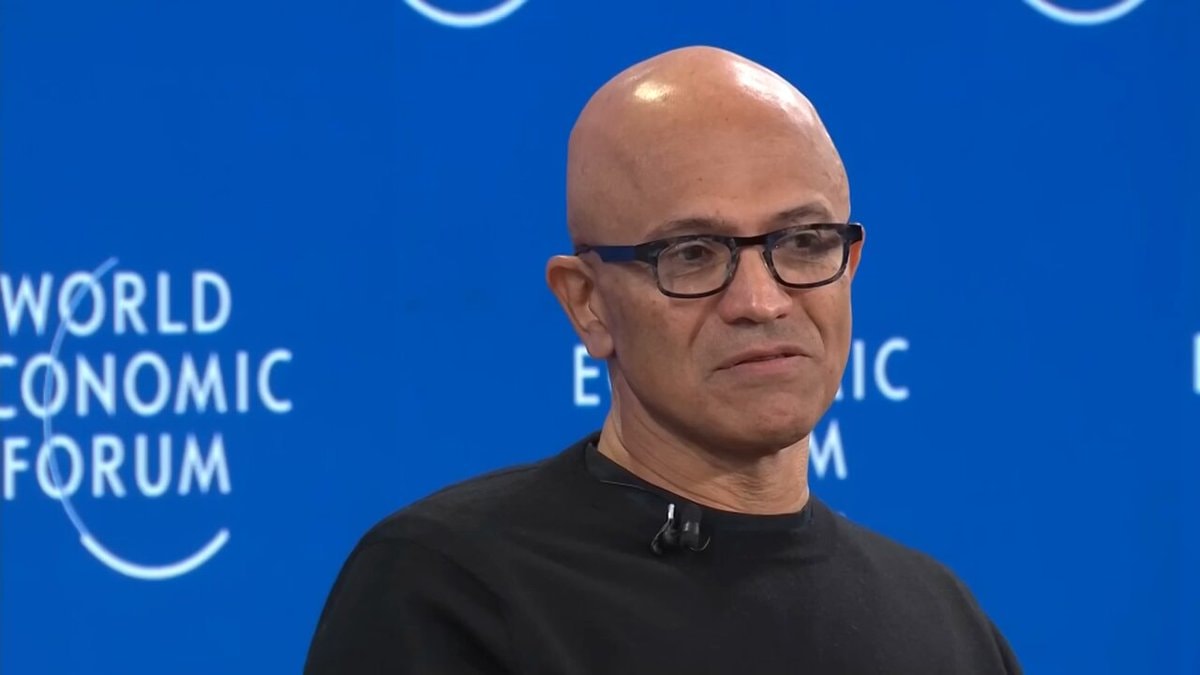
Satya Nadella Davos Copilot workflow
by Evira: Satya Nadella
Productivity gains from AI stay elusive until the actual work process shifts. Satya Nadella's prep for around 50 bilateral meetings at Davos had barely evolved since he started at Microsoft in 1992, yet now he gets one 360 brief from Copilot and circulates it across teams, which compels a structural overhaul. The core idea: change only happens when the work product and the workflow evolve together.
Transcript (en)
The big challenges with all of these new technologies is when work, work artifact and workflow changes, that means we as firms have to change how we work. In fact, I remember meeting the CEO of Generale, you know, a few years back, and he was describing, he had joined the firm, you know, pre-PC era, And he was describing how, for example, they worked with their agents in the field with faxes, inter-office memos, and suddenly the PC showed up and people would then put a spreadsheet in an email and send it around. And the entire workflow and the work process changed. So similarly, I think with AI, you are going to start seeing actual change in how workflow happens. I mean, even preparing, in fact, for me coming to Davos, you know, whatever, 50 bilateral meetings I have preparing for those had a particular workflow right Which is there is to be my field team would prepare notes and that would come to my HQ and that would get further refined And nothing had really changed, right, since I joined in 92 to essentially even a few years back. Whereas now, I just go to co-pilot and say, hey, I'm meeting Larry, please give me a brief. And it comes back and gives me, by the way, the one nice thing is it gives me a 360, right? It knows what we are doing with you as a client, what we are doing as a client of yours, and everything in between as an investment. So it captures even information unlike anything else. In fact, what I do is I take that and immediately share that back with all my colleagues across all the functions. Think about it. It's a complete inversion of how information is flowing in the organization. It's not like this classic, we have an organization, we have departments, we have these specializations and the information trickles up. No, no, no. It actually flattens the entire information flow So once you start having that you have to redesign structurally So the current structure may not make sense because you want people to be able to work in a way that allows them to have this information flow freely. So what all this leads me to, if I have to sort of say, what's the formula? The formula, I think it starts with the mindset. So the mindset we as leaders should have is we need to think about changing the workflow with the technology. Then that needs skill set. So you can't sort of talk about this in the abstract. You've got to use it. So if I'm not using the truth. You have to trust it. You have to trust it. You have to use it. You have to learn even how to put the guardrails to trust it. So you can't, again, you can't just be afraid of it. it's going to be diffused. So the question is, as a firm, you have to use it to learn how to even put the guardrails that allow you to be able to trust it. So skills so mindset skills The other big consideration really is how do you make sure you have the data set that you feeding Like context. It's kind of like you have a new intelligence layer. But the intelligence layer is only as good as the context you give it. So people describe it even as context engineering. But that is what firms do. If you think about what do firms do, it's all about the tacit knowledge we have by working as people in various departments and moving paper and information. So the question is, how do you really have this? AI also have that context. So these are sort of some of the new things that have to percolate throughout an organization to take advantage. In fact, that's why I think you're going to see that challenge of, why am I not seeing immediate results in productivity? because you have to do the hard work. In fact, that's why it's not going to be some, you know, it's going to, there are going to be firm-wide differences. There could be sector-wide differences, but it's going to fundamentally be because of the leadership will in an organization.