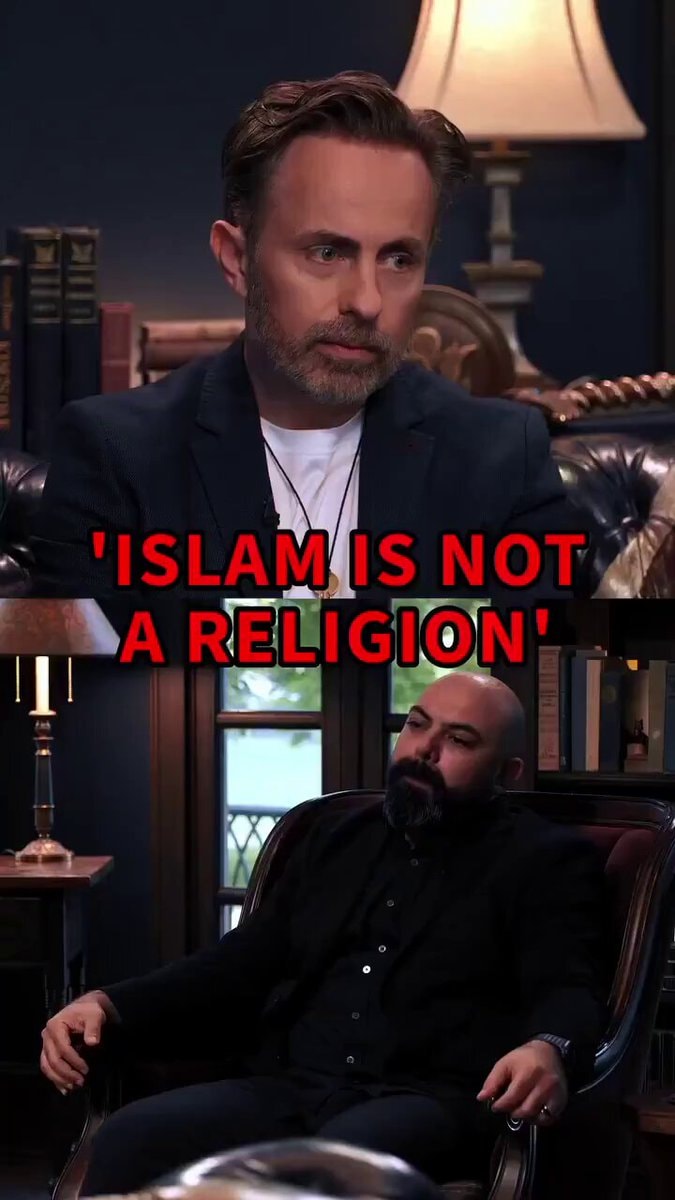
Danny Burmawi Islam is not a religion interview
Jeremy Boring highlights a national tradition where the state upholds freedom of religion and refrains from critiquing religious theology. Danny Burmawi identifies this classification as the fundamental error, arguing that viewing Islam merely as a religion is incorrect. He illustrates the distinction with an analogy: a house contains a kitchen, yet the house itself is not defined as a kitchen. In the same way, Islam possesses religious aspects but is not itself a religion. Burmawi contends that Islam cannot function within a system where laws are established by consensus, because it does not tolerate criticism. He asserts that in places where Islam holds dominance, individuals are too afraid to criticize it, and those who do face immediate imprisonment or death. In contrast, he claims that in the West, where Islam does not dominate, proponents attempt to introduce blasphemy laws through alternative avenues. One such avenue is self-censorship, leveraging societal values of kindness and tolerance to discourage critique. Burmawi warns that once political power is attained, critics receive treatment comparable to Salman Rushdie. He links this to historical precedents, citing those Muhammad ordered to be exterminated for criticism. This pattern is observed in Egypt and Pakistan, where Christians accused of blasphemy or criticizing Muhammad suffer severe consequences. Their homes are burned, they are expelled from their villages, and their land and businesses are confiscated. Burmawi notes that when lacking power, the stated demand is often just for respect.
Transcript (en)
We have a long tradition in this country of freedom of religion and that the state doesn't engage in critiques of religious theology. That's the problem. You think Islam is a religion. Islam has a religion. Think of it as your house. It has a kitchen, but your house is not a kitchen. Islam has a religion. It's not a religion. Can Islam coexist in such a system where consensus is going to determine the laws of the land? The answer is no, because Islam doesn't accept criticism. Wherever Islam has the upper hand, no one can criticize Islam. If they do, they get killed or jailed immediately. Wherever Islam doesn't have the upper hand like the West, what happens? They try to smuggle the blasphemy laws through different doors. One of the doors is self-censorship. They use your kindness, your tolerance to force you not to criticize Islam. But once they have the upper hand, you get the same treatment as Salman Rushdie. You get the same treatment as the people who Muhammad ordered to be massacred immediately because they just criticized him. And this is what happens today in Egypt, in Pakistan. If a Christian is accused of blasphemy, of criticizing Muhammad, they don't only burn his house and kick them out of the village or whatever. They confiscate their lands, their businesses. But when they don't have the upper hand, they say, we just want respect.