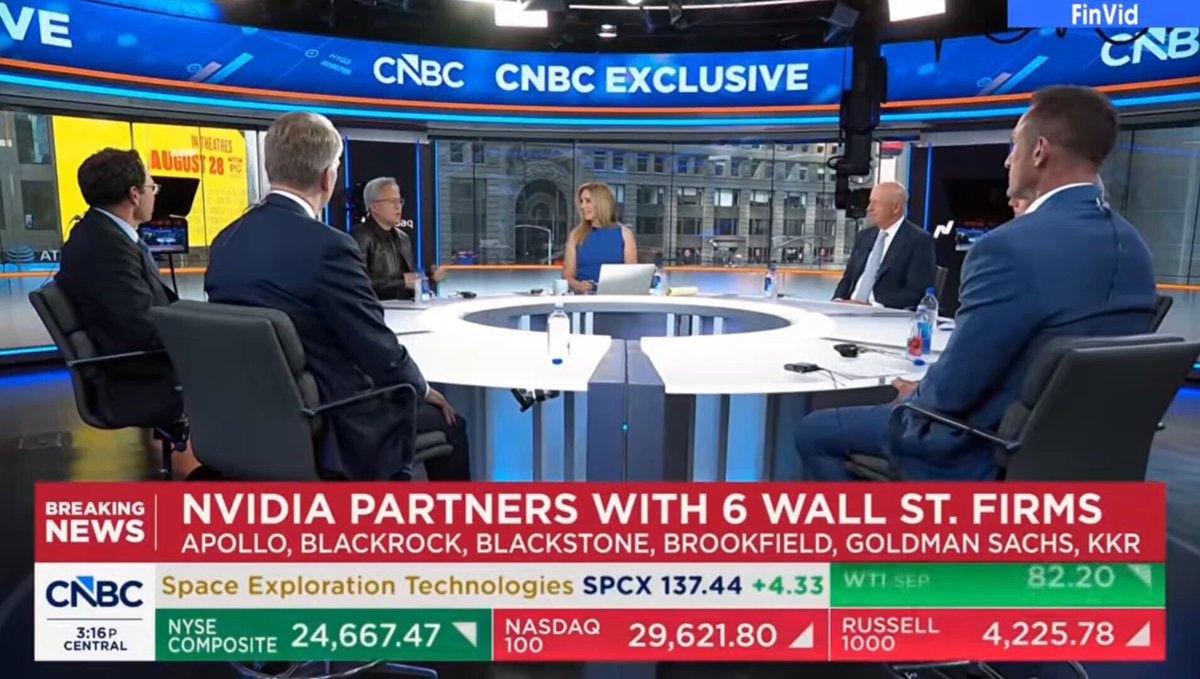
Nvidia $500 billion AI financing with Wall Street
Jensen Huang just revealed his $500 BILLION financing scheme with 6 of the biggest money managers on Earth. Here's the deal they signed: Nvidia and those 6 firms are mobilizing more than $500 billion of outside capital to finance AI infrastructure. The money goes to Nvidia's own customers so they can build data centers and buy Nvidia chips. Nvidia is not putting up a single dollar. The CHIPS themselves become the collateral. This is like "buying a GM car and getting the financing from GM." Jensen clarified that none of it is Nvidia's money. That part is technically true. But then Larry Fink explained what they are actually building... Fink runs BlackRock, the largest asset manager on Earth. Asked about financing data centers, he said this is the very beginning, the way it was when he started out in the mortgage backed securities market in the 1970s. Then he called it the "next frontier of financial engineering." He compared the AI buildout to the machine that CRASHED the world economy in 2008. Then KKR's global head of digital infrastructure laid out the mechanics: He said the revenue coming off those chips can be securitized, the risk divided up, and the slices sold to investors who want exposure anywhere in the stack. So the GPU is the house, the compute bill is the mortgage payment, and the slices get sold to whoever wants them. Blackstone's John Gray made the comparison himself. He said when you buy a house the bank underwrites you and also looks at the value of the home. When an airline buys a plane, they look at the credit of the airline and at the plane. The chips are the plane. But a plane holds its value because Boeing cannot make your plane obsolete on purpose. Nvidia can, and it does it roughly every year. KKR's own man spent part of that panel praising Vera Rubin, calling the jump in tokens per watt a step change. Every leap like that makes the previous generation worth less. And the price per token has already fallen 99%, so the collateral behind these loans depreciates on a schedule Nvidia controls, while the revenue those chips earn keeps getting cheaper. So what happens if the AI companies run out of cash? Jensen said somebody else can take the machines over and operate them. "There will always be a customer for that computing platform." He planned the repossession before the first loan even closed. Then who ends up holding this paper? Fink answered that one himself: He said they will be working with pension funds across the world. David Solomon pointed at the $9 trillion sitting in US money market funds. Fink pitched moving that cash into longer dated returns and said investors who are overweight equities will rotate in too. And $500 billion is only the opening bid. Fink said the US alone needs over 70 gigawatts of power for this, and every gigawatt costs $50 to $60 billion to build. That works out to more than $3.5 TRILLION for America by itself. Six days earlier, Apollo had called its $35 billion Broadcom financing the largest of its kind ever done. This deal is literally more than 14x bigger. Solomon was the only guy on that panel who mentioned the risk. He admitted the returns will NOT all be ample, that capital will get allocated to things that do not work, and that there will be winners and losers. Jensen's case is that the machines print money. He said AI tokens are incredibly profitable. Within months everyone will realize the AI labs are extremely profitable, and that when those labs go public it will be the biggest IPOs in history. None of that has happened yet. The financing is being built right now, ahead of the proof. So this is either the largest infrastructure buildout in history, or Wall Street just turned the AI bubble into bonds and handed them to the pension funds. #JensenHuang #Nvidia
Transcript (en)
We're announcing six partnerships today. These partnerships are going to pull together independent long-term capital to fund and support AI infrastructure build-out. This is an extraordinary time, as you know, because this is the first time in some 60 years that the computing industry is going through a fundamental platform shift, from the way that software was done before to the way that it's going to be done in the future called artificial intelligence. Fundamentally, what's different about this industry and this way of doing computing is that the computer is now part of the infrastructure, like electricity, like the internet, and so you have to think about it like its infrastructure and build it out accordingly. Every company will be powered by it. Every country will build it. And so we're talking about an extraordinarily significant infrastructure build. This is a very hefty price tag. It's a hefty price tag. Each gigawatt is something like 50, $60 billion.