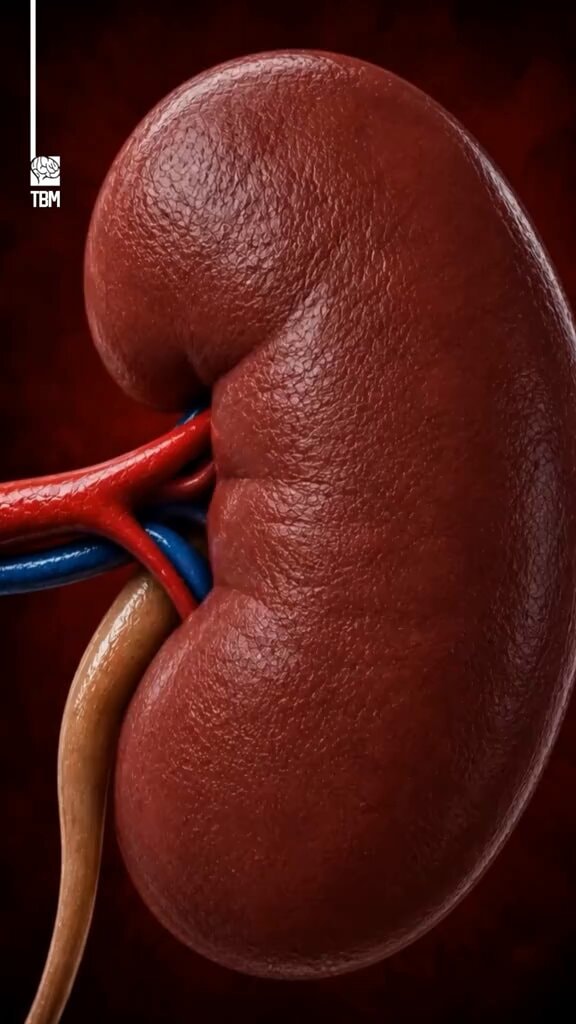
Kidney nephrons filtering blood 3D render
The renal artery pushes blood into the kidney nonstop, and from there it fans out into tinier vessels until it hits millions of nephrons. Those nephrons are where the real sorting happens, pressure forces fluid into a filter that holds back blood cells and proteins while letting water, salts, nutrients, and waste through. Then the kidney starts reclaiming the good stuff: glucose, amino acids, and most of the water get reabsorbed into the bloodstream. It also tweaks salt and water levels on the fly to keep your internal balance steady. What’s left is concentrated urine that travels to the renal pelvis, down the ureter, and into the bladder for storage. Cleaned blood exits via the renal vein, ready to loop through the body again
Transcript (en)
Blood enters the kidney through the renal artery and begins a process of continuous filtering and balance control. Inside the kidney, this blood is directed into smaller and smaller vessels until it reaches millions of microscopic filtering units called nephrons. At the start of each nephron, pressure pushes part of the blood's fluid into a filtering space, separating what the body needs to keep from what it needs to remove. Blood cells and proteins stay inside the bloodstream, while water, salts, nutrients, and waste move into the nephron. As this fluid travels through the nephron, the kidney fine-tunes its composition. Essential substances like glucose, amino acids, and much of the water are reabsorbed back into the blood. At the same time, excess salts and extra water are adjusted depending on the body's needs, keeping internal balance stable. What remains becomes urine, a concentrated waste fluid. It flows toward the renal pelvis, then into the ureter to be stored in the bladder. Meanwhile, the cleaned blood exits through the renal vein, ready to circulate again through the body.