Microsoft bans Claude Code for engineers
Microsoft has banned its own engineers from using AI. The tool ended up costing more than the humans it was supposed to replace. They misled everyone about AI adoption, and now the entire narrative is falling apart. Six months ago Microsoft gave thousands of engineers access to Claude Code and pushed them to use it. Engineers embraced it and adoption spread rapidly. Then the invoices started coming in. Because of token-based pricing, every query, every code review, and every debugging session added to the bill. Once scaled across 100,000 engineers the costs grew so high that Microsoft issued an internal order to cancel nearly all Claude Code licenses by the end of June and shift everyone to their own cheaper alternative. The company that invested $5 billion in Anthropic has now instructed its own staff to stop using Anthropic's product because it costs too much. Uber's experience has been even more extreme. Their CTO Praveen Neppalli Naga told The Information that the budget he planned for the full year was blown away already by April. Uber had rolled out Claude Code in December 2025. By March, 84 percent of their 5,000 engineers were using it and 70 percent of all committed code came from AI systems. Heavy users were burning $500 to $2,000 per month each. Naga himself spent $1,200 in a single two-hour demo session. The company had even built internal leaderboards ranking engineers by how much AI they used. They literally gamified the spending and then ran out of money. Now consider what Nvidia's own VP of applied deep learning Bryan Catanzaro said to Axios last month. His direct quote was that for his team the cost of compute is far beyond the costs of the employees. This comes from a vice president at the company that sells the chips, saying that using AI is more expensive than paying humans. Think about what this means for the entire AI narrative. Every CEO on every earnings call for the past two years has said the same thing. AI will make us more efficient, reduce headcount, and cut costs. The stock market rewarded every company that said it. Fired workers and the stock goes up. Announced AI adoption and the stock goes up. But the actual companies deploying AI at scale are discovering the math does not work. The more employees use AI, the higher the bill. Goldman Sachs forecasts a 24x increase in token consumption by 2030 as companies adopt AI agents. Gartner just published a report showing that even though individual token prices will drop 90 percent by 2030, total enterprise AI costs will go up because agents consume exponentially more tokens per task than basic tools. Meta built an internal dashboard called Claudeonomics to track which employees use the most AI. Amazon started pushing engineers to tokenmaxx, their internal term for consuming as many AI tokens as possible. Both companies are spending hundreds of billions on AI infrastructure this year alone. And Microsoft, the company that bet its entire future on AI, just told 100,000 engineers to stop using the tool they liked best because the per-token bills got out of control. The companies building AI are telling investors it saves money. The companies using AI are finding out it costs more than the humans it was supposed to replace. And even the company that makes the chips just admitted it through its own vice president. This is the gap nobody on Wall Street is pricing in. $725 billion in AI infrastructure spending this year across Big Tech. And the first companies to actually deploy these tools at scale are already pulling back because the economics do not work. What do you think?
Transcript (en)
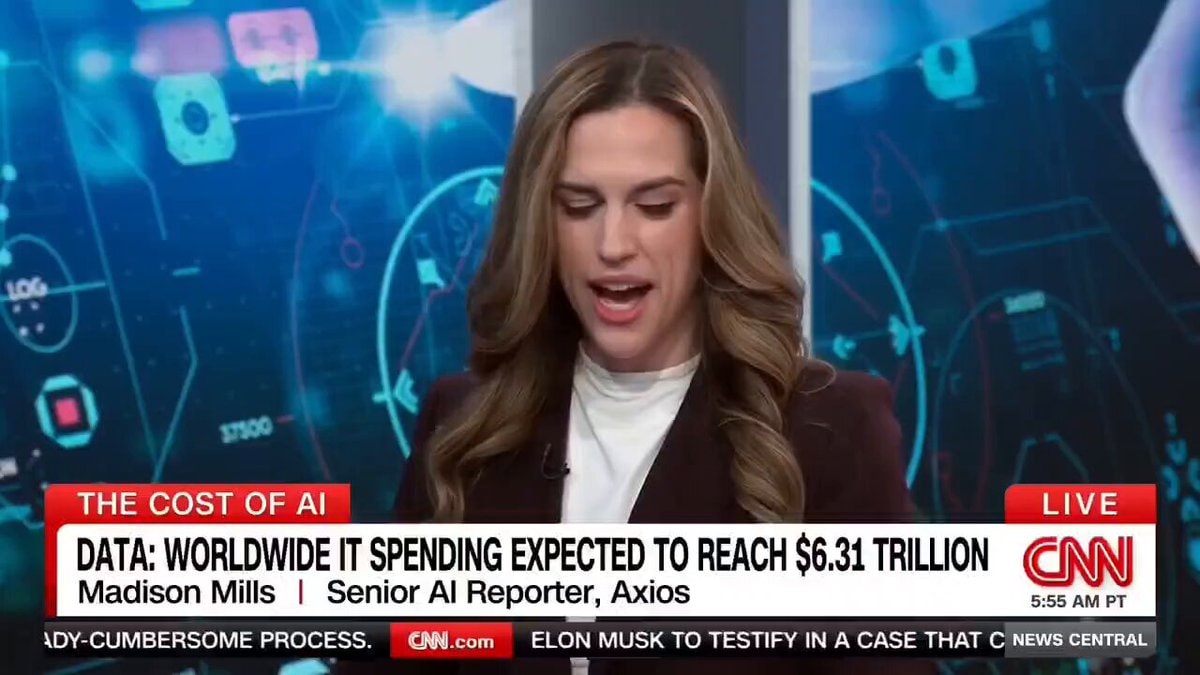
I spoke with a VP at NVIDIA who first flagged this to me. He said, oh yeah, for months, our costs for my team have been more for AI than humans. So that was the first flag. And then we started to hear this coming out in droves. Uber's CTO said he already blew out his whole budget for 2026 just on AI-related costs. And obviously that means he's spending more on that than he's spending on human workers. And now I'm starting to hear, especially from startup founders, they're bragging about their AI bills being high because kind of this sign of like, yeah, I'm really ahead. I'm blowing so much cash on this. Exactly. But the whole point of this was supposed to be that it cut down on costs, expanded profits, especially for public companies. But it's unclear if that's going to be tenable. When is that curve? I guess is one big question. But you have some of the data you have in your report is kind of fascinating. Worldwide IT spending is expected to be up 13 and a half percent this year compared to just last year over six trillion dollars. Where is all this money going to? Well a lot of it is going towards token costs which is basically like the currency of AI use. Also of course subscriptions if you've got an enterprise contract with OpenAI with Anthropic. So a lot of it is going towards these AI labs. The thing is though the queries that I'm putting into AI those don't cost very much. It's for the people who are coding or using an autonomous agent overnight but at some companies especially the tech ones like meta they're encouraging that high token use because again they want to see and seem like they're really ahead in the ai race