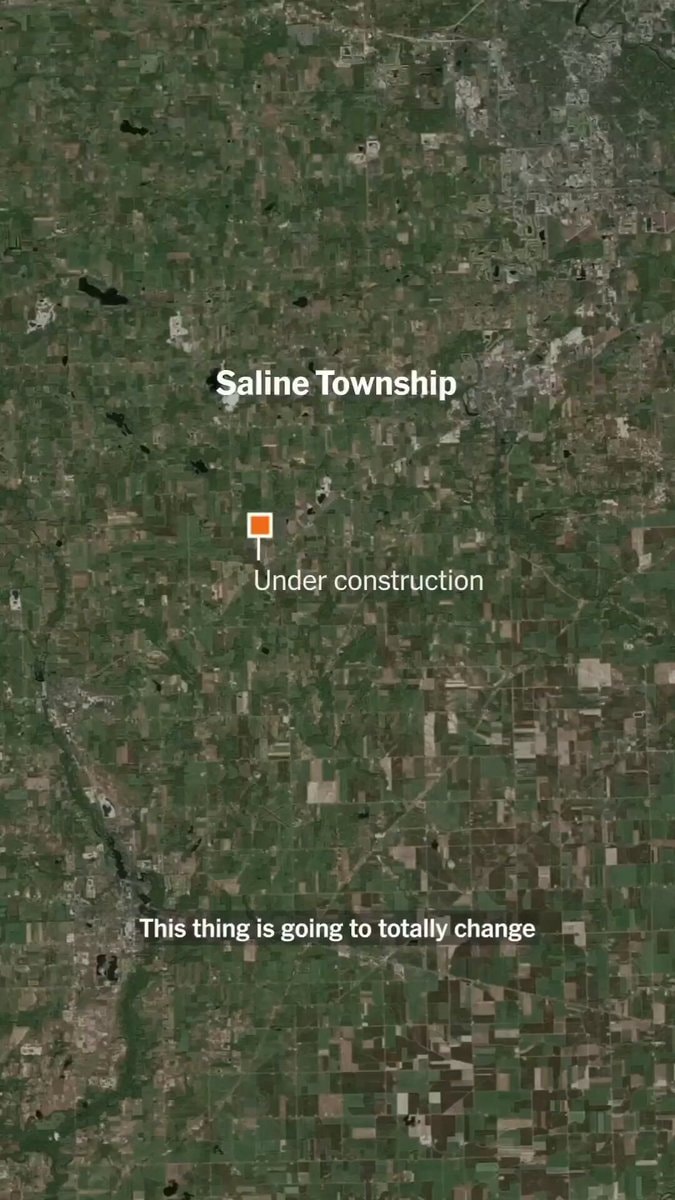
Saline Township Data Center Construction
by Tim Official: United States
Technology giants are ruining farmland throughout the United States in order to erect data facilities projected to cost around seven hundred billion dollars. These structures will contain processors that lose all value in roughly three years. The firms mislead the public on the underlying calculations involved. Nvidia brings out a fresh chip design every two years while also delivering yearly improvements inside each cycle. Each new version renders earlier models unprofitable for advanced artificial intelligence work. Jensen Huang stated during a presentation that once Blackwell reaches high volume shipments the previous generation would have no resale value. The following design called Vera Rubin arrives later this year and promises ten times better performance per watt along with ten times lower cost for running models. Research from Princeton indicates that graphics processors handling typical artificial intelligence tasks last only one to two years in physical operation and three years at the longest before heat damage ends their usefulness. Thus the processors fail quickly and lose relevance even sooner. The financial reporting maneuver that hides the problem involves Microsoft Google Meta and Amazon spreading the expense of these processors across five or six years in their accounts. They previously applied a three year period but lengthened it precisely when artificial intelligence investments surged. Meta alone adjusted its schedule three times over three years with each change adding billions to reported earnings in a single quarter. Depreciating a processor across six years while it actually stops generating returns after two produces misleading profit figures. The expense gets allocated into periods when the equipment creates no value. Earnings appear strong in statements even though the hardware merely consumes electricity without economic output. Michael Burry examined these figures and calculated that between twenty twenty six and twenty twenty eight the four large cloud companies will understate depreciation expenses by one hundred seventy six billion dollars. This implies they are overstating earnings by more than twenty percent. He allocated seventy nine percent of his final holdings to positions opposing Nvidia and Palantir before closing his fund completely. These facilities must be located somewhere and the companies place them in rural areas that lack resources to resist. Sixty seven percent of recent data centers appear outside urban zones on agricultural land or inside small communities. Trump issued an order that simplifies approvals for any project exceeding five hundred million dollars which removes the ability of local groups to stop developments. A farm community in Michigan illustrates the outcome. Saline Township rejected a sixteen billion dollar OpenAI Oracle facility by a four to one board vote. Two days afterward the developer filed suit. The company is Related Digital started by billionaire Stephen Ross and one of its executives is married to the Michigan Secretary of State who is currently campaigning for governor. The township lacked funds to litigate against OpenAI Oracle and SoftBank so it reached a settlement that allowed building to begin at once. More than one hundred communities spread across twelve states attempted to stop similar projects this year. Power prices have risen thirty two percent over five years. Every few years the entire set of computers inside these structures is removed and exchanged for newer versions that demand additional electricity water and grid capacity. The structures remain permanently while the disruption continues without end yet the processors themselves are replaced regularly. Communities therefore experience lasting effects from a business approach that relies on constant building and constant replacement to sustain quarterly results. Company leaders will depart and discard the hardware while the harm to local areas persists.
Transcript (en)
This thing is going to totally change the character of the landscape of the township. In terms of size, it's 250 acres. And it's being built for tech giant Oracle. In terms of how much power it needs, it's enough to power a million homes. And people here are really upset. It is our land. It's our water. It's our power. They can't even turn the damn lights off at night. I mean, give me a break. I don't know why you're not more angry at them. I don't get why your loyalty is to them and not us. I know that there's some trust that's broken. I think that we could help to rebuild that. We do have your best interest in mind. The company's developer says that this is going to be good for the town. It's going to be environmentally friendly, bring jobs, it's going to bring money into the school system. But a lot of the residents don't believe that. And the reason is that the deals around these data centers have been very secretive. The projects themselves don't have names that scream data center. They're named things like Project Cannoli and Project Cherry Blossom. And in Saline Township's case, it was Project Mitten. And contracts related to how the data center is going to get its power have been heavily redacted. Even the signatures are blacked out. Oracle says that they're protecting competitive information and that their developer has met repeatedly with residents. The residents feel like they're being bulldozed and overrun. I see both sides just not listening to the little people. It just feels like there's really nobody rooting for us.