
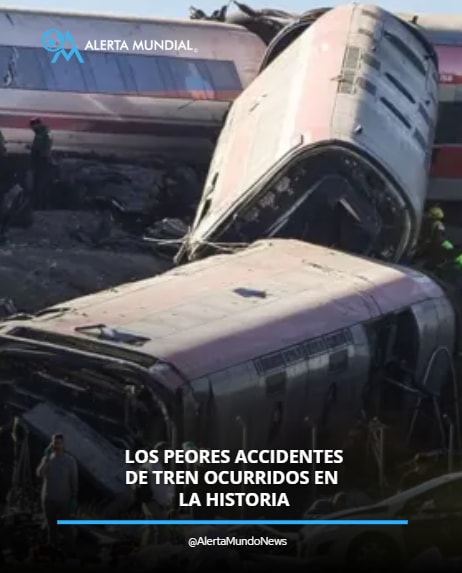
@BetanewsWhat stands out in this list is how few of these were simple track faults. Take 1917 in Romania: the Ciurea catastrophe, a train packed with refugees and wounded soldiers, brakes gone at speed, slamming into another train and going up in flames, 800 to 1,000 dead in the middle of World War I. France, the same year, the Saint-Michel derailment, a troop train coming back from the Italian front with double the carriages it should have had, brakes overheating on the Alpine descent until they quit, more than 675 killed as the cars left the rails in flames. Two years earlier, the Guadalajara tragedy in the Mexican Revolution, a military train carrying soldiers' families on a steep run toward the city, overloaded, brakes shot, down into a ravine, 600-plus dead. War kept feeding the toll. At Vereshchyovka in 1944, a Soviet military train moving troops and equipment came off the rails when a temporary river bridge gave way, over 700 dead. Italy's Balvano tragedy that same year: a freight train crammed with stowaways stalled inside a long tunnel, and carbon monoxide from poor-quality coal took between 517 and 600 people silently in their seats. Plenty had nothing to do with war. The 1998 Dancheon disaster in North Korea began with a power outage that left a train without brakes, so it rolled backward at full speed until it derailed and dropped into a ravine in extreme cold, with deaths reported anywhere from 500 to over 1,500. Then 1989, the Ufa disaster in the USSR, 575 dead after an LPG gas pipeline leak built an inflammable cloud near the tracks and sparks from two passing passenger trains set it off with the force of a bombing. Nature and speed accounted for the rest. The 2004 tsunami in Sri Lanka caught the Queen of the Sea Express, where hundreds had climbed onto the roof thinking the water could not reach them; instead the force of the waves rolled the carriages over and buried them, around 1,700 dead. At Awash in Ethiopia in 1985, an express took a curved bridge over a deep gorge too fast, derailed and fell into the abyss, 428 killed. And Egypt's Al-Ayyat fire in 2002 started with a gas stove passengers were using illegally on a packed train; it kept moving for kilometers, fanning the flames, between 373 and 383 dead.
View original post











No comments yet. Be the first!