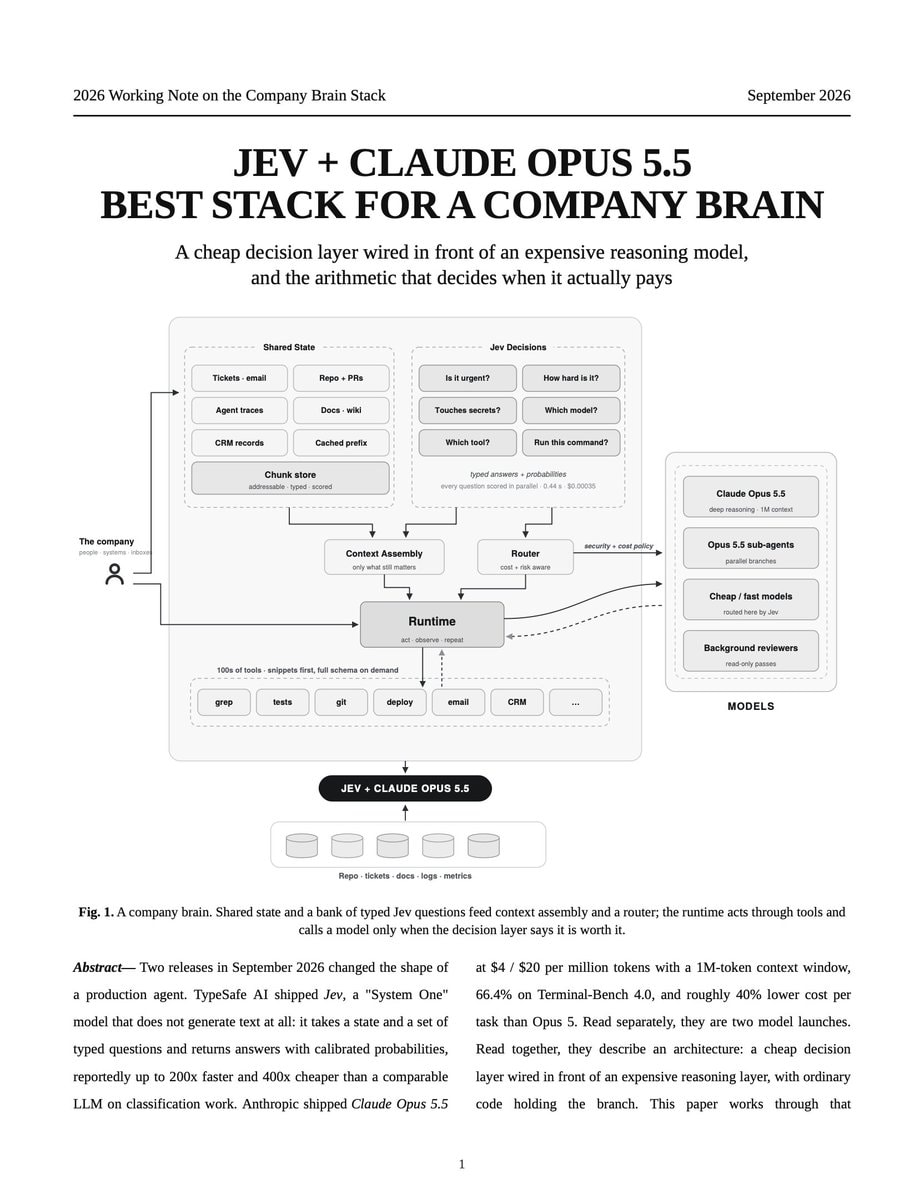
@ts_floydJEV + Opus 5.5 is insane for building a company brain... I collected the whole architecture from TypeSafe and Anthropic docs into a 14-page PDF. Here are the 10 steps: step 1 → meet the pair: Opus 5.5 thinks, Jev decides, your code holds the branch. two models, one loop, no prompt in the middle step 2 → stop asking a text generator for a boolean: Jev takes a state and returns a typed answer with a calibrated probability in 0.44s for $0.00035 step 3 → ask everything at once: Choice, Score and Noul all evaluated in parallel, so the fourth question costs almost nothing. ask what you might need, not what you can afford step 4 → branch on the number: 0.999 is not text you parse, it is the if statement. ~99% of turns end here and never become a generation call step 5 → stop routing blind: Opus 5.5 → Sonnet → 5.5 costs 5.84 vs 3.32 for pure 5.5, because handing back reprocesses the whole context step 6 → keep one context warm instead: cache reads at $0.20 per Mtok are 20x cheaper than loading fresh. route work, not context step 7 → escalate, don't delegate: the hard 1% goes to Opus 5.5 with 1M context, 128K output and 66.4% on Terminal-Bench 4.0. pay for thinking, not plumbing step 8 → score every chunk per query: keep whole, summarize, or drop. context stops being a transcript you append to and becomes something rebuilt each turn step 9 → gate the command, not the intent: classify the concrete bash call before it executes. the auto-mode that lived inside closed harnesses, now in your own code step 10 → judge 100% of runs: $3.50 a day for 10,000 traces, variance 92-913x lower than an LLM judge, and it matched the human label on all 500 decisions the result: a while loop that pays a frontier model for every small decision becomes a brain that spends a third of a cent to notice and spends properly to think Copy the complete 14-page company brain blueprint, then read the full 10-step roadmap below ↓ #Jev #Anthropic
View original post